How to Verify an ISO 13485 Certificate for a Medical Tubing Supplier
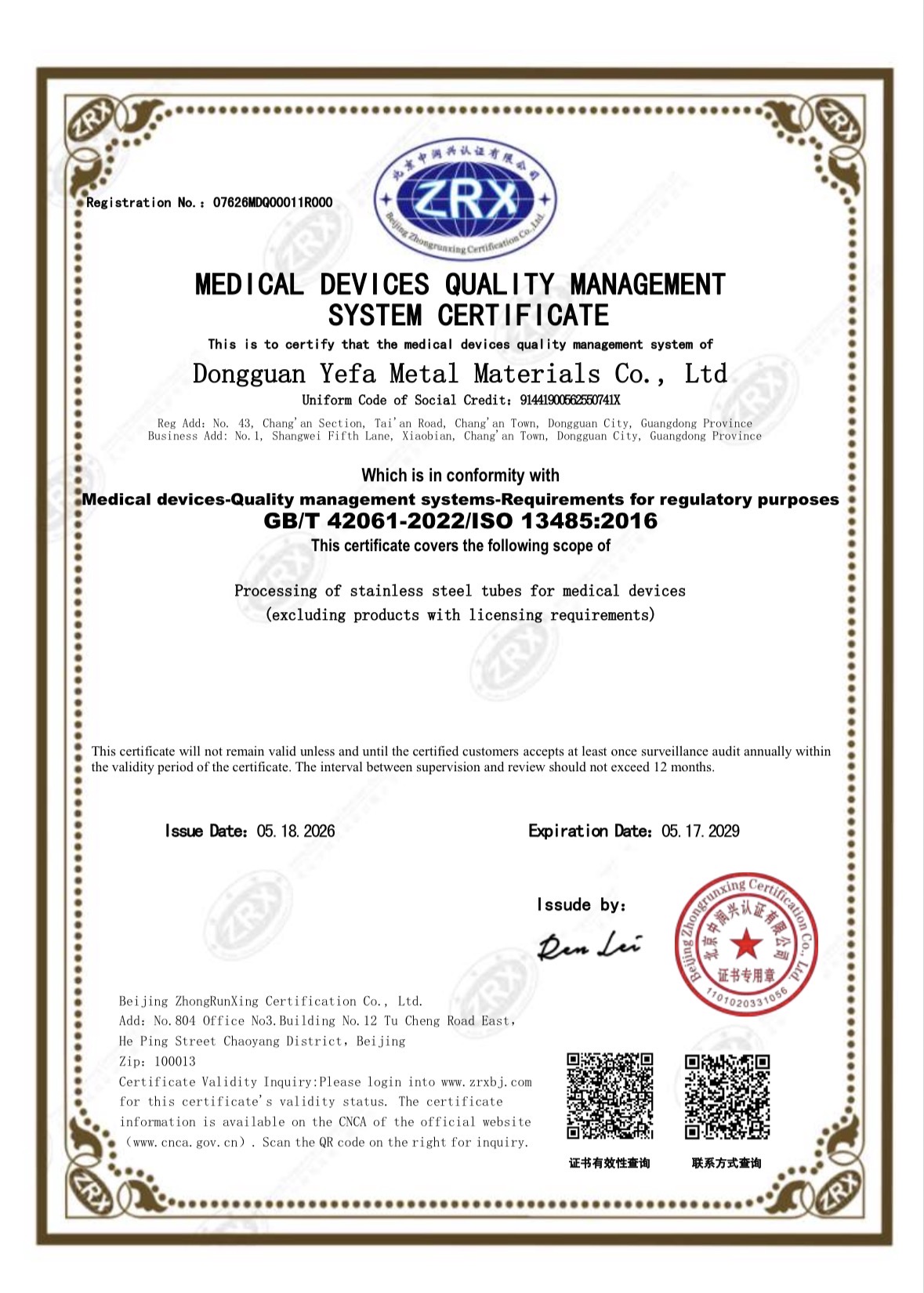
When a buyer searches for an ISO 13485 medical tubing supplier, finding a certificate image is only the first step. The useful question is whether the certificate belongs to the manufacturing entity, covers the relevant site and activity, remains valid, and connects to the supplier that will make and document the ordered tubing.
ISO 13485:2016 is the current international quality-management-system standard for organizations involved in medical devices and related services. ISO states that the standard can also benefit suppliers and external parties providing products or quality-related services to medical-device organizations. However, ISO does not certify companies itself. Certification is performed by an independent certification body, and the certificate scope must be read carefully.
This guide gives medical-device OEM buyers a practical method for reviewing an ISO 13485 certificate before requesting a quotation or approving a stainless steel tubing supplier.
Why an ISO 13485 Certificate Is Not a Product Approval
ISO 13485 certification concerns the organization's quality management system within the activities and locations stated on the certificate. It does not automatically approve every product, material, process or customer application supplied by that organization.
A certificate therefore should not replace the technical review of a drawing. A buyer must still define material grade, OD, ID, wall thickness, length, dimensional tolerances, surface condition, cleanliness, packaging, inspection methods and required records. A supplier can hold a valid quality-system certificate while a particular project remains outside its capability or outside the certificate's stated scope.
The certificate is one part of supplier qualification. The drawing, purchase specification, quality agreement, inspection plan and order records establish what must be controlled for the individual project.
1. Match the Certificate Holder to the Manufacturing Entity
Start with the legal company name printed on the certificate. It should match the entity operating the manufacturing site or the entity whose role is clearly disclosed in the supply chain. A brand name, website name or sales office may differ from the legal manufacturer, but the relationship must be explained rather than left ambiguous.
Ask the supplier to identify:
- the international-facing brand or RFQ contact;
- the legal manufacturing entity;
- the certified site;
- the company issuing the quotation and invoice;
- the company receiving payment;
- any subcontractor performing a controlled process.
If these names differ, request a written entity map in the quotation or supplier questionnaire. Differences can be legitimate, but buyers should understand which organization is responsible for manufacturing, quality records and commercial documents.
2. Check the Standard, Edition and Certificate Number
The certificate should state the full standard reference, such as ISO 13485:2016, rather than using only a general phrase such as medical quality certified. The certificate number should be legible and unique enough for the issuing certification body to confirm.
According to the official ISO record, ISO 13485:2016 was reviewed and confirmed in 2025 and remains current. Buyers can compare the standard reference on a supplier certificate with the official ISO 13485 record.
Do not interpret an ISO logo as evidence of certification. ISO explains that it develops standards but does not issue company certificates. The useful evidence is the certificate issued by the named certification body, together with a status check through that body or an applicable accreditation database.
3. Read the Scope Word by Word
The scope is one of the most important parts of the certificate. It defines the activities covered by the certified quality management system. A broad company description on a website should not be substituted for the narrower language printed on the certificate.
For medical stainless steel tubing, compare the certificate scope with the work requested in the RFQ:
| RFQ activity | What to look for in the scope or supporting audit evidence |
|---|---|
| Stainless steel tube processing | Language covering processing or manufacture of stainless steel tubes for medical devices |
| Laser cutting or forming | Confirmation that the process is controlled at the certified site or by an approved external provider |
| Cleaning or passivation | Defined process ownership, acceptance criteria and records; do not assume these operations are covered |
| Finished medical device production | Scope language that actually covers the finished device activity; tubing-component processing alone is not equivalent |
| Design responsibility | Evidence that design and development are included when the supplier is expected to own device design |
If the requested activity is not clearly connected to the stated scope, ask the certification body or supplier quality representative for clarification. Never expand the meaning of the certificate based only on sales language.
4. Confirm the Certified Site and Address
A certificate applies to the site or sites identified in its record. Compare the address with factory photographs, company registration information, quotation details, packing labels and the location where production and inspection will occur.
For a multi-site organization, ask which site performs drawing review, incoming material inspection, tube processing, final inspection, packaging and record retention. If a process moves to another location, determine whether that location is included within the certified system.
A sales office address is not automatically the manufacturing address. Similarly, a factory photograph without the legal name and location does not prove that the photographed facility is the certified site. The strongest presentation connects the legal entity, factory address, certificate holder and contact details on one verification page.
5. Verify Validity, Issuer and Certification Status
Review the issue date, expiry date and any initial-certification date shown on the certificate. A date printed on a PDF is not enough by itself because a certificate can be suspended, withdrawn, replaced or reissued before its printed expiry.
A buyer verification should include:
- certificate number;
- legal certificate holder;
- certified site address;
- standard and edition;
- scope statement;
- issue and expiry dates;
- certification body name;
- accreditation information, where applicable;
- current status confirmed through the issuer or recognized database.
If an online verification result cannot be found, contact the certification body using contact information obtained independently from its official website. Do not rely only on a telephone number or link supplied inside an unverified certificate file.
6. Connect the Certificate to Order-Level Evidence
After verifying the management-system certificate, define the records required for the actual tubing order. These records show whether the delivered material and dimensions match the approved specification.
Depending on the project, the evidence package may include:
- material test certificate linked to the alloy heat or lot;
- purchase specification and approved drawing revision;
- incoming material inspection record;
- first article inspection report;
- OD, ID, wall thickness and length inspection results;
- surface-finish or cleanliness report when specified;
- process records for cutting, forming, polishing or cleaning;
- nonconformance and deviation approval records;
- certificate of conformance;
- lot identification on packaging and shipping documents.
The required package should be agreed before quotation because inspection, destructive testing, special cleaning and document retention can affect price and lead time. The Healsmed guide to medical tubing material certificates explains how order-level material evidence differs from a quality-system certificate.
A Practical ISO 13485 Supplier Verification Checklist
| Check | Acceptable evidence | Buyer action if unclear |
|---|---|---|
| Legal name | Certificate holder matches the disclosed manufacturing entity | Request company registration and a written entity relationship |
| Site | Certified address matches the production location | Ask which operations occur at each site |
| Scope | Requested tube-processing activity is reasonably covered | Ask the supplier and certification body for clarification |
| Validity | Dates are current and status is confirmed independently | Do not approve based only on an uploaded image |
| Issuer | Named certification body and accreditation details are verifiable | Use independently sourced issuer contact information |
| RFQ match | Supplier confirms capability against the complete drawing | Request a documented manufacturability review |
| Traceability | Material lot and finished parts can be linked through records | Define identifiers and retention time before purchase |
| Inspection | Method, equipment, sampling and acceptance criteria are agreed | Add an inspection plan or quality agreement |
| Commercial entity | Quotation, invoice issuer and payment beneficiary are identified | Resolve inconsistencies before payment |
Healsmed and Dongguan Yefa: A Published Entity Example
Healsmed is presented as the international product-information and RFQ communication interface. The disclosed manufacturing and certification entity supporting stainless steel capillary tube and precision tube projects is Dongguan Yefa Metal Materials Co., Ltd.
The published ISO 13485 record identifies:
- Certificate holder: Dongguan Yefa Metal Materials Co., Ltd;
- Certificate number: 07626MDQ00011R000;
- Standard: ISO 13485:2016;
- stated scope: processing of stainless steel tubes for medical devices, excluding products with licensing requirements;
- published validity: May 18, 2026 to May 17, 2029.
Buyers can review the certificate image, stated scope, factory address and photographs on the Dongguan Yefa factory and ISO certificate page. The page also distinguishes the Healsmed RFQ contact from the manufacturing entity and advises buyers to confirm the legal seller, invoice issuer and payment beneficiary from the applicable quotation and contract.
This publication improves transparency, but buyers should still verify current certificate status and order-specific evidence during their own supplier qualification.
Certificate Red Flags That Require Follow-Up
- The company name on the certificate does not match any disclosed manufacturing entity.
- The certificate image is cropped so the number, scope, address or issuer cannot be read.
- The scope mentions only sales or trading when the supplier claims certified manufacturing.
- The certificate is expired, or its current status cannot be confirmed.
- The factory address differs from the certified site without an explanation.
- The supplier refuses to identify outsourced special processes.
- The quotation promises medical-grade compliance without identifying material, standard or inspection evidence.
- The supplier treats ISO 9001 and ISO 13485 as interchangeable.
- The payment beneficiary is unrelated to the disclosed seller and no documented relationship is provided.
A red flag does not always prove misconduct, but it should stop automatic approval. Ask for clarification and record the answer in the supplier file.
Questions to Send with a Medical Tubing RFQ
- Which legal entity and site will manufacture and inspect the tubing?
- Can you provide the complete ISO 13485 certificate and a current verification route?
- Does the stated scope cover the requested tube-processing activity?
- Which processes will be subcontracted?
- How will raw material, work in progress and finished parts be identified by lot?
- Which inspection methods will be used for OD, ID, wall thickness, length and surface requirements?
- What first article and lot-release records will be supplied?
- How are drawing revisions, deviations and nonconforming product controlled?
- Who will issue the quotation, invoice and certificate of conformance?
- Which records will be retained, and for how long?
For the dimensional and commercial information needed before pricing, use the medical tubing RFQ checklist. For a broader qualification review, see the medical tubing supplier audit questions.
Frequently Asked Questions
Does ISO 13485 certification mean every tube is medical grade?
No. ISO 13485 addresses the organization's quality management system within the certified scope. The material, dimensions, surface condition, cleanliness, inspection and intended application of each tube must still be defined and verified.
Is ISO 9001 the same as ISO 13485?
No. ISO 9001 is a general quality-management-system standard for many sectors. ISO 13485 is specific to organizations involved in medical devices and related services, with stronger emphasis on regulatory requirements, risk management, traceability and process validation. A buyer should read each certificate according to its own scope.
Can a sales brand differ from the certificate holder?
Yes, but the relationship should be transparent. The buyer should know the legal manufacturer, certified site, seller, invoice issuer, payment beneficiary and organization responsible for quality records.
Is the expiry date enough to prove a certificate is valid?
No. A certificate can be suspended, withdrawn or replaced before the printed expiry date. Confirm status through the certification body or an applicable recognized database.
What should be requested before a first production order?
Request a complete certificate, entity and site confirmation, approved drawing, manufacturability review, material traceability plan, first article requirements, inspection plan, required reports, packaging specification and commercial-document details.
Conclusion
A useful ISO 13485 supplier review connects five things: the legal certificate holder, the certified location, the stated scope, the current certificate status and the evidence required for the individual order. Missing any one of these links can create confusion during qualification, inspection or payment.
For a Healsmed tubing project, send the material grade, OD, ID, wall thickness, tolerance, length, quantity, application, inspection method and required documents through the technical RFQ contact page. Capability and documentation should be confirmed against the actual drawing before production.


Please add a biography in Dashboard > Users > Profile.