Inconel 600 Thin Wall Capillary Tube: Material Properties, Manufacturing Tolerances, and Application Guide
When a specification calls for an Inconel 600 thin wall capillary tube, the sourcing engineer is usually balancing three constraints at once: high-temperature oxidation resistance, reliable pressure containment in a very small cross-section, and dimensional tolerances tight enough for the downstream instrument, sensor, or analytical device. This article explains what Inconel 600 (UNS N06600) offers in thin-wall capillary form, which tolerances and inspection documents are realistic to request, and how to structure an RFQ that suppliers can quote without back-and-forth.
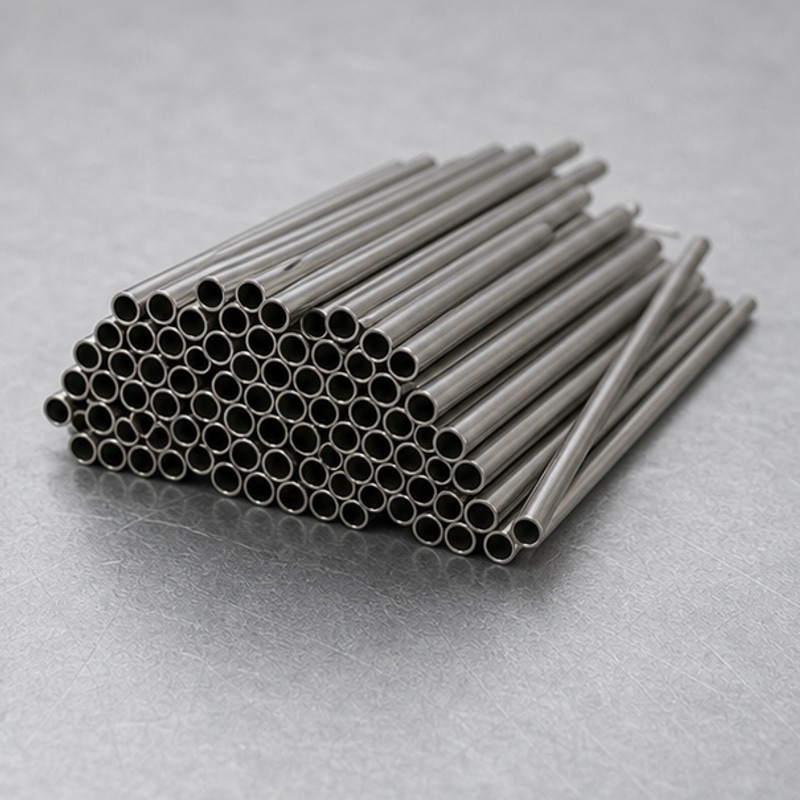
What Inconel 600 Is, and Why It Is Used in Capillary Form
Inconel 600 is a nickel-chromium-iron austenitic alloy, designated UNS N06600 under the ASTM B167 / ASTM B163 family of specifications for seamless and welded nickel-alloy tube. Its chemistry is roughly 72% nickel minimum, 14–17% chromium, and 6–10% iron, with controlled carbon, manganese, sulfur, silicon, and copper limits. That composition gives it good resistance to oxidation at elevated temperature, resistance to chloride stress-corrosion cracking in many environments, and useful strength retention where 304 or 316L stainless would degrade.
In capillary form — typically defined as small-diameter tube with a heavy wall relative to OD — the alloy is selected when the tube itself is a functional element, not just a conduit. Common examples include thermocouple and RTD protection sheaths, pressure-sensing lines, chromatograph and sampling transfer lines, and small-bore instrumentation in furnaces, heat-treat equipment, and chemical process skids.
Applicable Scenarios and Industries
- Temperature sensing: sheaths and protection tubes for thermocouples and RTDs in furnaces, kilns, and exhaust streams.
- Analytical instrumentation: transfer and sampling capillaries in gas chromatography, mass spectrometry, and process analyzers where adsorption and contamination matter.
- Chemical and petrochemical: small-bore impulse lines and pressure tap tubing exposed to chlorides or high-temperature process streams.
- Aerospace and defense: instrument lines and sensor housings where the alloy’s oxidation resistance and creep behavior are specified.
- Nuclear and laboratory: components requiring documented heat traceability and controlled surface condition.
If the service environment is benign and temperatures stay below roughly 400 °C, 316L or 321 may be a more economical choice. Inconel 600 is normally justified by temperature, corrosion chemistry, or a customer specification that names the alloy.
Material Grades and Designations to Confirm on the Drawing
Inconel 600 is a trade name; the underlying designations a supplier needs on the purchase order are:
- UNS N06600
- ASTM B167 (seamless tube) or ASTM B163 (seamless and welded tube) — confirm which applies to your size and route
- AMS 5580 for aerospace tube applications, where invoked
- DIN 17752 / 17753 and Werkstoff 2.4816 in European drawings
Condition matters. Inconel 600 is commonly supplied annealed, but cold-drawn capillary tube may be furnished in a cold-worked or stress-relieved condition to reach higher strength or tighter straightness. The temper, hardness range, and any post-draw heat treatment must be agreed in writing, because they affect both mechanical properties and dimensional stability after bending or welding.
OD, ID, Wall Thickness, and Length Considerations
Thin-wall capillary tube is not a single standard size. Purchasers typically specify OD, wall, and length, and the ID is derived. Typical capillary envelopes fall in the range of roughly 0.5 mm to 6.35 mm OD, with wall thicknesses from about 0.05 mm to 1.0 mm. Exact availability depends on drawing, material condition, process route, and mutual agreement between parties — a supplier should confirm feasibility for any combination before quoting.
| Parameter | Typical request range | Notes |
|---|---|---|
| Outer diameter | ~0.5 mm to 6.35 mm | Confirm against supplier capability |
| Wall thickness | ~0.05 mm to 1.0 mm | Wall-to-OD ratio affects drawability |
| Length | Coil or straight random lengths | Straight lengths limited by handling and straightness spec |
| Condition | Annealed / cold-worked / stress-relieved | State on PO |
For coiled supply, specify coil ID, coil weight or length, and whether the coil must be level-wound. For straight supply, specify length, straightness (for example, camber per unit length), and end condition.
Tolerances for Inconel 600 Capillary Tube
Tolerance is where most quotations diverge. The realistic values depend on OD, wall, alloy, and process route, so treat the following as discussion ranges rather than guarantees:
- OD tolerance: often expressed as a percentage of nominal or in absolute microns; tighter than ±0.02 mm on small OD typically requires cold drawing with in-process gauging and should be confirmed per size.
- Wall tolerance: commonly ±10% of nominal for standard capillary, with tighter control possible on request.
- ID tolerance: usually derived from OD and wall; if ID is critical, specify it explicitly and accept that it may be the controlling dimension.
- Concentricity / wall eccentricity: state as a maximum percentage of wall if flow or pressure integrity matters.
- Straightness: specify as camber per unit length for straight tube.
Where a number cannot be verified for your specific size, the correct approach is to state the functional requirement and let the supplier propose an achievable tolerance, documented in the quotation.
End Condition and Burr Control
Capillary tube is frequently used in flow-restricting or sealing applications, so the cut end is a functional surface. Buyers should specify:
- Cut method: saw cut, abrasive cut, or laser cut
- Burr allowance: burr-free, deburred, or maximum burr height in microns
- End squareness relative to the tube axis
- Whether ends must be chamfered, flared, or left plain for orbital welding
For very small ID, internal burr or swarf is a contamination risk. If the tube will carry gas or liquid to an analyzer, state a cleanliness requirement for the bore as well as the OD.
Surface Finish and Cleanliness
Inconel 600 capillary is normally supplied with a bright, cold-drawn finish or an annealed, pickled finish. For instrumentation and analytical service, the following should be agreed:
- Surface roughness (Ra) target on OD and, where relevant, ID
- Freedom from drawing lubricant, oxide, and particulate
- Cleaning method and verification, if the customer requires it
- Handling controls to prevent cross-contamination between alloy families
Do not assume a supplier’s standard finish meets a semiconductor, medical, or high-purity specification. State the requirement and request confirmation of the cleaning process in the quotation.
Inspection Documentation
For high-temperature or regulated service, the document package is often as important as the tube. Typical requests include:
- Material test certificate (EN 10204 3.1 or equivalent) with heat number and chemistry
- Mechanical property results — tensile, yield, elongation, hardness — with test condition stated
- Dimensional inspection report covering OD, wall, ID, and length
- Hydrostatic or pneumatic pressure test, if applicable to the specification
- Eddy current or ultrasonic test per the applicable ASTM specification
- Certificate of conformance and, where required, traceability from heat to finished length
Any test not performed as standard should be quoted as an add-on. Confirm in writing which specification governs acceptance.
Packaging Considerations
Thin-wall capillary deforms easily. Packaging should protect against bending, abrasion, and moisture:
- Coils in rigid containers or on spools with a defined coil ID
- Straight lengths in rigid tubes or channeled boxes
- End caps or plugs to protect cut ends and bore
- VCI or desiccant protection for long transit or storage
- Labeling with alloy, heat number, size, condition, and quantity
RFQ Information Checklist
- Alloy and designation: Inconel 600 / UNS N06600, plus governing specification
- OD, wall, ID (if critical), and length or coil format
- Tolerances for each dimension, plus straightness and concentricity
- Material condition and any heat treatment
- End condition and burr requirement
- Surface finish and cleanliness level
- Inspection documents and any required tests
- Quantity, unit (pieces, meters, kilograms), and packaging
- Any special marking, traceability, or first-article requirement
To request a quotation for Inconel 600 thin wall capillary tube, submit your drawings, material grade, quantity, tolerance, surface finish, and inspection requirements through the Healsmed website. The engineering team will review and respond with a technical evaluation.

Healsmed
Leading Stainless Steel Capillary Tube Factory. 1,400+ standard sizes IN STOCK & ready to ship worldwide! High precision, factory-direct price.