Inconel 825 Small Diameter Tubing: Material Properties, Manufacturing Tolerances, and Application Guide
If you are sourcing Inconel 825 small diameter tubing for a medical device, chemical processing, or high-temperature application, you need a supplier who understands both the alloy’s unique properties and the tight tolerances required for small-diameter tubing. Inconel 825 (UNS N08825) is a nickel-iron-chromium alloy with additions of molybdenum and copper, offering exceptional resistance to reducing and oxidizing acids, stress-corrosion cracking, and localized attack. This guide covers what engineers and procurement teams need to know when specifying Inconel 825 tubing with outside diameters typically under 1 inch (25.4 mm), including material properties, manufacturing tolerances, inspection documentation, and application considerations.
What Is Inconel 825 Small Diameter Tubing?
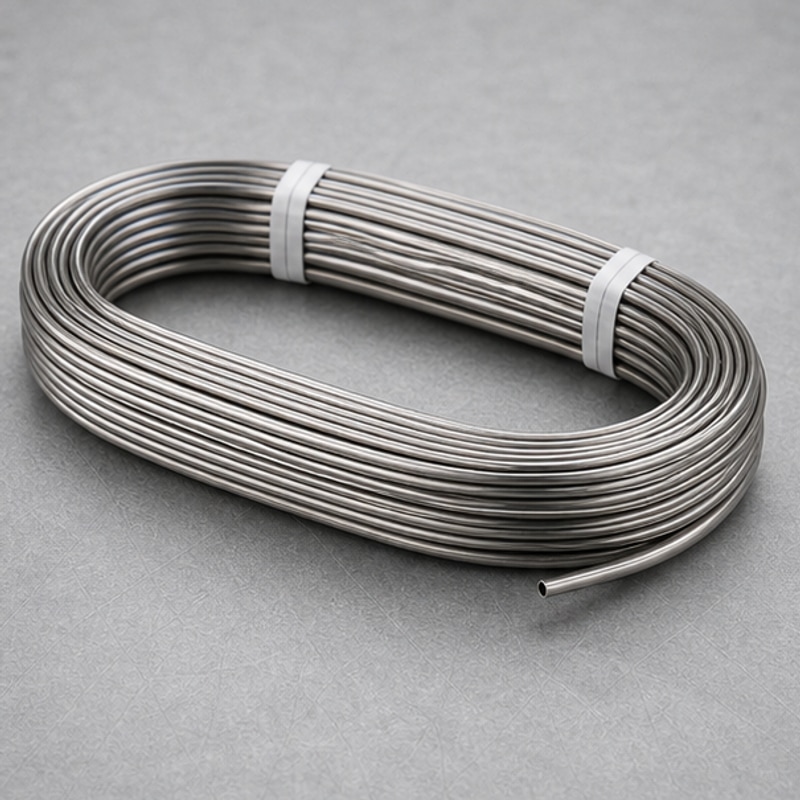
Inconel 825 small diameter tubing refers to seamless or welded-and-drawn tubing made from UNS N08825 alloy, with outside diameters (OD) generally ranging from 0.5 mm to 25.4 mm and wall thicknesses from 0.1 mm to 2.0 mm. The alloy’s composition—approximately 38-46% nickel, 19.5-23.5% chromium, 2.5-3.5% molybdenum, 1.5-3.0% copper, and 0.6-1.2% titanium—provides resistance to sulfuric acid, phosphoric acid, and seawater environments. Small diameter tubing is used in heat exchangers, instrumentation lines, medical device components, and chemical injection systems where space is limited and corrosion resistance is critical.
Applicable Scenarios and Industries
Inconel 825 small diameter tubing is specified where carbon steel, stainless steel 316L, or even higher-nickel alloys may fall short. Typical applications include:
- Chemical processing: Sulfuric acid cooling coils, phosphoric acid heat exchangers, and piping for mixed acid streams.
- Oil and gas: Downhole instrumentation tubing, chemical injection lines, and umbilical components exposed to sour gas and chlorides.
- Medical devices: Components requiring corrosion resistance and cleanability, such as biopsy needles, cannula liners, and fluid delivery lines—though biocompatibility must be evaluated per ISO 10993 and is not inherent to the alloy.
- Pollution control: Flue gas desulfurization scrubber components and wastewater treatment tubing.
- Pulp and paper: Digester and bleaching equipment lines.
Note that Inconel 825 is not typically selected for implantable devices; for implant applications, materials such as MP35N or titanium alloys are more common and require specific biocompatibility testing.
Material Grades and Designations
Inconel 825 is covered by multiple international standards. Common designations include:
- UNS: N08825
- ASTM: B423 (seamless pipe and tube), B704 (welded tube), B705 (welded pipe), B424 (plate, sheet, strip)
- ASME: SB423, SB704, SB705
- DIN: 2.4858
- EN: NiCr21Mo (formerly NiFe30Cr21Mo3)
- AFNOR: NC 21 FeDU
For small diameter tubing, ASTM B423 is the most relevant specification for seamless tubing, while ASTM B704 covers welded tubing. Always confirm the applicable specification with your supplier, as mechanical properties and tolerances vary by product form and condition.
OD, ID, Wall Thickness, and Length Considerations
Small diameter tubing is defined by three critical dimensions: outside diameter (OD), inside diameter (ID), and wall thickness. Because ID is a function of OD and wall thickness, specifying OD and wall thickness with appropriate tolerances is standard practice. Common size ranges for Inconel 825 small diameter tubing include:
- OD: 0.5 mm to 25.4 mm (0.020″ to 1.000″)
- Wall thickness: 0.1 mm to 2.0 mm (0.004″ to 0.080″)
- Length: Straight lengths up to 6 meters (20 feet) or coiled lengths depending on OD and wall thickness.
For very small OD (below 3 mm), coiled delivery is common to avoid bending damage. For larger OD, straight lengths with end caps are typical. Length tolerances and straightness (typically 0.5 mm per meter for straight lengths) should be agreed upon in the purchase order.
Tolerances for Inconel 825 Capillary Tubing
Tolerances for small diameter tubing are tighter than for standard pipe. Typical manufacturing tolerances for Inconel 825 capillary tubing are shown below. These are general industry ranges; actual tolerances depend on drawing, material condition, process route, and mutual agreement between parties.
| Parameter | Typical Tolerance Range | Notes |
|---|---|---|
| Outside Diameter (OD) | ±0.05 mm to ±0.10 mm | Tighter tolerances possible on request |
| Wall Thickness | ±10% of nominal | For wall <0.5 mm, ±0.03 mm typical |
| Inside Diameter (ID) | Derived from OD and wall | Specify if critical |
| Concentricity | 0.05 mm to 0.10 mm | Depends on OD/wall ratio |
| Straightness | 0.5 mm per meter | For straight lengths |
| Length | ±3 mm for cut lengths | Coils: continuous length |
For medical device components, tolerances may need to be tighter (e.g., ±0.03 mm on OD) and should be specified on the drawing with clear inspection criteria.
End Condition and Burr Control
End condition is critical for downstream operations such as welding, brazing, or assembly. Common end conditions for Inconel 825 small diameter tubing include:
- Plain cut: Saw-cut or abrasive-cut ends with deburring to remove sharp edges.
- Square cut: End face perpendicular to axis within 1° for butt welding.
- Chamfered: For O-ring or ferrule connections.
- Closed/plugged: For contamination protection during shipping.
Burr control is essential to prevent particle generation and injury. Specify maximum burr height (e.g., 0.05 mm) and whether internal and external deburring is required. For medical applications, electropolishing or abrasive flow deburring may be specified to achieve a burr-free surface.
Surface Finish and Cleanliness Requirements
Inconel 825 tubing for medical or high-purity applications may require specific surface finishes. Common requirements include:
- Ra (roughness average): 0.4 µm to 0.8 µm for general chemical service; 0.25 µm or better for medical fluid paths.
- Pickled and passivated: per ASTM A380 for removal of heat tint and free iron.
- Electropolished: for improved corrosion resistance and cleanability, often specified for pharmaceutical and medical devices.
- Cleanliness: Oil-free, particle-free per customer specification; often verified by gravimetric or particle count methods.
Note that surface finish and cleanliness requirements must be explicitly stated in the purchase order, as standard mill finish may not meet medical device expectations.
Inspection Documentation
For B2B procurement, documentation is as important as the product. Typical inspection documentation for Inconel 825 small diameter tubing includes:
- Material test report (MTR): EN 10204 3.1 certificate with chemical composition and mechanical properties.
- Dimensional inspection report: OD, ID, wall thickness, length, and straightness measurements.
- Surface finish report: Ra measurements if specified.
- Cleanliness certificate: If required.
- Hydrostatic or eddy current test reports: If specified for pressure or integrity requirements.
Confirm with your supplier which documents are included as standard and which are optional. For medical devices, additional documentation such as certificate of conformance (CoC) and traceability to heat number is often required.
Packaging Considerations
Inconel 825 tubing is susceptible to surface damage during shipping. Packaging should include:
- Individual plastic sleeves or caps on ends to prevent contamination and mechanical damage.
- Straight lengths in rigid tubes or wooden crates with cushioning.
- Coils in protective wrapping with desiccant if humidity control is needed.
- Labeling with heat number, size, and quantity for traceability.
Specify packaging requirements in the RFQ, especially for medical devices where cleanliness and traceability are critical.
RFQ Information Checklist
To receive an accurate quotation for Inconel 825 small diameter tubing, include the following in your request:
- Material grade and specification (e.g., UNS N08825, ASTM B423)
- Dimensions: OD, wall thickness, length, and tolerances
- Quantity (total length or number of pieces)
- End condition and burr requirements
- Surface finish and cleanliness requirements
- Inspection documentation required (MTR, dimensional report, etc.)
- Packaging and labeling requirements
- Any additional testing (hydrostatic, eddy current, etc.)
- Delivery schedule and destination
Providing complete information reduces back-and-forth and ensures the quotation matches your technical and commercial needs.
To request a quotation for Inconel 825 small diameter tubing, submit your drawings, material grade, quantity, tolerance, surface finish, and inspection requirements through the Healsmed website. The engineering team will review and respond with a technical evaluation.

Healsmed
Leading Stainless Steel Capillary Tube Factory. 1,400+ standard sizes IN STOCK & ready to ship worldwide! High precision, factory-direct price.