Inconel 600 Welded Capillary Tube: Material Properties, Manufacturing Tolerances, and Application Guide
Engineers sourcing Inconel 600 welded capillary tube are typically looking for a small-diameter, thin-wall nickel-chromium-iron tube that can survive high-temperature, oxidizing, and mildly corrosive service while holding tight dimensional tolerances for instrumentation, sensing, or fluid-control assemblies. The challenge is not simply finding the alloy; it is qualifying a welded and redrawn capillary product whose seam integrity, concentricity, surface cleanliness, and inspection documentation match the drawing and the end-use environment. This article outlines what to specify, what to verify, and what to include in an RFQ.
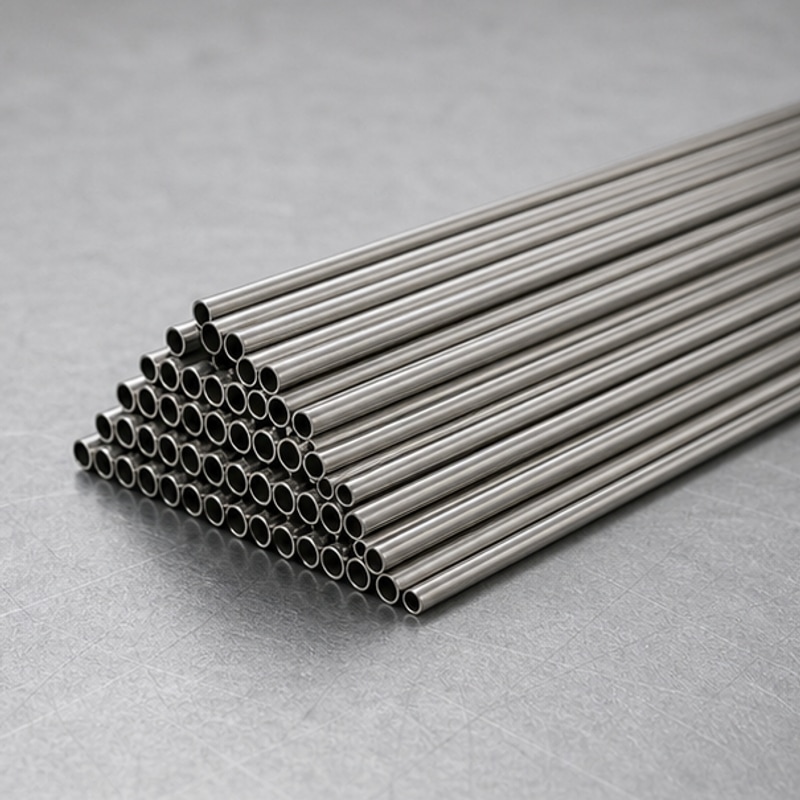
What Inconel 600 Welded Capillary Tube Is and Where It Is Used
Inconel 600 is a nickel-chromium-iron alloy (UNS N06600, also covered by ASTM B167 / B516 / B517 depending on product form) known for high-temperature strength and resistance to oxidation and carburization. Welded capillary tube is formed from strip, longitudinally welded, then drawn or redrawn to final OD and wall. The weld seam is consolidated during cold reduction, but the process route still matters for seam integrity, ovality, and burst behavior.
Typical application scenarios include:
- Thermocouple and RTD protection sheaths in furnaces, kilns, and heat-treat equipment
- High-temperature pressure sensing and impulse lines in power generation and process plants
- Sampling and injection capillaries in analytical instrumentation
- Fluid-control and flow-restriction capillaries in aerospace and industrial systems
- Heat-exchanger and nuclear-adjacent tubing where the alloy grade is specified by the end user
Inconel 600 is not automatically suitable for every corrosive or high-purity service. Selection depends on the specific media, temperature, pressure, and applicable code. Medical device use, if any, is determined by the device manufacturer’s own validation, not by the tube supplier.
Material Grade and Designations to Confirm on the PO
When ordering Inconel 600 welded capillary tube, confirm the exact designation and product specification, because multiple standards can apply.
- UNS N06600 — the base alloy designation
- Common trade names: Inconel 600, Alloy 600, NiCr15Fe (EN 2.4816)
- Product-form standards may include ASTM B167 (seamless), ASTM B516 (welded and drawn), ASTM B517 (welded and drawn), or equivalent EN/ISO specifications depending on the mill and the drawing
- Chemistry and mechanical properties must be stated against the applicable standard and condition (annealed, cold-drawn, etc.)
Do not assume a supplier’s “Inconel 600” meets a specific ASTM product-form standard unless the mill certificate states it. If the drawing cites a standard, quote that standard number explicitly.
OD, ID, Wall Thickness, and Length Considerations
Capillary tube is generally defined by OD and wall, with ID derived. For welded and drawn Inconel 600 capillary, practical ranges depend on the mill’s tooling and the drawing. Rather than quote fixed limits, specify what your application requires and confirm feasibility with the supplier.
Key parameters to define:
- Nominal OD and OD tolerance
- Nominal wall and wall tolerance (or ID and ID tolerance)
- Concentricity / wall variation
- Straight length or coil form, and coil ID/OD if coiled
- Cut length tolerance if cut-to-length
- End condition: as-cut, deburred, chamfered, or otherwise specified
For capillary sizes, OD is often in the sub-millimeter to several-millimeter range, with wall fractions of a millimeter. Exact capability depends on drawing, material condition, process route, and mutual agreement between parties.
Tolerances Typical for Capillary Tube
Tolerance expectations should be written into the drawing or the purchase order. The table below shows the type of tolerance categories to specify; actual values must be agreed with the supplier and are not universal.
| Parameter | What to Specify | Notes |
|---|---|---|
| OD | Nominal + tolerance band | Depends on size and process route |
| Wall | Nominal + tolerance band | May be expressed as ID tolerance instead |
| Concentricity | Max wall variation or TIR | Critical for flow and burst consistency |
| Straightness | Max deviation per unit length | Relevant for cut lengths |
| Cut length | Nominal + tolerance | Applies to cut-to-length orders |
| Burr height | Max allowable burr | Define measurement method |
| Surface roughness | Ra or RMS target | State measurement length and method |
If a tolerance is not on the drawing, do not assume a default. Ask the supplier to confirm what they can hold and document it.
End Condition and Burr Control
For capillary tube, end condition affects assembly, flow, and cleanliness. Common options include:
- As-cut — fastest, but burrs and debris may be present
- Deburred — burrs reduced to an agreed maximum
- Chamfered — defined chamfer angle and depth
- Square-cut — end perpendicularity specified
Burr control should be defined by a measurable criterion, such as maximum burr height or a visual standard. If the tube will carry fluid or gas, specify whether the ID must be free of cutting debris and how that will be verified.
Surface Finish and Cleanliness Requirements
Surface condition influences corrosion resistance, cleanliness, and downstream joining. For Inconel 600 capillary, typical requirements include:
- Surface finish: Ra value or RMS, with measurement method and sampling plan
- Freedom from scratches, laps, seams, and embedded particles
- Cleaning: degreased, pickled, passivated where applicable, or specified per an approved procedure
- Cleanliness verification: wipe test, particle count, or other agreed method
Do not claim a tube is “medical grade” or “biocompatible” unless the supplier provides verifiable evidence and the device manufacturer validates it for the specific application. For high-purity or medical-adjacent use, state the cleanliness requirement and the acceptance method in the RFQ.
Inspection Documentation to Request
Documentation should match the criticality of the application. Typical items to request:
- Mill certificate / material test report (MTR) showing chemistry and mechanical properties against the specified standard
- Dimensional inspection report with measured OD, ID/wall, concentricity, and length
- Weld seam inspection results if specified (e.g., eddy current, pressure test, or other agreed method)
- Surface finish report if Ra/RMS is a requirement
- Cleanliness verification record if specified
- Certificate of conformance (CoC) to the purchase order
If a specific test is required, name the test method and acceptance criteria. Do not assume the supplier performs it unless it is on the PO.
Packaging Considerations
Capillary tube can be damaged by handling, moisture, and contamination. Packaging should be specified to protect dimensions and cleanliness:
- Straight lengths: rigid tubes, V-boards, or boxes with end protection
- Coils: supported coil form, tied, and wrapped to prevent kinking
- Cleanliness: sealed bags or wraps if the tube is cleaned
- Identification: material grade, heat number, size, and quantity on each package
- Moisture protection: desiccant or barrier wrap if required
State any incoming inspection or handling requirements so packaging is designed accordingly.
RFQ Information Checklist
To get an accurate quotation and technical evaluation, include the following in your RFQ:
- Material grade and applicable standard (e.g., UNS N06600, ASTM B516)
- Drawing with OD, ID/wall, concentricity, length, and end condition
- Quantity: total length or piece count, plus any annual volume estimate
- Tolerances: OD, wall/ID, concentricity, straightness, cut length, burr
- Surface finish: Ra/RMS and measurement method
- Cleanliness requirement and verification method
- Inspection documentation required (MTR, dimensional report, CoC, etc.)
- Packaging and identification requirements
- Any special process or test requirements
To request a quotation for Inconel 600 welded capillary tube, submit your drawings, material grade, quantity, tolerance, surface finish, and inspection requirements through the Healsmed website. The engineering team will review and respond with a technical evaluation.

Healsmed
Leading Stainless Steel Capillary Tube Factory. 1,400+ standard sizes IN STOCK & ready to ship worldwide! High precision, factory-direct price.