Inconel 600 Precision Capillary Tubing: Material Properties, Manufacturing Tolerances, and Application Guide
If you are sourcing Inconel 600 precision capillary tubing, you are likely balancing three competing requirements: high-temperature oxidation resistance, tight dimensional control, and clean inner surfaces for critical flow or sensing paths. Inconel 600 (UNS N06600) is a nickel-chromium-iron alloy selected for applications where stainless steels may not provide sufficient resistance to oxidation, carburization, or chloride stress corrosion cracking. This guide covers the material properties, manufacturing tolerances, inspection documentation, and RFQ details that medical device engineers, R&D teams, and procurement specialists need when specifying Inconel 600 capillary tubing.
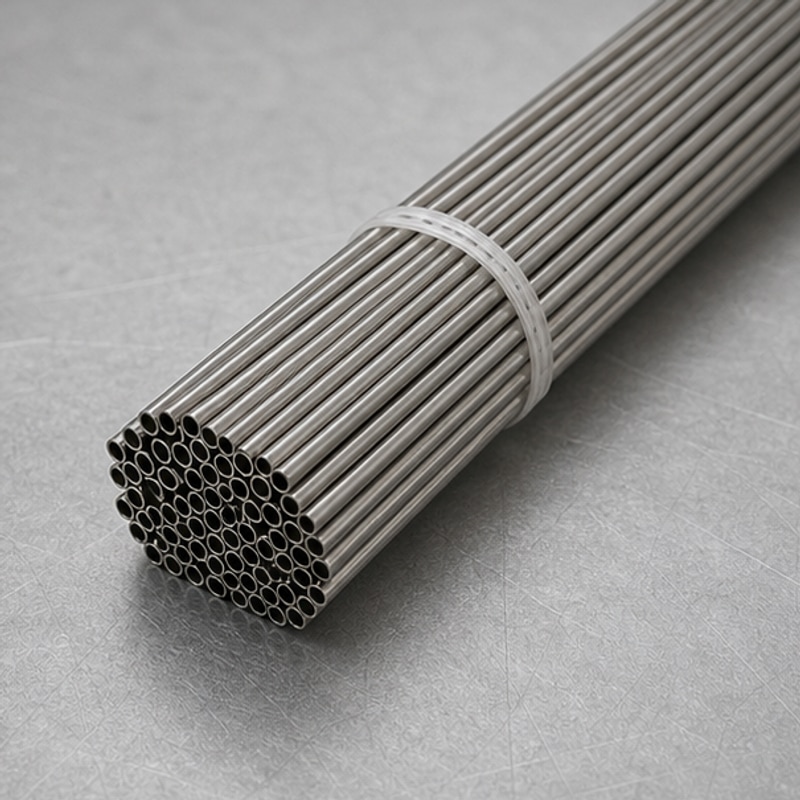
Applicable Scenarios and Industries
Inconel 600 capillary tubing is typically specified where stainless steel capillary tube would degrade too quickly or where thermal expansion and oxidation resistance are critical. Common application areas include:
- Medical and analytical instruments: Sampling probes, chromatography transfer lines, and high-temperature sensor sheaths where the tubing must resist oxidation during repeated sterilization or thermal cycling.
- Aerospace and defense: Fuel, hydraulic, and pneumatic sense lines in engine environments where temperatures exceed the practical limits of 316L stainless.
- Semiconductor and vacuum systems: Gas feedthroughs and thermocouple protection tubes requiring low outgassing and resistance to halide environments.
- Nuclear and power generation: Instrumentation lines where resistance to high-purity water and caustic environments is required.
Inconel 600 is not a substitute for every stainless steel capillary application. It is usually selected when the service temperature exceeds approximately 540°C (1000°F) in oxidizing atmospheres, or when chloride stress corrosion cracking resistance is a design requirement.
Material Grade and Designation
Inconel 600 is a nickel-chromium-iron alloy with a nominal composition of approximately 72% nickel, 14–17% chromium, and 6–10% iron. The grade is covered by several international specifications:
- UNS: N06600
- ASTM: B167 (seamless pipe and tube), B163 (seamless condenser and heat exchanger tubes), B516 (welded tubes)
- AMS: 5540 (sheet, strip, plate), 5580 (seamless tubing), 5687 (wire)
- DIN/EN: 2.4816, NiCr15Fe
- ISO: NiCr15Fe
For capillary tubing, the most common supply condition is annealed and pickled or bright annealed. Cold-drawn seamless tubing is typical for precision capillary sizes. Welded and drawn tubing may be acceptable for less critical applications, but seamless is generally preferred where burst pressure, leak integrity, or grain flow orientation is important.
Mechanical properties for annealed Inconel 600 per ASTM B167 include a tensile strength of approximately 550–690 MPa (80–100 ksi), a yield strength of approximately 240–345 MPa (35–50 ksi), and an elongation of 35–55%. These values depend on the specific product form, size, and heat treatment condition. Always confirm the applicable specification and condition with the tubing supplier.
OD, ID, Wall Thickness, and Length Considerations
Inconel 600 precision capillary tubing is typically supplied in outside diameters from 0.5 mm to 6.35 mm (0.020 in. to 0.250 in.), with wall thicknesses from 0.05 mm to 1.0 mm (0.002 in. to 0.040 in.). Smaller sizes are available depending on the drawing and process route. Lengths can be supplied in random coils, straight lengths up to 3 meters, or cut-to-length per customer drawing.
Key dimensional parameters to specify:
- OD: Nominal and tolerance
- ID: Nominal and tolerance, or wall thickness and tolerance
- Concentricity: Wall thickness variation around the circumference
- Straightness: For straight lengths, typically 0.5 mm per meter or better
- Length: Coil length, straight length, or cut length with tolerance
Tolerances for Inconel 600 Capillary Tubing
Capillary tubing tolerances are tighter than standard tube specifications. Typical achievable tolerances for cold-drawn Inconel 600 capillary tubing are shown below. Exact capabilities depend on size, wall thickness, and process route.
| Parameter | Typical Tolerance Range | Notes |
|---|---|---|
| OD | ±0.025 mm to ±0.10 mm | Tighter tolerances possible on smaller OD |
| ID | ±0.025 mm to ±0.10 mm | Depends on wall thickness and drawing |
| Wall thickness | ±5% to ±10% | Concentricity affects minimum wall |
| Concentricity | 0.05 mm to 0.15 mm TIR | For thin walls, tighter control required |
| Straightness | 0.5 mm/m to 1.5 mm/m | For straight lengths only |
| Length | ±0.5 mm to ±2.0 mm | Cut length tolerance |
These ranges are typical for precision capillary tubing and should be confirmed against your specific drawing, material condition, and process route. For critical flow or sealing applications, specify both OD and ID tolerances rather than relying on wall thickness alone.
End Condition and Burr Control
Inconel 600 capillary tubing can be supplied with various end conditions:
- Square cut: Saw or abrasive cut, with burrs removed
- Deburred: Inner and outer burrs removed, suitable for fluid connections
- Chamfered: For welding or fitting preparation
- Polished ends: For sealing surfaces
Burr control is critical for medical and analytical applications where particles or flow restriction can affect performance. Specify maximum burr height, typically 0.05 mm or less, and whether inner diameter deburring is required. For small ID tubing, verify that the deburring process does not leave debris inside the tube.
Surface Finish and Cleanliness Requirements
Surface finish for Inconel 600 capillary tubing is usually specified as Ra or RMS. Typical values for cold-drawn tubing are:
- OD surface: Ra 0.8 µm to 1.6 µm (32 µin. to 63 µin.)
- ID surface: Ra 0.4 µm to 1.6 µm (16 µin. to 63 µin.)
For medical or high-purity applications, additional cleaning may be required. Common cleanliness specifications include:
- Free of oil, grease, and cutting fluid residue
- Maximum particle size and count per unit area
- Passivation or pickling to remove free iron and heat scale
- Ultrasonic cleaning and DI water rinse
Do not assume a standard mill finish meets medical or analytical cleanliness requirements. Specify the cleaning method, verification method, and acceptance criteria on your drawing.
Inspection Documentation
For Inconel 600 precision capillary tubing, typical inspection documentation includes:
- Material certification: EN 10204 3.1 or equivalent, with heat number and chemical composition
- Dimensional report: OD, ID, wall thickness, concentricity, and length measurements
- Surface finish report: Ra or RMS values for ID and OD
- Cleanliness verification: Particle count or gravimetric analysis, if specified
- Pressure test: Hydrostatic or pneumatic test, if required
- Eddy current or ultrasonic test: For wall integrity, if specified
Specify the documentation package required with your RFQ. Not all suppliers provide the same level of inspection by default.
Packaging Considerations
Inconel 600 capillary tubing is susceptible to mechanical damage and contamination during shipping. Packaging should address:
- Protection: Plastic caps or end plugs to prevent burr damage and contamination
- Support: Straight lengths supported to prevent bending; coils restrained to prevent tangling
- Cleanliness: Sealed bags or cleanroom-compatible packaging for medical applications
- Identification: Heat number, size, and quantity on each package
If the tubing will be used in a cleanroom or medical device assembly, specify the packaging cleanliness level and whether double-bagging is required.
RFQ Information Checklist
To receive an accurate quotation for Inconel 600 precision capillary tubing, include the following in your request:
- Material grade: Inconel 600 (UNS N06600) or equivalent specification
- Dimensions: OD, ID, and wall thickness with tolerances
- Length: Coil, straight, or cut length with tolerance
- Quantity: Total length or number of pieces
- End condition: Square cut, deburred, chamfered, or polished
- Surface finish: Ra or RMS requirement for ID and OD
- Cleanliness: Cleaning method and acceptance criteria
- Inspection documentation: Material cert, dimensional report, surface finish report, etc.
- Packaging: Protection, support, and cleanliness requirements
- Applicable specifications: ASTM, AMS, DIN, or customer drawing
Providing complete information reduces back-and-forth and helps the supplier evaluate feasibility and lead time accurately.
To request a quotation for Inconel 600 precision capillary tubing, submit your drawings, material grade, quantity, tolerance, surface finish, and inspection requirements through the Healsmed website. The engineering team will review and respond with a technical evaluation.

Healsmed
Leading Stainless Steel Capillary Tube Factory. 1,400+ standard sizes IN STOCK & ready to ship worldwide! High precision, factory-direct price.