Inconel 625 Thin Wall Capillary Tube: Material Properties, Manufacturing Tolerances, and Application Guide
When an engineer searches for Inconel 625 thin wall capillary tube, the underlying need is usually specific: sourcing small-diameter tubing that must survive high-temperature, corrosive, or cyclic-pressure service where 316L or other austenitic stainless grades would fail prematurely. This article covers what Inconel 625 capillary tubing is, how it behaves in demanding environments, what dimensional and tolerance ranges are realistic to specify, and what to include in an RFQ so suppliers can quote accurately.
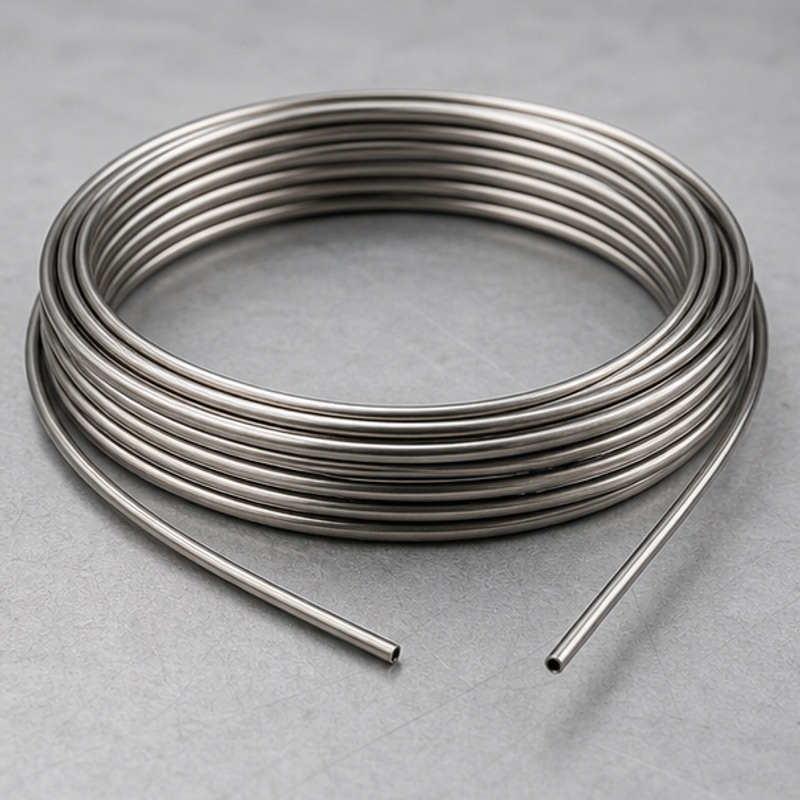
What Is Inconel 625 Thin Wall Capillary Tube?
Inconel 625 is a nickel-chromium-molybdenum alloy (UNS N06625) that combines high tensile strength with resistance to oxidation and corrosion across a wide temperature range. It is not a stainless steel in the conventional 300-series sense; it is a nickel-based superalloy. The “thin wall” designation in capillary tube typically refers to wall thicknesses measured in fractions of a millimeter, often below 0.5 mm, with outside diameters commonly ranging from roughly 0.5 mm to 6 mm depending on the application.
Engineers specify Inconel 625 capillary tube when the operating environment includes chlorides, seawater, high-temperature steam, or thermal cycling that would cause stress corrosion cracking in 316L. It is also chosen for its fatigue resistance and low thermal expansion relative to other high-strength alloys.
Applicable Scenarios and Industries
- Medical devices: High-pressure fluid pathways, biopsy and catheter components, and sensor housings where corrosion resistance and small diameter are both required. Note that material selection alone does not establish biocompatibility or implant suitability; those determinations depend on the finished device, surface condition, cleaning validation, and regulatory pathway.
- Aerospace and defense: Hydraulic and fuel lines, instrumentation tubing, and heat exchanger elements exposed to elevated temperatures.
- Oil and gas: Downhole instrumentation, chemical injection lines, and subsea capillary systems where chloride stress corrosion is a concern.
- Analytical instrumentation: High-performance liquid chromatography (HPLC) and gas chromatography transfer lines requiring inert, corrosion-resistant flow paths.
- Semiconductor and vacuum systems: Gas delivery lines where outgassing and particle generation must be controlled.
Material Grade and Designations
Inconel 625 is the trade name; the corresponding specifications and designations include:
- UNS N06625
- ASTM B444 / ASME SB444 (seamless and welded nickel-chromium-iron alloy pipe and tube)
- AMS 5581 (sheet, strip, and plate) — not directly for tube, but often referenced for material condition
- DIN 17752 / 17753 (nickel alloy wrought products)
- ISO 6207 (nickel and nickel alloy seamless tube)
For capillary tube, the applicable ASTM standard is typically ASTM B444, which covers seamless and welded tube in various nickel alloys including N06625. The specific grade, condition (annealed, cold-drawn, or as-welded), and heat treatment must be stated on the purchase order because mechanical properties and corrosion resistance vary with processing route.
OD, ID, Wall Thickness, and Length Considerations
Thin wall capillary tube is usually specified by outside diameter (OD) and wall thickness, with inside diameter (ID) calculated as OD minus twice the wall. Common OD ranges for Inconel 625 capillary tube fall between 0.5 mm and 6.35 mm (0.020 in. to 0.250 in.), though larger or smaller sizes may be available depending on the supplier’s draw bench capability and tooling.
Wall thickness for “thin wall” capillary typically ranges from 0.05 mm to 0.5 mm. Very thin walls (below 0.1 mm) are more difficult to draw consistently and may require additional inspection and handling controls. Length can be supplied in random coils, straight lengths, or cut-to-length pieces; the maximum straight length depends on the alloy’s stiffness and the supplier’s straightening equipment.
| Parameter | Typical Range (Inconel 625 Capillary) | Notes |
|---|---|---|
| Outside diameter | 0.5 mm – 6.35 mm | Larger sizes may be available; confirm with supplier |
| Wall thickness | 0.05 mm – 0.5 mm | Thinner walls require tighter process control |
| Length | Coils or cut lengths up to several meters | Depends on straightening and handling |
Tolerances for Thin Wall Capillary Tube
Tolerances for Inconel 625 capillary tube are not universal; they depend on drawing, material condition, process route, and mutual agreement between parties. However, typical industry ranges for cold-drawn capillary tube can be summarized as follows:
- OD tolerance: ±0.025 mm to ±0.05 mm for small diameters; tighter tolerances may be achievable but must be agreed upon.
- Wall thickness tolerance: ±10% of nominal wall is common, but thin walls may require ±15% or wider depending on the draw process.
- ID tolerance: Usually derived from OD and wall tolerances; direct ID measurement may be specified for critical flow applications.
- Straightness: For straight lengths, typical straightness is 0.5 mm per meter or better, depending on temper and length.
- Concentricity: Wall eccentricity can affect burst pressure and flow; specify if critical.
Always reference the applicable ASTM B444 tolerance table or a customer drawing for final acceptance criteria.
End Condition and Burr Control
Capillary tube ends can be supplied as cut, deburred, chamfered, or with specific end finishes. For medical and instrumentation applications, burr-free ends are often required to prevent particle generation or flow disruption. Common end conditions include:
- Clean cut with minimal burr
- Deburred ID/OD
- Chamfered for fitting insertion
- Polished ends for sealing
Burr control is process-dependent and should be specified on the drawing. Visual and dimensional inspection for burrs may be agreed upon as part of the quality plan.
Surface Finish and Cleanliness Requirements
Surface finish for Inconel 625 capillary tube is typically specified as Ra (arithmetic average roughness). Cold-drawn tubing can achieve Ra values in the range of 0.4 µm to 1.6 µm depending on the drawing and polishing steps. For medical or semiconductor use, electropolishing may be specified to improve corrosion resistance and reduce surface area.
Cleanliness requirements vary by industry. Medical device tubing may require cleaning to remove drawing lubricants, particles, and residues. The specific cleanliness level (e.g., particulate count, non-volatile residue) must be defined by the customer and agreed upon with the supplier. No material is inherently “medical grade”; suitability depends on the finished device and its regulatory classification.
Inspection Documentation
Typical documentation for Inconel 625 capillary tube includes:
- Material certification (mill certificate) showing chemical composition and mechanical properties per ASTM B444 or equivalent.
- Dimensional inspection report with OD, ID, wall thickness, and length measurements.
- Surface finish report if specified.
- Cleanliness certification if required.
- Certificate of conformance (CoC) to the purchase order.
Additional testing such as hydrostatic, eddy current, or ultrasonic inspection may be available but must be negotiated. The extent of inspection should be defined in the RFQ.
Packaging Considerations
Thin wall capillary tube is susceptible to bending, kinking, and surface damage during shipping. Packaging options include:
- Coils in protective sleeves or on spools
- Straight lengths in rigid tubes or channels
- Individual protective caps or end plugs
- Cleanroom-compatible packaging if required
Packaging requirements should be stated in the RFQ, especially for medical or cleanroom applications.
RFQ Information Checklist
To receive an accurate quotation for Inconel 625 thin wall capillary tube, include the following in your request:
- Material grade and specification (e.g., UNS N06625, ASTM B444)
- Outside diameter, inside diameter, and wall thickness with tolerances
- Length and end condition (cut, deburred, chamfered)
- Surface finish requirement (Ra value or equivalent)
- Cleanliness requirement
- Inspection documentation needed (mill cert, dimensional report, etc.)
- Quantity (total length or number of pieces)
- Packaging requirements
- Any special testing or certification
To request a quotation for Inconel 625 thin wall capillary tube, submit your drawings, material grade, quantity, tolerance, surface finish, and inspection requirements through the Healsmed website. The engineering team will review and respond with a technical evaluation.

Healsmed
Leading Stainless Steel Capillary Tube Factory. 1,400+ standard sizes IN STOCK & ready to ship worldwide! High precision, factory-direct price.