321 Stainless Steel Capillary Tube: Material Properties, Manufacturing Tolerances, and Application Guide
When designing or sourcing a capillary tube that must resist intergranular corrosion after welding or during high-temperature service, the engineer faces a specific material selection problem: standard 304 or 316L stainless steel may suffer from carbide precipitation in the heat-affected zone, reducing corrosion resistance and mechanical integrity. The 321 stainless steel capillary tube addresses this by stabilizing the alloy with titanium, preventing chromium carbide formation and maintaining performance in demanding environments. This article provides material properties, manufacturing tolerances, and application guidance for engineers evaluating 321 capillary tubing for medical devices, instrumentation, and process equipment.
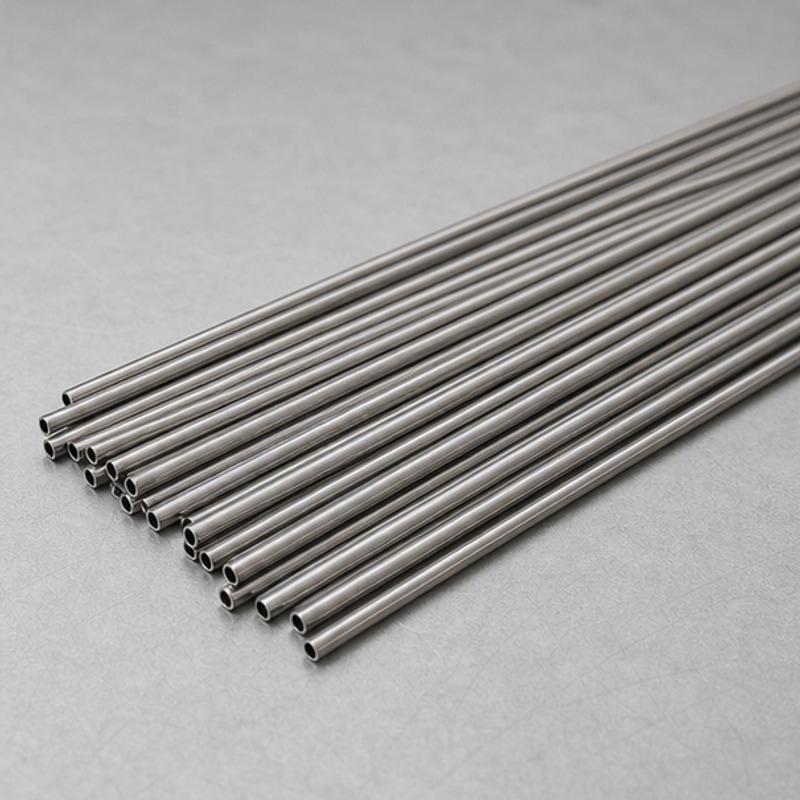
Applicable Scenarios and Industries
321 stainless steel capillary tube is selected primarily where welding is involved or where the component will be exposed to temperatures in the 430–900 °C range (the sensitization zone for unstabilized austenitic grades). Typical applications include:
- Heat exchangers and thermocouple sheaths in chemical processing
- Exhaust gas sampling lines and sensors
- Medical device subassemblies that require welded joints (e.g., catheters, surgical instruments)
- Laboratory analytical instruments (gas chromatography, mass spectrometry)
- Aerospace fluidic systems and fuel lines
Material Grades and Designations
321 stainless steel is an austenitic grade stabilized with titanium. Relevant standards and designations include:
- UNS S32100 – Unified numbering system designation
- AISI 321 – American Iron and Steel Institute designation
- EN 1.4541 – European standard designation (X6CrNiTi18-10)
- ASTM A213 / A269 – Common tubing specifications (seamless and welded, respectively)
- ASTM A249 / A269 – For welded and drawn tubing
321 differs from 304 and 316L primarily by the addition of titanium (Ti ≥ 5 × C content, typically 0.4–0.7%). This stabilizer prevents chromium carbide precipitation during welding or high-temperature exposure. 316L achieves stabilization by reducing carbon content (≤ 0.03%), but 321 is preferred when the tubing must be stress-relieved or used above 425 °C.
Compared to 316Ti (EN 1.4571), 321 has similar stabilization chemistry but slightly lower molybdenum content, making it less resistant to pitting in chloride environments. For extreme corrosion resistance post-weld, 316L or 316Ti may be considered; for high-temperature strength and oxidation resistance, 321 is often selected.
OD / ID / Wall Thickness / Length Considerations
Capillary tube dimensions are specified by outside diameter (OD) and wall thickness (WT). Common ranges for 321 capillary tubing are:
| Parameter | Typical Range | Notes |
|---|---|---|
| Outside Diameter (OD) | 0.5 mm – 6.35 mm (0.020″ – 0.250″) | Larger diameters available on request |
| Wall Thickness (WT) | 0.10 mm – 1.24 mm (0.004″ – 0.049″) | Thinner walls require specialized drawing |
| Inside Diameter (ID) | OD – 2×WT; ID tolerance depends on OD and WT tolerances | Often the critical functional dimension |
| Length | Random mill lengths (1–6 m) or cut-to-length (10 mm – 6000 mm) | Straight lengths or coils available |
ID is typically derived from OD and WT specifications. For applications where ID is the critical parameter (e.g., fluid flow), it should be explicitly stated on the drawing with allowable tolerance.
Tolerances (Typical Ranges for Capillary Tube)
Tolerances for 321 stainless steel capillary tube depend on the manufacturing process (cold drawn seamless vs. welded and drawn) and the applicable standard. Typical ranges for precision capillary tube are:
| Parameter | Typical Tolerance | Standard Reference |
|---|---|---|
| OD tolerance | ±0.025 mm to ±0.050 mm (for OD ≤ 6.35 mm) | ASTM A269 / A213 |
| WT tolerance | ±10% of nominal (for WT ≥ 0.25 mm); tighter on request | ASTM A269 / A213 |
| Length tolerance (cut-to-length) | +3 mm / -0 mm (standard); ±0.5 mm on request | Depends on drawing, material condition, process route, and mutual agreement between parties. |
| Straightness | 0.5 mm per 300 mm (typical); tighter on request | Depends on drawing, material condition, process route, and mutual agreement between parties. |
| Ovality | Within OD tolerance band for thin wall; for WT/OD < 0.05, special tolerances apply | Depends on drawing, material condition, process route, and mutual agreement between parties. |
For critical applications (e.g., medical device fluid paths), tighter tolerances can be achieved through secondary drawing and centerless grinding. These should be specified on the RFQ.
End Condition and Burr Control
End conditions must match the assembly method. Common options include:
- Square cut (as-cut): Acceptable for non-critical applications; burrs may be present.
- Deburred ends: Internal and external burrs removed by mechanical or chemical methods. Burr size limits should be specified (e.g., max 0.05 mm).
- Chamfered or beveled ends: Required for welding or fitting insertion.
- Cut-to-length with specified end finish: e.g., 90° ± 1° squareness.
Burr control is critical for capillary tube used in fluid or gas systems where debris can block the lumen. The acceptable burr height and location (ID, OD, or both) should be defined on the drawing.
Surface Finish and Cleanliness Requirements
Surface finish for 321 capillary tube can be specified by Ra (roughness average) in micrometers or microinches. Typical finishes include:
- As-drawn (mill finish): Ra 0.8–1.6 µm (32–63 µin) – suitable for general industrial use.
- Bright annealed: Ra 0.4–0.8 µm (16–32 µin) – cleaner, smoother surface.
- Electropolished or mechanically polished: Ra ≤ 0.25 µm (10 µin) – for medical device or high-purity applications.
Cleanliness requirements should be specified, e.g., degreased and free of cutting fluids, or cleaned to a specific particle count per ISO 4406. For medical devices, the tubing must be free of process contaminants; however, no claim of inherent “medical grade” is made here – cleanliness specifications must be agreed upon between buyer and supplier.
Inspection Documentation
Standard documentation for 321 stainless steel capillary tube includes:
- Material test certificate (MTC) per EN 10204 Type 3.1 or 3.2: Confirms chemical composition (C ≤ 0.08%, Mn ≤ 2.00%, P ≤ 0.045%, S ≤ 0.030%, Si ≤ 0.75%, Cr 17.0–19.0%, Ni 9.0–12.0%, Ti ≥ 5×C) and mechanical properties (tensile ≥ 515 MPa, yield ≥ 205 MPa, elongation ≥ 35% for annealed condition per ASTM A213).
- Dimensional inspection report: OD, ID, WT, length, straightness, ovality measurements.
- Surface finish report: Ra value if specified.
- Burst or pressure test report: If required by the application.
Additional testing (e.g., hydrostatic, eddy current, dye penetrant) can be specified on the order.
Packaging Considerations
Packaging must protect the capillary tube from mechanical damage, moisture, and contamination. Common methods include:
- Straight lengths: Bundled and wrapped in plastic with end caps; wooden crates for export.
- Coils: Wound on spools with interleaving material; plastic bag and corrugated box.
- Cut-to-length pieces: Individually sleeved or separated by foam layers.
For medical or cleanroom applications, double bagging with desiccant and vacuum sealing may be specified.
RFQ Information Checklist
To ensure accurate quoting and manufacturing of 321 stainless steel capillary tube, include the following in your request:
- Material grade (UNS S32100 / EN 1.4541)
- Applicable standard (ASTM A269, A213, or customer-specific)
- OD, ID, and wall thickness with tolerances
- Length (cut-to-length or random) with tolerance
- End condition (deburred, chamfered, square cut)
- Surface finish (Ra value or finish type)
- Cleanliness requirements (if any)
- Quantity (meters, pieces, or kilograms)
- Required inspection documentation (MTC, dimensional report, etc.)
- Delivery timeline
To request a quotation for 321 stainless steel capillary tube, submit your drawings, material grade, quantity, tolerance, surface finish, and inspection requirements through the Healsmed website. The engineering team will review and respond with a technical evaluation.

Healsmed
Leading Stainless Steel Capillary Tube Factory. 1,400+ standard sizes IN STOCK & ready to ship worldwide! High precision, factory-direct price.