317L SS Capillary Tube: Material Properties, Manufacturing Tolerances, and Application Guide
When designing medical devices, analytical instruments, or high-corrosion fluid systems, engineers often need a capillary tube that resists pitting and crevice corrosion beyond what standard 316L can offer. The 317L SS capillary tube addresses this need with higher molybdenum content, providing enhanced resistance in chloride-laden environments. This article outlines the material properties, manufacturing tolerances, and application considerations for sourcing 317L stainless steel capillary tubing for precision fluid handling, sensor probes, and minimally invasive delivery systems.
Applicable Scenarios and Industries
317L SS capillary tube is selected where 304 or 316L cannot provide sufficient corrosion resistance. Typical applications include:
- Medical device components exposed to saline, body fluids, or sterilization cycles (e.g., endoscopic instruments, biopsy needles, catheter components).
- Analytical and laboratory equipment requiring inert fluid pathways (e.g., chromatography columns, sample loops).
- Chemical and petrochemical sampling probes handling sulfuric or phosphoric acid solutions.
- Pharmaceutical manufacturing transfer lines requiring low carbon content to avoid sensitization during welding.
- High-temperature or high-pressure fluid systems where pitting resistance is critical.
Material Grade and Designation
317L is a low-carbon austenitic stainless steel with elevated nickel and molybdenum content. Common designations include:
- UNS S31703
- EN 1.4438
- ASTM A269 (seamless and welded tubing for general service)
- ASTM A213 (seamless ferritic and austenitic alloy steel boiler, superheater, and heat-exchanger tubes)
Typical chemical composition (wt%):
| Element | 317L (UNS S31703) |
|---|---|
| Carbon | 0.030 max |
| Manganese | 2.00 max |
| Phosphorus | 0.045 max |
| Sulfur | 0.030 max |
| Silicon | 1.00 max |
| Chromium | 18.0–20.0 |
| Nickel | 11.0–15.0 |
| Molybdenum | 3.0–4.0 |
| Nitrogen | 0.10 max |
Source: ASTM A269 / A213 standard composition ranges. Actual lot values depend on the mill certificate.
Compared to 316L (UNS S31603, Mo 2.0–3.0%), 317L offers approximately 30% higher pitting resistance equivalent number (PREN) due to the higher molybdenum content. This makes it preferable for environments with elevated chloride concentrations (e.g., >500 ppm Cl⁻).
OD / ID / Wall Thickness / Length Considerations
Capillary tube dimensions for 317L are typically specified by outer diameter (OD) and wall thickness (WT), with inner diameter (ID) derived from the difference. Common ranges for capillary applications:
- OD: 0.50 mm to 6.35 mm (0.020″ to 0.250″)
- WT: 0.10 mm to 1.00 mm (0.004″ to 0.040″)
- ID: determined by OD – 2 × WT; typical ID range 0.20 mm to 4.35 mm
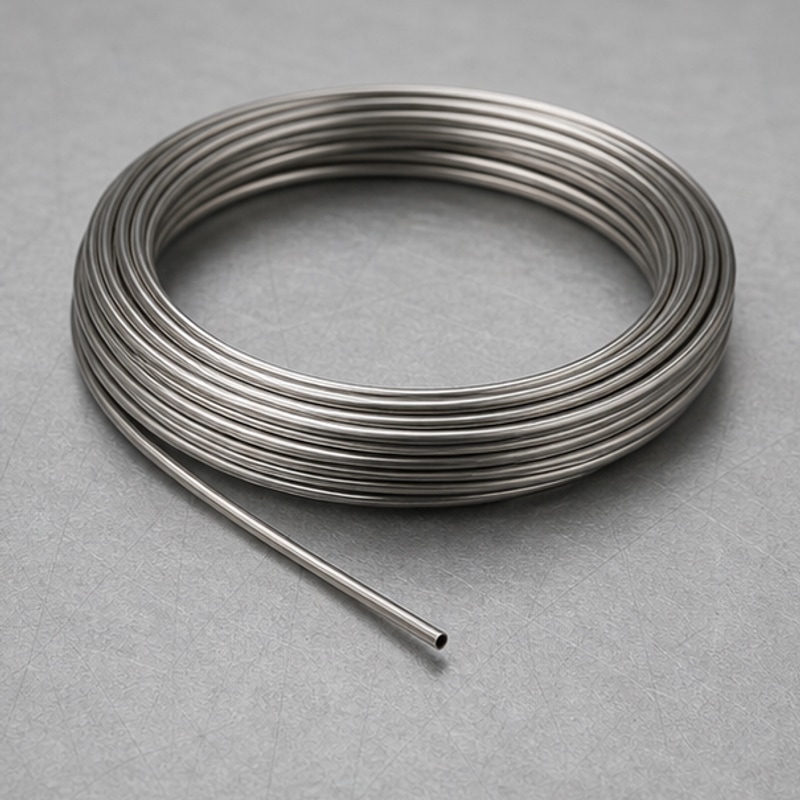
- Length: cut-to-length from 5 mm to 6,000 mm; coil lengths possible for small diameters depending on drawing capability
For applications requiring precise ID control (e.g., flow restrictors), it is critical to specify whether ID tolerance or OD tolerance is the controlling dimension. When ID is the functional dimension, the drawing should clearly note “ID critical – OD reference.”
Tolerances (Typical Ranges for Capillary Tube)
Tolerances for 317L SS capillary tube depend on the manufacturing process (seamless drawn vs. welded and drawn), the condition (annealed or hard-drawn), and the specific dimension. Typical ranges for precision drawn capillary tube:
| Parameter | Typical Tolerance | Notes |
|---|---|---|
| OD | ±0.025 mm to ±0.050 mm | Tighter possible for drawn product; depends on drawing ratio and final pass |
| ID | ±0.025 mm to ±0.075 mm | ID tolerance is more difficult to hold than OD; requires careful process control |
| Wall thickness | ±0.025 mm to ±0.075 mm | Concentricity affects consistency; specify if heavy-wall or light-wall |
| Length (cut pieces) | ±0.5 mm to ±1.0 mm | Tighter on request for precision assemblies |
| Straightness | 1 mm per 500 mm typical | Can be improved by straightening passes; depends on material condition |
Note: All tolerances are negotiable based on drawing, material condition, process route, and mutual agreement between parties. Always confirm with the supplier before tooling commitment.
End Condition and Burr Control
For capillary tube used in fluid or gas flow, end condition is critical. Typical requirements:
- Square cut: cut perpendicular to tube axis with burr height ≤ 0.10 mm (0.004″).
- Deburred ends: internal and external burrs removed via mechanical or thermal methods.
- Chamfered or radiused ends: specified for insertion into fittings or to reduce flow disturbance.
Burr control is especially important for ID-critical applications (e.g., catheter tubes) where a burr can cause flow obstruction or tissue damage. If the drawing does not specify burr limits, the supplier may default to a commercial burr standard (e.g., ≤ 0.15 mm).
Surface Finish and Cleanliness Requirements
Surface finish for 317L SS capillary tube can be specified as:
- Bright annealed (BA): smooth surface, Ra ≤ 0.4 µm typical after bright annealing in hydrogen atmosphere.
- Pickled and passivated: matte surface, Ra 0.8–1.6 µm typical.
- Electropolished: Ra ≤ 0.25 µm achievable; improves corrosion resistance by removing surface inclusions.
- Mechanically polished: Ra 0.2–0.8 µm depending on grit sequence.
Cleanliness requirements may include degreasing, ultrasonic cleaning, or packaging in clean-room conditions. For medical or analytical applications, specify “clean and bagged” with no residual lubricants or particulate. Verify with the supplier whether their cleaning process meets your specific cleanliness standard (e.g., ISO 14971 for medical devices).
Inspection Documentation
When sourcing 317L SS capillary tube, request the following documentation to verify material and dimensional conformance:
- Material test report (MTR) per ASTM A269 or A213, including chemical composition and mechanical properties (tensile, yield, elongation).
- Dimensional inspection report for OD, ID, WT, length, and straightness (if specified).
- Surface finish measurement report (if Ra is specified).
- Burst pressure or hydrostatic test certificate (if required for pressure applications).
- Certificate of conformance (CoC) confirming compliance with the PO and drawing.
Note: The supplier should provide lot-specific traceability. Ensure the MTR is from the mill that produced the raw material, not a re-certification unless fully traceable.
Packaging Considerations
Packaging for 317L capillary tube depends on sensitivity and end use:
- Standard: poly bags or bubble wrap in cardboard boxes for cut lengths.
- Clean packaging: heat-sealed poly bags with desiccant, optionally nitrogen-purged for moisture-sensitive applications.
- Coil packaging: spools or coils for long lengths; secure to prevent kinking.
- Labeling: each bundle or spool labeled with material grade, heat number, dimensions, and quantity.
If the tube is intended for cleanroom assembly, specify “double-bagged in cleanroom environment” and verify the supplier’s cleanroom classification (e.g., ISO Class 7 or 8) if required.
RFQ Information Checklist
To ensure accurate quotation and production, include the following in your RFQ for 317L SS capillary tube:
- Drawing or sketch with critical dimensions (OD, ID, WT, length) and tolerances.
- Material grade: 317L (UNS S31703) or equivalent.
- Quantity (pieces or meters).
- Surface finish requirement (bright annealed, electropolished, etc.) and Ra value if specified.
- End condition (square cut, deburred, chamfered).
- Cleanliness and packaging requirements.
- Inspection documentation required (MTR, dimensional report, CoC).
- Any special testing (hydrostatic, burst, leak) or certification.
To request a quotation for 317L SS capillary tube, submit your drawings, material grade, quantity, tolerance, surface finish, and inspection requirements through the Healsmed website. The engineering team will review and respond with a technical evaluation.

Healsmed
Leading Stainless Steel Capillary Tube Factory. 1,400+ standard sizes IN STOCK & ready to ship worldwide! High precision, factory-direct price.