317L Stainless Steel Capillary Tubing: Material Properties, Manufacturing Tolerances, and Application Guide
When medical device engineers and procurement teams require capillary tubing that withstands aggressive chemical environments or elevated chloride exposure, the material choice often narrows to molybdenum-bearing austenitic stainless steels. 317L stainless steel capillary tubing is specified when 316L does not provide sufficient pitting or crevice corrosion resistance, particularly in applications involving pharmaceutical processing, diagnostic instrumentation, or implantable device delivery systems. This article provides the material properties, dimensional tolerances, and procurement specifications needed to source 317L capillary tubing for demanding medical and industrial applications.
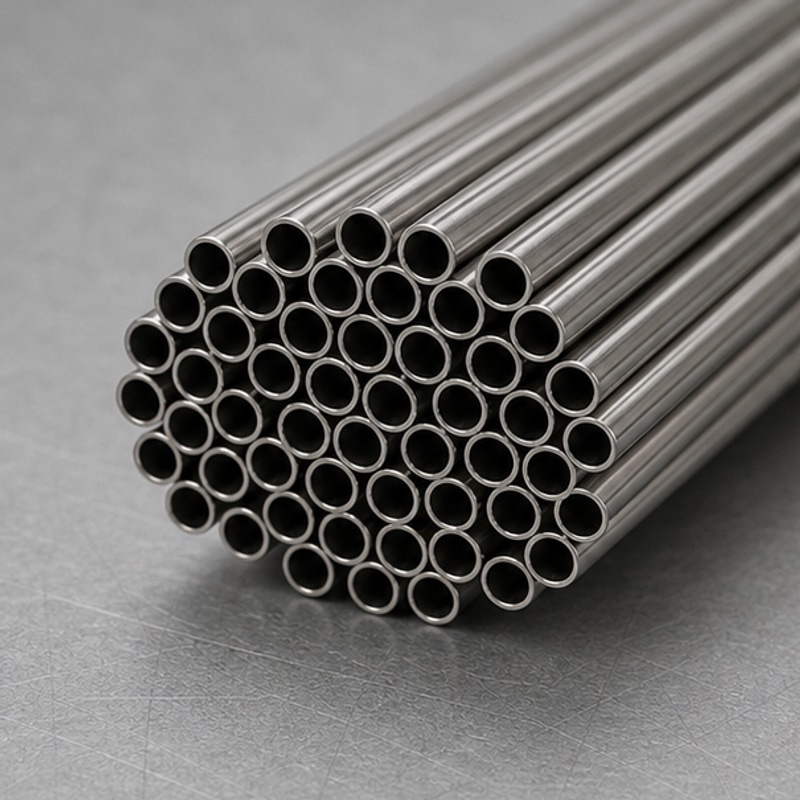
Applicable Scenarios and Industries
317L capillary tubing is selected where the operating environment includes chlorides, reducing acids, or sulfur-bearing compounds. Typical applications include:
- Pharmaceutical fluid transfer lines and chromatography columns
- Bioreactor sampling and sensing ports
- Diagnostic instrument fluidic paths (e.g., hematology analyzers)
- Chemical injection and dosing systems
- High-purity gas handling in analytical equipment
- Subsea or marine instrumentation where chloride pitting is a concern
The medical device sector uses 317L for components that contact aggressive cleaning agents or sterilants, though the material is not inherently “medical grade” — suitability depends on the specific application and validation.
Material Grade and Designation
317L is a low-carbon version of Type 317 stainless steel, with a maximum carbon content of 0.03%. This minimizes carbide precipitation during welding and sensitization in heat-affected zones. The key alloying addition is molybdenum, which enhances pitting resistance.
Typical Composition (weight %, per ASTM A269 / ASTM A213)
| Element | 317L | 316L (for comparison) |
|---|---|---|
| Carbon | ≤ 0.03 | ≤ 0.03 |
| Manganese | ≤ 2.00 | ≤ 2.00 |
| Phosphorus | ≤ 0.045 | ≤ 0.045 |
| Sulfur | ≤ 0.030 | ≤ 0.030 |
| Silicon | ≤ 0.75 | ≤ 0.75 |
| Chromium | 18.0 – 20.0 | 16.0 – 18.0 |
| Nickel | 11.0 – 15.0 | 10.0 – 14.0 |
| Molybdenum | 3.0 – 4.0 | 2.0 – 3.0 |
| Nitrogen | ≤ 0.10 | ≤ 0.10 |
| Iron | Balance | Balance |
The higher molybdenum content in 317L gives it a higher pitting resistance equivalent number (PREN = %Cr + 3.3%Mo + 16%N), typically in the range of 30–34, compared to 24–28 for 316L. This makes 317L more resistant to chloride-induced pitting and crevice corrosion.
Alternative Designations
- UNS S31703
- EN 1.4438 (X2CrNiMo18-15-4)
- JIS SUS 317L
Other common grades for capillary tubing include 304, 304L, 316L, 316Ti, 321, and 347. 317L is chosen specifically when corrosion resistance beyond 316L is required, but 904L or duplex grades (e.g., 2205) are not justified.
OD / ID / Wall Thickness / Length Considerations
317L capillary tubing is typically supplied in small diameters. Common outer diameter (OD) ranges for capillary tubing are 0.5 mm to 6.0 mm (0.020″ to 0.250″), with wall thicknesses from 0.10 mm to 1.0 mm (0.004″ to 0.040″). Inner diameter (ID) is calculated as OD minus twice the wall thickness.
Standard lengths are usually 1,000 mm, 2,000 mm, or random mill lengths of 3,000–6,000 mm. Custom cut lengths are available per drawing. For very small bores (ID < 0.5 mm), special drawing processes are required to maintain concentricity.
Tolerances (Typical Ranges for Capillary Tube)
Tolerances for 317L capillary tubing depend on the manufacturing standard (ASTM A269, ASTM A213) and the specific diameter and wall thickness. The values below are typical for cold-drawn capillary tube; exact tolerances should be agreed upon with the supplier.
| Parameter | Typical Tolerance | Notes |
|---|---|---|
| Outer Diameter | ± 0.05 mm to ± 0.10 mm (for OD ≤ 6.0 mm) | Tighter tolerances (± 0.025 mm) are possible for precision applications |
| Wall Thickness | ± 10% of nominal (for wall ≥ 0.25 mm) | For thinner walls (< 0.25 mm), tolerance depends on drawing process |
| Length | +0 / -0 mm (cut to length) or +0 / +5 mm (random mill) | Per agreed specification |
| Straightness | 1.5 mm per 1,000 mm (typical) | Tighter straightness available for mandrel applications |
| Ovality | Depends on drawing, material condition, process route, and mutual agreement between parties |
For applications requiring tight ID control (e.g., fluid metering), specify both OD and ID tolerances on the drawing.
End Condition and Burr Control
After cutting, capillary tube ends must be free of sharp edges and burrs to prevent particle generation and flow disruption. Common end conditions include:
- Square cut (as cut) – typical for standard lengths
- Deburred ends – both ID and OD chamfered
- Precision cut with minimal burr (≤ 0.05 mm burr height)
- Custom end profiles (e.g., bullet nose, taper) per drawing
For medical fluid path components, deburring is essential. Specify the acceptable burr height and method (mechanical, chemical, or thermal) in the RFQ.
Surface Finish and Cleanliness Requirements
Surface finish is critical for corrosion resistance and fluid compatibility. Common finishes for 317L capillary tubing:
- Bright annealed (BA) – smooth, clean surface with a reflective finish; suitable for most medical and pharmaceutical applications
- Pickled (2D) – matte finish; acceptable for non-cosmetic applications
- Electropolished (EP) – enhanced surface smoothness (Ra ≤ 0.4 µm or better); required for high-purity or clean-in-place (CIP) systems
Cleanliness levels should be specified if the tubing is used in contact with sterile fluids. Typical requirements include degreased, free of oils, and packaged in clean polyethylene bags.
Inspection Documentation
For critical applications, the following documentation should be requested:
- Material test report (MTR) per EN 10204 3.1 or 3.2, showing heat analysis and mechanical properties
- Dimensional inspection report (OD, ID, wall thickness, length, straightness)
- Surface finish measurement (Ra or RMS)
- Hydrostatic or pneumatic pressure test report (if required)
- Burst pressure calculation (based on nominal dimensions and tensile strength)
317L capillary tubing is typically supplied in the annealed condition (solution treated at 1040–1120°C, then quenched). Mechanical properties per ASTM A269: tensile strength ≥ 515 MPa (75 ksi), yield strength ≥ 205 MPa (30 ksi), elongation ≥ 35% in 2″. Hardness is typically ≤ 95 HRB.
Packaging Considerations
Packaging must protect the surface finish and prevent contamination. Options include:
- Bundled in plastic sleeves or tubes
- Coiled in clean plastic containers for long lengths
- Individual polybagging for small quantities
- Wooden crates or corrugated boxes with foam inserts
For medical use, specify “clean packaging” with no residual oils or particles.
RFQ Information Checklist
To ensure an accurate quotation for 317L stainless steel capillary tubing, include the following in your request:
- Material grade: 317L (UNS S31703)
- OD, ID, and wall thickness (or OD and wall thickness)
- Tolerance requirements for OD, ID, wall, length, straightness
- Length (cut to length or random mill)
- End condition (as cut, deburred, custom)
- Surface finish (BA, pickled, electropolished, with Ra value)
- Cleanliness level (medical, pharmaceutical, industrial)
- Quantity (total length or number of pieces)
- Inspection documentation required (MTR, dimensional report, etc.)
- Packaging requirements
- Target delivery timeline
To request a quotation for 317L stainless steel capillary tubing, submit your drawings, material grade, quantity, tolerance, surface finish, and inspection requirements through the Healsmed website. The engineering team will review and respond with a technical evaluation.

Healsmed
Leading Stainless Steel Capillary Tube Factory. 1,400+ standard sizes IN STOCK & ready to ship worldwide! High precision, factory-direct price.