316 Welded Capillary Tube: Material Properties, Manufacturing Tolerances, and Application Guide
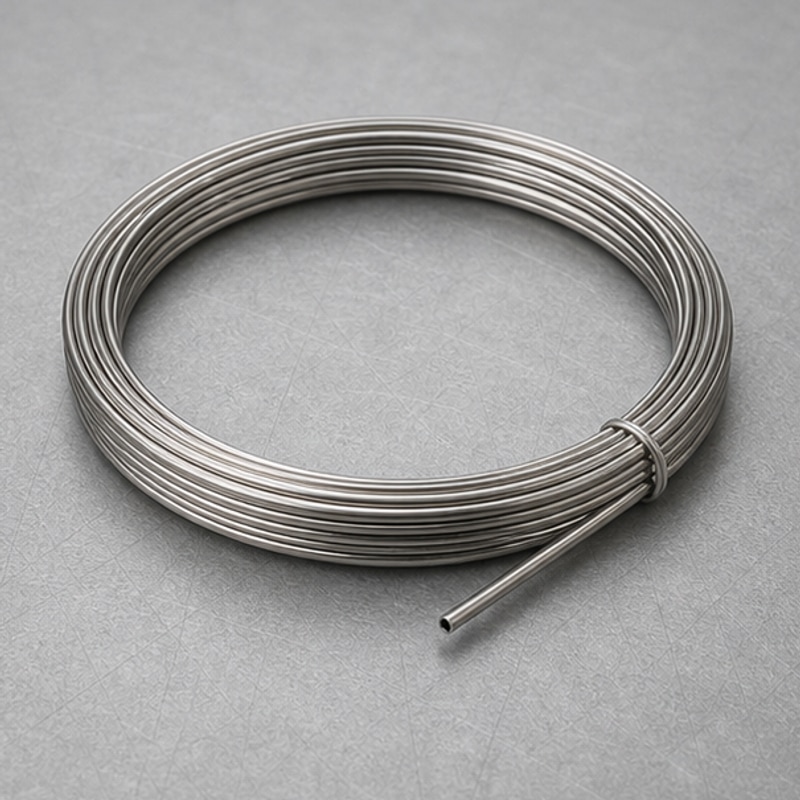
When a design calls for small-diameter tubing that must resist pitting and crevice corrosion in chloride-containing environments, the 316 welded capillary tube often emerges as a cost-effective alternative to seamless products. This article provides a technical reference for engineers and procurement professionals evaluating 316 welded capillary tube for medical devices, analytical instruments, or industrial systems. We cover material properties, manufacturing routes, dimensional tolerances, and inspection criteria relevant to this product form.
Material Grade Fundamentals: 316 Stainless Steel for Capillary Tubing
Type 316 stainless steel is an austenitic grade with molybdenum addition that significantly improves resistance to chlorides and reducing acids. For capillary tube applications, the typical chemical composition (weight percent) is: chromium 16.0–18.0, nickel 10.0–14.0, molybdenum 2.0–3.0, carbon ≤0.08, manganese ≤2.0, silicon ≤0.75, phosphorus ≤0.045, sulfur ≤0.030, and iron balance. Mechanical properties for drawn capillary tubing generally include tensile strength of 515–690 MPa, yield strength (0.2% offset) of 205–310 MPa, and elongation in 50 mm of 35–55%. Maximum continuous service temperature in oxidizing environments is approximately 870°C, though sensitization can occur in the 430–870°C range if carbon content is not controlled. For welded applications, low-carbon variants such as 316L (C ≤0.03) are often preferred to minimize carbide precipitation at the weld zone.
Manufacturing Process: From Strip to Welded and Drawn Capillary
316 welded capillary tube begins as precision-rolled strip of controlled width and thickness. The strip is continuously formed into a tubular shape and the abutting edges are joined by autogenous TIG or laser welding without filler metal. The weld bead is then cold drawn through a series of dies and over a mandrel to reduce the outer diameter (OD) and wall thickness to final specifications. Drawing also refines the weld zone microstructure, improves dimensional consistency, and enhances surface finish. Typical drawing reductions per pass range from 10% to 30%, depending on starting dimensions and required final properties. After final drawing, the tube is annealed in a protective atmosphere to restore corrosion resistance and ductility, then straightened and cut to length.
Seamless vs. Welded and Drawn: When Welded Is Acceptable
Seamless capillary tube is extruded or rotary-pierced from a solid billet, then cold drawn. It has no longitudinal weld line, which can be an advantage in high-pressure or cyclic-load applications where weld integrity is a concern. However, welded and drawn 316 capillary tube offers several practical benefits: tighter dimensional tolerances are achievable because the starting strip has precise thickness control, and the weld zone is mechanically worked during drawing to produce a homogeneous microstructure. For applications where internal pressure is moderate (below 20 MPa) and the fluid is not highly corrosive to weld heat-affected zones, welded and drawn tubing is acceptable. Key industries where welded capillary is specified include medical gas chromatography, pneumatic controls, and low-pressure hydraulic sensing lines. For high-pressure fuel injection or subsea instrumentation, seamless is typically required. The choice should be based on a risk assessment of weld zone performance under service conditions.
Dimensional Specifications and Tolerance Classes for 316 Welded Capillary
Healsmed supplies 316 welded capillary tube in OD ranges from 0.5 mm to 12.7 mm, with wall thicknesses from 0.05 mm to 2.0 mm. Tolerance classes depend on the number of drawing passes and final annealing. Standard drawn tolerances are ±0.05 mm on OD for tubes above 3 mm OD, and ±0.025 mm for smaller diameters. Wall thickness tolerances are typically ±10% of nominal. For applications requiring precision fit, such as ferrule-based compression fittings, tighter tolerances (e.g., ±0.013 mm on OD) can be achieved with additional drawing and inspection steps. The table below summarizes common tolerance grades.
| OD Range (mm) | Standard Tolerance (mm) | Precision Tolerance (mm) |
|---|---|---|
| 0.5 – 1.5 | ±0.025 | ±0.013 |
| 1.6 – 3.0 | ±0.038 | ±0.020 |
| 3.1 – 6.35 | ±0.050 | ±0.025 |
| 6.36 – 12.7 | ±0.076 | ±0.038 |
Corrosion Resistance of 316 Welded Capillary in Service Environments
316 stainless steel offers superior resistance to pitting and crevice corrosion compared to 304 due to its molybdenum content. In welded capillary, the weld zone and heat-affected zone (HAZ) are the most susceptible areas. Proper post-weld annealing (solution treatment at 1065–1120°C followed by rapid cooling) restores corrosion resistance by dissolving chromium carbides and homogenizing the microstructure. In chloride environments (e.g., seawater, saline medical fluids), 316 welded capillary is suitable up to approximately 1000 ppm chlorides at ambient temperatures. For higher chloride levels or elevated temperatures, 316L or 317L may be specified. Typical corrosion rates in ASTM G48 Method A (ferric chloride test) for properly annealed 316 are less than 0.5 mm/year. Buyers should request intergranular corrosion testing per ASTM A262 Practice E for welded tubing intended for critical service.
Inspection and Quality Control for Welded Capillary Tube
Routine inspection of 316 welded capillary tube includes dimensional measurement (OD, ID, wall using laser micrometers and air gauges), surface defect detection via eddy current testing (per ASTM E309 or E426), and hydrostatic or pneumatic pressure testing. For medical and analytical applications, internal cleanliness is verified by flushing with filtered solvent and measuring particulate content. Weld integrity is assessed by flattening tests (ASTM A1016) and reverse flattening tests on weld seam samples. Destructive tests include tensile testing, flaring, and flange tests on representative samples from each production lot. A typical inspection protocol is shown below.
| Test | Standard | Acceptance Criteria |
|---|---|---|
| Eddy Current | ASTM E309 | No indications > 5% wall depth |
| Flattening | ASTM A1016 | No cracks or splits |
| Hydrostatic | ASTM A1016 | No leakage at specified pressure |
| Intergranular Corrosion | ASTM A262 Practice E | No fissures after bend test |
Common Specification Mistakes When Ordering 316 Welded Capillary
One frequent error is specifying seamless when welded and drawn would meet performance requirements at lower cost. Another is neglecting to define post-weld annealing requirements—as-welded tubing may have reduced corrosion resistance in the HAZ. Buyers sometimes assume that all 316 is 316L; if low carbon is required for weldability, it must be explicitly stated. Dimensional tolerances are often left unspecified, leading to fit issues with standard connectors. Finally, surface finish requirements (e.g., 0.4 µm Ra for medical devices) should be included in the purchase specification to avoid rework. A clear procurement checklist should include: material grade (316 or 316L), OD and wall with tolerance class, annealed condition, inspection reports required, and packaging (e.g., capped ends, clean room packaging for medical use).
For more information about 316 welded capillary tube, contact Healsmed’s engineering team with your material grade, drawing, tolerance requirements, and quantity. Submit inquiries through the Healsmed website for prompt technical review and quotation.
Conclusion
316 welded capillary tube provides a practical balance of corrosion resistance, dimensional precision, and manufacturing economy for many OEM applications. The welded and drawn process yields tubing with consistent wall thickness and tight tolerances, suitable for pneumatic, fluidic, and analytical systems operating in mildly corrosive environments. Understanding the material properties, manufacturing steps, and inspection protocols allows engineers to specify the correct product for their design.
When evaluating suppliers, request documentation of chemical analysis, mechanical properties, and nondestructive test results for each lot. For applications where weld zone integrity is critical, consider specifying 316L and post-weld annealing. With proper specification and quality assurance, 316 welded capillary tube is a reliable component in demanding medical and industrial equipment.

Healsmed
Leading Stainless Steel Capillary Tube Factory. 1,400+ standard sizes IN STOCK & ready to ship worldwide! High precision, factory-direct price.