316 Seamless Capillary Tubing: Material Properties, Manufacturing Tolerances, and Application Guide
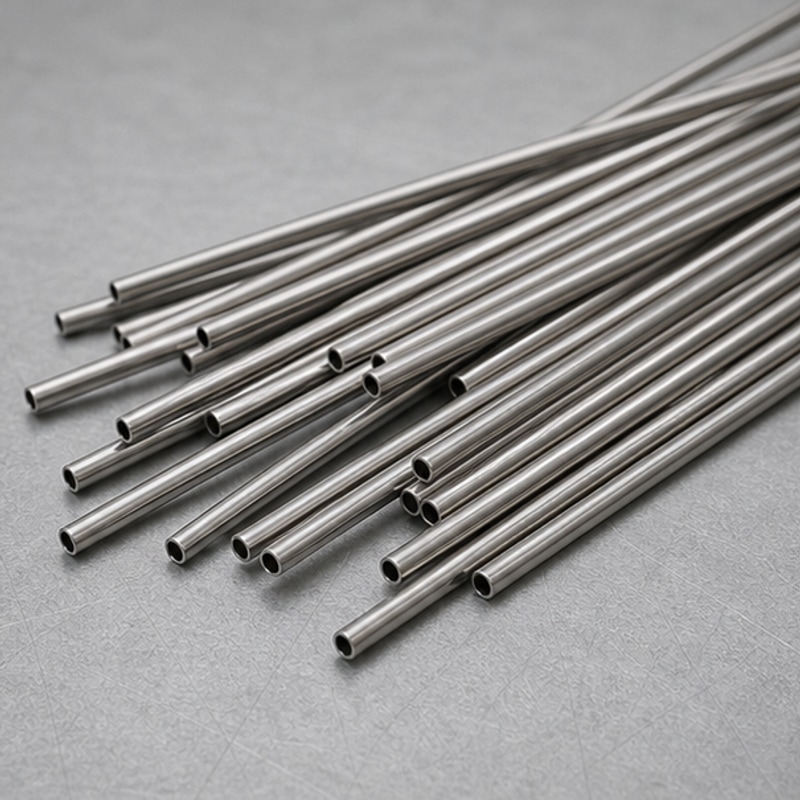
Selecting 316 seamless capillary tubing for a precision fluid system requires understanding how the material grade, manufacturing process, and dimensional tolerances interact. This article provides engineers and procurement professionals with technical data on 316 stainless steel capillary tubing, covering chemical composition, mechanical properties, corrosion resistance, and the practical implications of seamless versus welded construction. The goal is to support informed specification decisions without relying on marketing claims.
Material Grade Fundamentals: Why 316 Is Specified for Capillary Tubing
The designation “316” refers to an austenitic stainless steel alloyed with molybdenum (typically 2.0–3.0% by weight) to improve pitting and crevice corrosion resistance compared to 304. In capillary tubing applications—where wall thicknesses range from 0.05 mm to 2.0 mm—corrosion resistance is critical because a localized pit can penetrate the full wall thickness and cause leakage. The addition of molybdenum also enhances resistance to chloride environments, making 316 a standard choice for medical devices, analytical instruments, and industrial gas chromatography systems. The typical chemical composition for 316 seamless capillary tubing per ASTM A269 and ASTM A213 is shown in Table 1.
| Element | Composition Range |
|---|---|
| Carbon | ≤ 0.08 |
| Manganese | ≤ 2.00 |
| Silicon | ≤ 0.75 |
| Phosphorus | ≤ 0.045 |
| Sulfur | ≤ 0.030 |
| Nickel | 10.0 – 14.0 |
| Chromium | 16.0 – 18.0 |
| Molybdenum | 2.00 – 3.00 |
| Iron | Balance |
Seamless Construction: The Metallurgical Advantage for Capillary Tubes
Seamless capillary tubing is manufactured by cold drawing a solid billet through a series of dies without any longitudinal weld seam. For 316 material, this process produces a uniform grain structure around the entire circumference. In contrast, welded-and-drawn tubing retains a weld zone with a different grain morphology, often coarser or with carbide segregation. In small-diameter capillary tubing (OD 0.5 mm to 12.7 mm), the weld zone can represent a significant proportion of the cross-section, creating a potential site for preferential corrosion or fatigue crack initiation. Seamless 316 capillary tubing eliminates this weld zone entirely, providing consistent mechanical properties and pressure integrity. For applications where the tube must withstand repeated thermal cycling or internal pressures up to 20,000 psi (1379 bar), seamless construction is the standard.
Mechanical Properties and Pressure Ratings
Cold-drawn 316 seamless capillary tubing exhibits higher tensile and yield strengths than annealed 316 bar stock due to work hardening. Typical mechanical properties for tubing in the as-drawn condition (per ASTM A269) are listed in Table 2. Engineers should note that these values can be adjusted via post-drawing annealing if higher ductility is required for bending or flaring operations. Pressure ratings for thin-wall capillary tubing are calculated using the Barlow formula, but practical burst testing is recommended for wall thicknesses below 0.10 mm because manufacturing tolerances have a larger proportional effect on the stress calculation.
| Property | Value |
|---|---|
| Tensile Strength | ≥ 515 MPa (75 ksi) |
| Yield Strength (0.2% offset) | ≥ 205 MPa (30 ksi) |
| Elongation in 50 mm | ≥ 35% |
| Hardness (Rockwell B) | ≤ 95 HRB |
Dimensional Specifications and Tolerance Classes for Capillary Tubing
Capillary tubing dimensions are typically defined by outside diameter (OD) and wall thickness (WT). Common OD ranges for 316 seamless capillary tubing are 0.5 mm to 12.7 mm, with wall thicknesses from 0.05 mm to 2.0 mm. Tolerance on OD depends on the drawing sequence and final pass: standard commercial tolerances are ±0.05 mm, while precision-drawn tubing can achieve ±0.025 mm or tighter. For instruments requiring consistent internal diameter (ID), specifying ID tolerance directly is often more reliable than deriving it from OD and WT tolerances. Healsmed can provide tubing with ID tolerances of ±0.025 mm on request. Length tolerances are typically +6.35 mm / -0 mm for standard cut lengths, with custom lengths available.
Corrosion Behavior in Service Environments
316 stainless steel resists general corrosion in most organic and mild inorganic media. In chloride-containing environments, 316 offers improved pitting resistance compared to 304, quantified by a Pitting Resistance Equivalent Number (PREN) of approximately 24–26. For capillary tubing used in HPLC systems, pharmaceutical fluid transfer, or marine analytical equipment, 316 provides adequate corrosion resistance provided the chloride concentration remains below 1000 ppm and temperature below 50°C. For higher chloride levels or temperatures exceeding 60°C, 316L (low-carbon variant) or 317L may be more appropriate to minimize sensitization and intergranular corrosion. Maximum continuous service temperature for 316 in air is approximately 870°C, though oxidation scaling becomes significant above 800°C.
Surface Finish and Internal Cleanliness Requirements
For capillary tubing used in medical devices or analytical instrumentation, internal surface finish directly affects fluid flow consistency and particle entrapment. Standard mill finish for 316 seamless capillary tubing has an internal surface roughness (Ra) of 0.5–1.0 µm after drawing. Electropolishing can reduce Ra to 0.2–0.4 µm, which is often required for applications where the tube carries biological fluids or reagents. Internal cleanliness is verified by flushing the tubing with deionized water and measuring particle counts per ISO 4406 or by solvent extraction and gravimetric analysis. For oxygen service or high-purity gas systems, degreasing and passivation per ASTM A967 are standard requirements.
Quality Control and Inspection Protocol
Procurement specifications for 316 seamless capillary tubing should include inspection criteria. Common nondestructive tests include eddy current testing (ECT) per ASTM E309 or ASTM E243 to detect surface defects, and hydrostatic testing per ASTM A1016 to verify pressure integrity. Dimensional inspection is performed using laser micrometers or air gauges for OD and ultrasonic gauges for wall thickness. For critical applications, a 100% dimensional inspection report can be provided. Material traceability from the original melt to the finished tube is maintained via heat numbers and mill test certificates (MTC) per EN 10204 Type 3.1 or 3.2, depending on the project requirements.
Procurement Checklist for 316 Seamless Capillary Tubing
When writing a specification for 316 seamless capillary tubing, include the following parameters: OD and tolerance, wall thickness and tolerance, length and tolerance, surface finish (internal and external), straightness (typically 1 mm per meter for capillary sizes), end condition (square cut, deburred), and any required certifications (MTC, NDE reports). Specify whether the tubing will be used in as-drawn or annealed condition. For applications involving bending or flaring, request a hardness test to confirm the tubing is within the acceptable range for the forming operation. Avoid specifying “medical grade” without defining the actual cleanliness and biocompatibility requirements, as this term is not standardized across all tubing suppliers.
For more information about 316 seamless capillary tubing, contact Healsmed’s engineering team with your material grade, drawing, tolerance requirements, and quantity. Submit inquiries through the Healsmed website for prompt technical review and quotation.
Conclusion
316 seamless capillary tubing provides a reliable combination of corrosion resistance, mechanical strength, and dimensional consistency for demanding fluidic applications. The seamless manufacturing route eliminates the weld zone, ensuring uniform grain structure and predictable pressure integrity across the full tube cross-section. Engineers specifying this material should pay attention to dimensional tolerances, surface finish requirements, and inspection protocols to match the tubing to the actual service conditions.
By understanding the chemical composition limits, mechanical property ranges, and manufacturing tolerances discussed in this guide, procurement and engineering teams can evaluate supplier capabilities more effectively and avoid common specification errors. For custom dimensions or special testing requirements, early dialogue with the tubing manufacturer is recommended to confirm feasibility and lead times.

Healsmed
Leading Stainless Steel Capillary Tube Factory. 1,400+ standard sizes IN STOCK & ready to ship worldwide! High precision, factory-direct price.