310S Welded Capillary Tube: Material Properties, Manufacturing Tolerances, and Application Guide
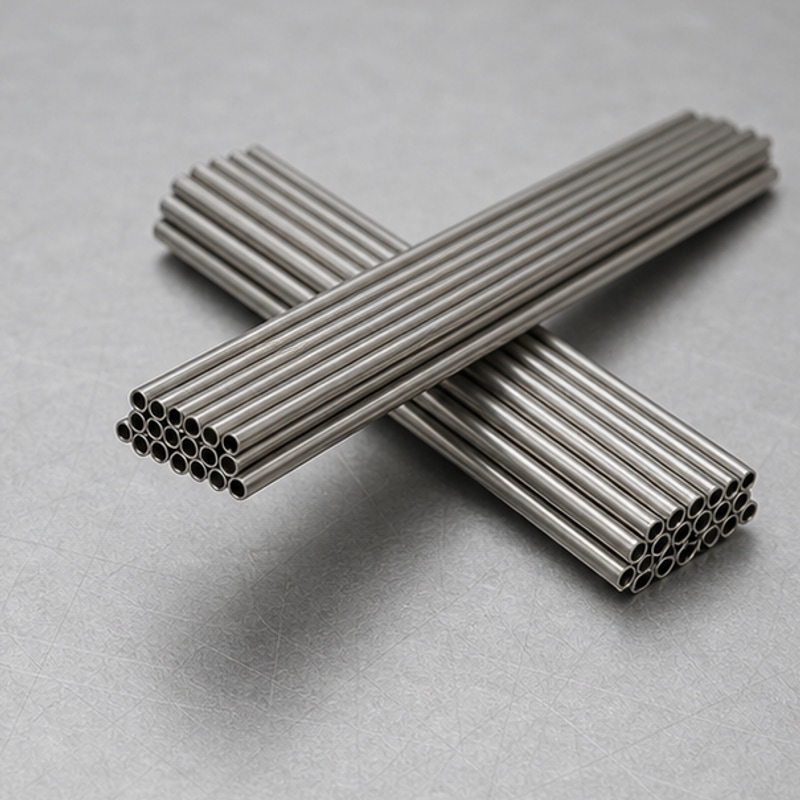
When specifying small-diameter tubing for high-temperature or corrosive environments, engineers often default to seamless designs. However, 310S welded capillary tube offers a viable, cost-effective alternative when the manufacturing process includes a drawing step that refines the weld zone and restores mechanical properties. This article covers the material characteristics of grade 310S, the welded-and-drawn manufacturing route, dimensional tolerances, and practical application limits to help procurement and design engineers make informed decisions.
Chemical Composition and Mechanical Properties of 310S
Grade 310S is an austenitic stainless steel with higher chromium and nickel content than 304 or 316 grades. The “S” suffix indicates a low-carbon variant (max 0.08% C) to minimize carbide precipitation during welding or sustained high-temperature exposure. Typical composition ranges per ASTM A240 are listed below.
| Element | Weight % (range) |
|---|---|
| Carbon | 0.08 max |
| Manganese | 2.00 max |
| Phosphorus | 0.045 max |
| Sulfur | 0.030 max |
| Silicon | 1.50 max |
| Chromium | 24.00 – 26.00 |
| Nickel | 19.00 – 22.00 |
Mechanical properties at room temperature (annealed condition): tensile strength 515 MPa min, yield strength 205 MPa min, elongation 40% min. The material maintains useful strength up to 1150°C, with continuous service recommended up to 1100°C in oxidizing atmospheres. Oxidation resistance is superior to 309S due to the higher chromium content.
Welded and Drawn Manufacturing Process
310S welded capillary tube begins as cold-rolled strip, which is formed into a tubular shape and longitudinally welded using TIG or plasma arc under inert gas shielding. The as-welded tube typically has a bead on the inner and outer surfaces. The tube then undergoes one or more cold drawing passes over a mandrel, which reduces the diameter and wall thickness while elongating the tube. Drawing accomplishes three objectives: it consolidates the weld zone microstructure, improves dimensional accuracy, and produces a smooth surface finish. The final anneal restores corrosion resistance and ductility. Unlike seamless tube, which requires extrusion or piercing of a solid billet, the welded-and-drawn route uses less material and can achieve tighter tolerances on small ODs.
Dimensional Specifications and Tolerance Classes
310S welded capillary tube is commonly available in outer diameters from 0.5 mm to 12.7 mm and wall thicknesses from 0.05 mm to 2.0 mm. After drawing, typical OD tolerances are ±0.025 mm for sizes under 6.0 mm and ±0.05 mm for larger diameters. Wall thickness tolerance is usually ±10% of nominal. Straightness is specified as 1 mm per 1000 mm length unless otherwise agreed. Custom lengths from 500 mm to 6000 mm are standard, with cut lengths available on request.
| OD Range (mm) | Standard Tolerance (mm) | Precision Tolerance (mm) |
|---|---|---|
| 0.5 – 3.0 | ±0.025 | ±0.013 |
| 3.1 – 6.0 | ±0.025 | ±0.018 |
| 6.1 – 12.7 | ±0.050 | ±0.025 |
Seamless vs Welded: When Welded Is Acceptable
The choice between seamless and welded capillary tube depends on service conditions and cost constraints. Welded-and-drawn 310S tube is acceptable when the application does not involve cyclic thermal fatigue through the weld zone, extremely high internal pressure (above 35 MPa), or a requirement for zero weld seam per standards such as ASTM A269 or A1016. For instrumentation lines, thermocouple sheaths, and gas sampling probes operating below 20 MPa and 900°C, welded tube performs reliably. The drawn process refines the weld grain structure to the point where mechanical properties approach those of the parent metal. Inspection methods—eddy current, hydrostatic, or air-under-water testing—verify seam integrity. For critical applications, 100% eddy current testing per ASTM E309 is recommended.
Corrosion Resistance and High-Temperature Behavior
310S offers excellent resistance to oxidation, sulfidation, and carburization at elevated temperatures. In oxidizing environments, a protective Cr₂O₃ scale forms and remains adherent up to 1100°C. The high nickel content also provides resistance to chloride stress corrosion cracking, though pitting resistance in chloride solutions is moderate (PREN ≈ 25). In welded tubing, the heat-affected zone may exhibit slight sensitization if cooling is slow, but the low carbon content of 310S minimizes this risk. For aqueous corrosion at room temperature, 316L or 904L may be more suitable; 310S is selected primarily for high-temperature service.
Quality Control and Inspection Protocol
Each lot of 310S welded capillary tube should be supplied with a mill test certificate confirming chemical composition and mechanical properties. Dimensional inspection includes OD, ID, wall thickness, ovality, and straightness. Surface finish is examined for scratches, pits, or weld bead remnants. Nondestructive testing options include eddy current (for longitudinal defects), ultrasonic (for wall thickness variation), and pneumatic pressure testing. For medical or analytical applications, internal cleanliness is verified by flushing with solvent and measuring particulate residue. A typical acceptance standard is ASTM A269 or ASTM A213, depending on the intended service.
Industry-Specific Applications for 310S Welded Capillary
Common applications include thermocouple sheaths in furnace sensors, gas chromatography columns, high-temperature pressure sensing lines, and sampling probes in petrochemical reactors. The material is also used in heat treatment furnace atmosphere sampling, exhaust gas analysis systems, and certain solar thermal receiver components. In analytical instrumentation, the combination of oxidation resistance and dimensional stability makes 310S suitable for transfer lines carrying hot process gases up to 1000°C.
Procurement Checklist for Engineers
When specifying 310S welded capillary tube, confirm the following: material certification to ASTM A240 or equivalent, OD and wall tolerance class, straightness requirement, surface finish (e.g., 0.8 µm Ra or better for clean service), and NDT method. Specify whether the tube is required in the as-drawn or annealed condition—annealed is standard for corrosion resistance. Also state if the weld seam must be removed (cold drawn normally flattens the bead, but a fully seam-free ID may require additional processing).
For more information about 310S welded capillary tube, contact Healsmed’s engineering team with your material grade, drawing, tolerance requirements, and quantity. Submit inquiries through the Healsmed website for prompt technical review and quotation.
Conclusion
310S welded capillary tube provides a practical option for high-temperature applications where seamless tube is not cost-justified. The welded-and-drawn process delivers dimensional precision, a refined weld microstructure, and mechanical properties suitable for many industrial and analytical uses. Engineers should evaluate service temperature, pressure, and corrosion environment to determine whether welded construction meets the design requirements.
Understanding the material limits and inspection options allows procurement teams to specify the correct product without over-engineering. For applications up to 1100°C in oxidizing atmospheres and moderate pressures, 310S welded capillary tube offers reliable performance at a lower material cost than seamless equivalents.

Healsmed
Leading Stainless Steel Capillary Tube Factory. 1,400+ standard sizes IN STOCK & ready to ship worldwide! High precision, factory-direct price.