Inconel 825 Welded Capillary Tube: Material Properties, Manufacturing Tolerances, and Application Guide
When sourcing an Inconel 825 welded capillary tube, engineers are typically looking for a nickel-iron-chromium alloy tube that resists chloride stress corrosion cracking and oxidizing/reducing acids, while holding tight dimensional control in small diameters. The challenge is not finding the alloy — it is finding a welded tube supplier who can control weld quality, bead condition, concentricity, and cleanliness in capillary sizes, and who can document the material and dimensions to a level that satisfies a medical or instrumentation quality system.
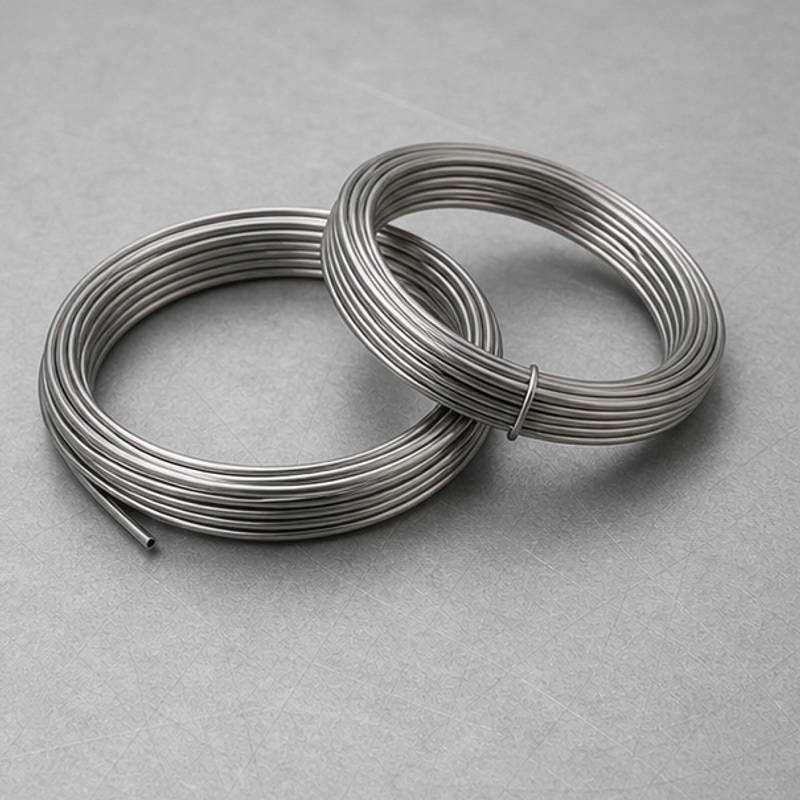
What Inconel 825 Welded Capillary Tube Is Used For
Inconel 825 (UNS N08825) is a nickel-iron-chromium alloy with additions of molybdenum, copper, and titanium. It is specified where carbon steel and many stainless grades fail: sulfuric acid service, phosphoric acid service, seawater and chloride-bearing environments, and sour gas or oilfield applications. In capillary form, welded 825 tube is used in:
- Downhole and surface instrumentation tubing, pressure sensing lines, and chemical injection lines
- Analytical and sampling systems in chemical and petrochemical plants
- Heat exchanger and condenser tubing in small diameters
- Medical and laboratory equipment where corrosion resistance to aggressive disinfectants or process fluids is required
- Thermowell, thermocouple, and sensor protection sheaths
The alloy is not inherently a medical implant material, and it is not supplied with any regulatory approval. Suitability for a given application depends on the end user’s own qualification and risk assessment.
Material Grade and Designations
Inconel 825 is a trade name of Special Metals Corporation. Equivalent designations buyers may see on drawings or purchase orders include:
| System | Designation |
|---|---|
| UNS | N08825 |
| DIN / W.-Nr. | 2.4858 |
| EN | NiCr21Mo (older designation NiFe30Cr21Mo3) |
| Common trade names | Incoloy 825, Nicrofer 4221 |
Typical chemical composition limits for UNS N08825 (per ASTM B424 / B423 / B704 and ASME SB-424 / SB-423 / SB-704) are approximately: Ni 38.0–46.0%, Cr 19.5–23.5%, Fe balance, Mo 2.5–3.5%, Cu 1.5–3.0%, Ti 0.6–1.2%, C max 0.05%, Mn max 1.0%, S max 0.03%, Si max 0.5%, Al max 0.2%. Always confirm against the current edition of the applicable specification before releasing a drawing.
For welded capillary tube, the relevant product specifications are typically ASTM B704 (welded nickel-alloy tube) or ASTM B423 (seamless). The choice between welded and seamless depends on pressure rating, corrosion allowance, and whether the seam is acceptable in the fluid path.
Welded vs. Seamless: What Buyers Should Know
Welded capillary tube is produced from strip or coil, formed into a tubular shape, welded longitudinally, and then drawn down to final capillary dimensions. The drawing operation reduces wall thickness and diameter while improving surface finish and dimensional consistency. Key points for specification:
- Weld seam must be fully consolidated — no incomplete penetration, no oxidation, no bead that protrudes into the ID
- Post-weld drawing typically cold-works the seam, but weld quality still depends on strip edge preparation, weld atmosphere, and tooling condition
- If the application requires a seamless product, welded tube is not a substitute — specify seamless and expect different lead time and cost
- Eddy current or ultrasonic testing can be specified to verify weld integrity, but the specific test method and acceptance criteria must be agreed in writing
OD, ID, Wall Thickness, and Length Considerations
Capillary tube generally means outside diameters in the range of roughly 0.5 mm to 6.35 mm (0.020 in to 0.250 in), although the upper limit depends on the supplier’s draw bench and the welded strip thickness available. Wall thickness is often expressed as a wall-to-OD ratio. Common configurations include:
- OD 1.0 mm to 3.0 mm with wall 0.10 mm to 0.50 mm
- OD 3.0 mm to 6.35 mm with wall 0.20 mm to 1.00 mm
These ranges are typical industry ranges, not a statement of any specific supplier’s capability. Final dimensions depend on the drawing, material condition, process route, and mutual agreement between parties.
Length options include random coils, straight lengths, or cut-to-length pieces. For coiled product, specify coil ID, coil OD, and whether the tube must be free of kinks or ovality at the coil ends.
Tolerances for Inconel 825 Welded Capillary Tube
Capillary tube tolerances are tighter than standard tube tolerances because the end use often involves fitting, swaging, or sealing. Typical tolerance ranges that buyers specify include:
| Parameter | Typical specified range |
|---|---|
| OD | ±0.02 mm to ±0.05 mm for small diameters |
| ID | ±0.02 mm to ±0.05 mm, or minimum ID only |
| Wall thickness | ±10% of nominal, or ±0.02 mm, whichever is tighter |
| Concentricity / wall variation | 10% to 15% of wall thickness |
| Straightness (straight lengths) | 0.5 mm to 1.0 mm per meter, depending on length and diameter |
| Length | ±0.5 mm to ±2.0 mm for cut lengths, depending on cut method |
These values are illustrative. Actual tolerance must be confirmed against the drawing and the supplier’s demonstrated capability. Do not assume a supplier can hold a tolerance simply because it appears in a table.
End Condition and Burr Control
Capillary tube ends are often the first place a leak or a flow restriction appears. Specify one of the following end conditions:
- Clean cut, deburred ID and OD — suitable for most instrumentation and analytical lines
- Square cut within a specified angular tolerance — required where the tube butts against a fitting or ferrule
- Chamfered ID or OD — for easier insertion into fittings
- Sealed, plugged, or capped ends — for pressure testing or contamination control during shipping
Burr height should be specified if the tube will be used in a flow path where a loose burr could migrate. A common requirement is no visible burr and no loose particles when the tube is flushed.
Surface Finish and Cleanliness
Inconel 825 welded capillary tube is typically supplied in one of the following conditions:
- As-drawn, bright annealed, or pickled — depending on the corrosion and cleanliness requirement
- ID surface finish specified as Ra or as a visual cleanliness standard
- Free of drawing lubricant, oxide scale, and loose particles
For medical, analytical, or high-purity applications, buyers may specify a cleaning process, a maximum residual lubricant level, or a particle count. These requirements must be stated in the RFQ and agreed before production, because they affect process route and inspection method.
Inspection Documentation
For a traceable purchase, the following documents are commonly requested:
- Material test certificate (EN 10204 3.1 or equivalent) showing heat number, chemical composition, and mechanical properties
- Dimensional inspection report with measured OD, ID, wall, and length
- Weld integrity test report if eddy current, ultrasonic, or pressure testing is specified
- Surface finish or cleanliness report if specified
- Certificate of conformance to the purchase order and drawing
Do not assume a supplier provides any of these by default. Specify them in the RFQ and confirm the format and language required.
Packaging Considerations
Capillary tube is easily bent, kinked, or contaminated in transit. Packaging should be specified to match the end use:
- Coils or straight lengths in protective sleeves or plastic bags
- End caps or plugs to keep out dust and moisture
- Rigid containers or wooden boxes for straight lengths
- Cleanroom-compatible packaging if the tube will enter a controlled environment
- Labeling with heat number, dimensions, and quantity for traceability
RFQ Information Checklist
To get an accurate quotation for Inconel 825 welded capillary tube, include the following in your request:
- Material grade and specification (e.g., UNS N08825, ASTM B704)
- Welded or seamless requirement
- OD, ID, and wall thickness with tolerances
- Length and form (coil, straight, cut-to-length)
- End condition and burr requirement
- Surface finish and cleanliness requirement
- Inspection documents required
- Packaging requirement
- Quantity and any annual usage forecast
- Any additional testing or certification required
To request a quotation for Inconel 825 welded capillary tube, submit your drawings, material grade, quantity, tolerance, surface finish, and inspection requirements through the Healsmed website. The engineering team will review and respond with a technical evaluation.

Healsmed
Leading Stainless Steel Capillary Tube Factory. 1,400+ standard sizes IN STOCK & ready to ship worldwide! High precision, factory-direct price.