Inconel 825 Thin Wall Capillary Tube: Material Properties, Manufacturing Tolerances, and Application Guide
Engineers sourcing Inconel 825 thin wall capillary tube are typically working on instrumentation, sampling, or fluid-control assemblies where a nickel-iron-chromium alloy is needed to resist chloride stress corrosion cracking, reducing acids, and oxidizing media in the same service environment. The sourcing challenge is not simply finding the alloy—it is finding tube drawn thin enough (often below 1 mm wall) to meet pressure, flow, or heat-transfer requirements while holding OD and ID tolerances tight enough for ferrules, fittings, or brazed joints. This guide covers the material properties, dimensional envelope, tolerances, surface and end conditions, and inspection documentation that should be defined before an RFQ is issued.
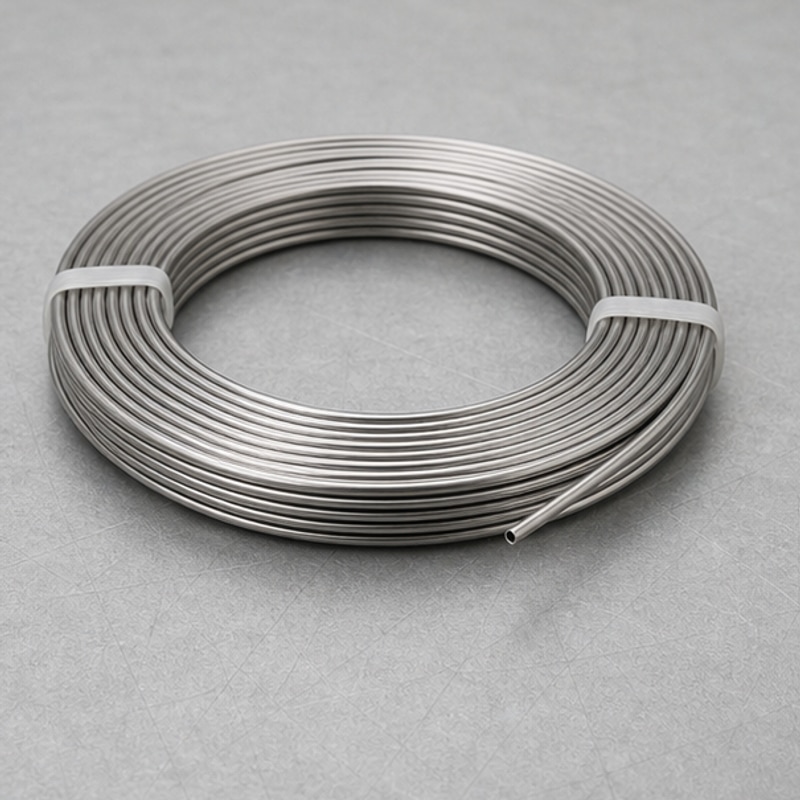
What Inconel 825 Is and When It Fits a Capillary Application
Inconel 825 (UNS N08825, also specified as Alloy 825 or NiCr21Mo by EN 2.4858 / DIN 2.4858) is a nickel-iron-chromium alloy with molybdenum and copper additions. The nickel content is typically 38–46%, chromium 19.5–23.5%, iron 22% minimum, molybdenum 2.5–3.5%, and copper 1.5–3.0% by weight. These ranges are defined in ASTM B423 (seamless and welded nickel-iron-chromium-molybdenum-copper alloy pipe and tube) and ASME SB423. Because the chemistry is standardized, a supplier should be able to provide a mill certificate that traces the heat to one of these specifications.
The practical reason an engineer selects Inconel 825 over 316L or 904L is usually one of three conditions:
- Sulfuric or phosphoric acid service where both reducing and oxidizing conditions occur.
- Chloride-containing environments where stress corrosion cracking resistance is required beyond what austenitic stainless steels provide.
- Seawater or brine exposure at moderate temperatures where pitting and crevice corrosion resistance matters.
Inconel 825 is not a substitute for every corrosion problem. It is not intended for high-temperature strength above roughly 540 °C in continuous service, and it should not be specified where strong oxidizing chloride conditions or very high-purity nuclear applications demand a different alloy. The material selection should be confirmed against the actual media, concentration, temperature, and flow velocity.
Industries and Applications for Thin Wall Inconel 825 Capillary Tube
Thin wall capillary tube in this alloy is most often found in:
- Chemical process sampling systems and analyzer lines handling aggressive acids or mixed streams.
- Oil and gas downhole instrumentation and surface sampling where chloride and sour service are concerns.
- Heat exchangers and cooling loops in marine or offshore equipment.
- Pharmaceutical and fine chemical pilot plants where corrosion resistance and cleanability are both required.
- Research and laboratory systems requiring a small-diameter, corrosion-resistant flow path.
Each of these applications imposes different priorities. A sampling line may prioritize ID cleanliness and burr-free ends, while a heat transfer coil may prioritize wall thickness uniformity and bendability. These priorities should be stated in the RFQ rather than assumed.
Dimensional Range: OD, ID, Wall Thickness, and Length
Capillary tube is generally understood as small-diameter tubing with a wall thin enough that the OD-to-wall ratio is high. For Inconel 825, common capillary sizes fall in the OD range of approximately 0.5 mm to 6.35 mm (0.020 in. to 0.250 in.), with wall thickness from about 0.05 mm to 1.0 mm. These are general industry ranges, not a statement of Healsmed’s specific capability. The actual feasible combination depends on drawing, material condition, process route, and mutual agreement between parties.
Length is usually supplied in straight lengths or coils. Straight lengths are common for analyzer and instrumentation runs; coils are common for heat transfer and long sampling lines. The maximum straight length and coil weight depend on the alloy’s condition, the drawing route, and the handling equipment available. These should be confirmed at quotation.
Tolerances for Inconel 825 Capillary Tube
Tolerance is where capillary tube sourcing most often fails. A tube that meets ASTM B423 dimensional requirements may still be outside the tolerance needed for a specific ferrule or brazed joint. The table below shows typical tolerance categories that should be discussed, not a guaranteed capability.
| Parameter | Typical consideration | Notes |
|---|---|---|
| Outside diameter (OD) | Depends on drawing and process route | Tighter than standard pipe tolerance is normal for capillary |
| Inside diameter (ID) | Depends on mandrel or plug used during drawing | ID is often the critical flow dimension |
| Wall thickness | Depends on reduction schedule and material condition | Wall uniformity affects pressure rating and bendability |
| Concentricity | Depends on drawing practice and straightness | Important for ferrules and orbital welding |
| Straightness | Depends on straightening method and length | Coiled tube may not require straightness |
| Length | Depends on cut method and handling | Tolerance should be stated per piece or per lot |
ASTM B423 provides standard tolerances for seamless and welded tube. When a drawing calls for tolerances tighter than the standard, the supplier and buyer must agree on the measurement method, the gauge, and the inspection frequency.
End Condition and Burr Control
Capillary tube ends are often the first point of leakage or contamination. The end condition should be specified as one of the following:
- Square cut with deburred ID and OD.
- Bevelled for welding.
- Prepared for ferrule or compression fitting.
- Sealed, plugged, or capped for shipment.
Burr control is especially important in small ID tube because a burr can restrict flow or shed particles into the system. The acceptable burr height and the inspection method should be stated on the drawing. If the tube will be orbital welded, the end squareness and surface condition at the weld zone should also be defined.
Surface Finish and Cleanliness
Surface finish requirements for Inconel 825 capillary tube vary by application. A sampling line may require a smooth ID to reduce particle entrapment, while a heat transfer coil may only require a clean, oxide-free surface. Common specifications include:
- Pickled and annealed condition for general corrosion resistance.
- Bright annealed condition for cleaner surface and better ID finish.
- ID surface roughness (Ra) specified by the customer when flow or cleanliness is critical.
- Freedom from oil, grease, drawing lubricant, and loose particles.
Cleanliness level should be defined by the customer. A generic statement such as “clean” is not measurable. If the tube will be used in a high-purity or oxygen service, the cleaning method and verification should be agreed in advance.
Inspection Documentation
For Inconel 825 capillary tube, the following documents are commonly requested:
- Mill certificate or material test report (MTR) showing heat number and chemistry.
- Mechanical property report (tensile, yield, elongation) where applicable.
- Dimensional inspection report covering OD, ID, wall, and length.
- Surface finish or roughness report if specified.
- Hydrostatic or pneumatic test report if pressure testing is required.
- Eddy current or ultrasonic test report if specified.
- Certificate of conformance to the purchase order and drawing.
The specific test methods and acceptance criteria should be listed in the RFQ. Not every test is applicable to every order, and adding unnecessary tests increases cost and lead time.
Packaging Considerations
Thin wall capillary tube is easily damaged in transit. Packaging should protect both the OD and the ID. Typical considerations include:
- Straight lengths in rigid tubes or wooden boxes with end supports.
- Coils supported to prevent kinking and flattening.
- End caps or plugs to keep the ID clean.
- VCI or desiccant protection if the tube will be stored in humid conditions.
- Labeling with heat number, size, quantity, and purchase order reference.
Packaging requirements should be stated in the RFQ, especially if the tube will be stored for an extended period or shipped internationally.
RFQ Information Checklist
To receive a usable quotation for Inconel 825 thin wall capillary tube, include the following in your request:
- Material grade and specification (e.g., UNS N08825, ASTM B423).
- OD, ID, and wall thickness with tolerances.
- Length and form (straight or coil).
- Quantity (pieces, meters, or weight).
- End condition and burr requirement.
- Surface finish and cleanliness requirement.
- Inspection documents required.
- Packaging and labeling requirements.
- Any additional testing or certification required.
If a dimension or requirement is not defined, the supplier will either ask for clarification or quote to a general standard, which may not match the application. Clear input reduces the risk of receiving tube that cannot be used.
To request a quotation for Inconel 825 thin wall capillary tube, submit your drawings, material grade, quantity, tolerance, surface finish, and inspection requirements through the Healsmed website. The engineering team will review and respond with a technical evaluation.

Healsmed
Leading Stainless Steel Capillary Tube Factory. 1,400+ standard sizes IN STOCK & ready to ship worldwide! High precision, factory-direct price.