Inconel 825 Precision Capillary Tubing: Material Properties, Manufacturing Tolerances, and Application Guide
If you are sourcing Inconel 825 precision capillary tubing for a medical device, analytical instrument, or high-purity fluid system, you are likely balancing three priorities: corrosion resistance in chloride-rich or reducing environments, tight dimensional control on small OD/ID combinations, and documented traceability from melt to finished tube. This article explains what Inconel 825 (UNS N08825) is, where it is used, what tolerances are realistic for capillary dimensions, and what to include in an RFQ so suppliers can quote accurately.
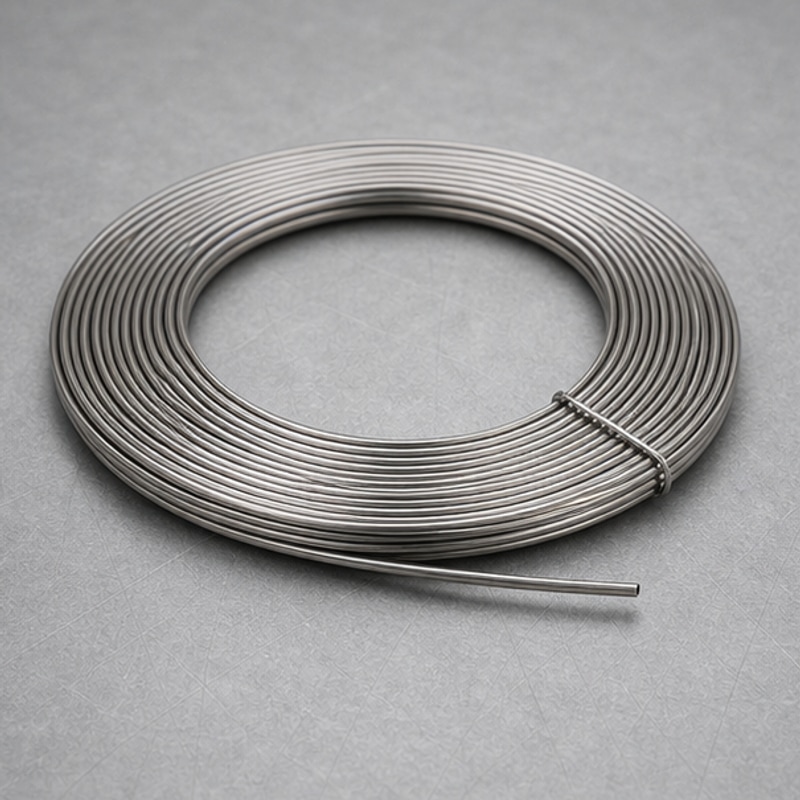
What Is Inconel 825 Precision Capillary Tubing?
Inconel 825 is a nickel-iron-chromium alloy with additions of molybdenum, copper, and titanium. It was developed to resist both oxidizing and reducing acids, and it is commonly specified for chloride stress-corrosion cracking resistance and pitting resistance in aggressive aqueous environments. In capillary form—typically OD below 6 mm with wall thicknesses in the sub-millimeter range—the tube is used for sample transfer, sensor protection, drug delivery, and precision fluid metering where the alloy’s corrosion resistance and clean surface are as important as the bore diameter.
“Precision capillary” generally means the tube is cold-drawn to final dimensions with controlled OD, ID, wall concentricity, and straightness, rather than merely being a small-diameter welded tube. The manufacturing route and inspection plan determine whether the tube meets a drawing or only a commercial tolerance.
Applicable Scenarios and Industries
- Medical and laboratory equipment: HPLC and analytical instrument flow paths, sampling probes, and fluid transfer lines where chloride-containing buffers or cleaning agents are used.
- Chemical and petrochemical analysis: Corrosive sample conditioning systems, sulfur recovery, and acid gas handling.
- Semiconductor and high-purity gas/liquid delivery: Where alloy cleanliness and low particle shedding matter.
- Aerospace and marine instrumentation: Pressure sensing lines and hydraulic control capillaries exposed to seawater or chloride environments.
- Oil and gas downhole instrumentation: Small-diameter control and sensor tubing for sour service evaluations.
Inconel 825 is not a substitute for every application. For strongly oxidizing media, higher-molybdenum alloys may be preferred; for high-temperature strength, other nickel alloys may be more suitable. Material selection should be confirmed against the actual fluid chemistry, temperature, and pressure cycle.
Material Grades and Designations
Inconel 825 is a trade name; the generic designation is UNS N08825. Common product forms and specifications include:
| Designation | Type | Notes |
|---|---|---|
| UNS N08825 | Generic alloy | Nickel-iron-chromium alloy with Mo, Cu, Ti additions |
| ASTM B423 | Seamless and welded pipe/tube | Nickel-iron-chromium-molybdenum-copper alloy (UNS N08825) tube specification |
| ASTM B163 / B167 | Condenser and heat exchanger tubes | Applicable to N08825 in some product forms; confirm scope with supplier |
| DIN 2.4858 | European designation | NiCr21Mo (approx.) |
| NACE MR0175 / ISO 15156 | Sour service | Applicability depends on condition, hardness, and environment; verify per project |
Typical chemical composition ranges for UNS N08825 include approximately 38–46% Ni, 19.5–23.5% Cr, 2.5–3.5% Mo, 1.5–3.0% Cu, and 0.6–1.2% Ti, with balance Fe and controlled carbon. Exact limits should be taken from the applicable ASTM specification and the mill certificate. Mechanical properties depend on product form, heat treatment, and cold work; for capillary tubing, the final temper (annealed or cold-drawn) must be agreed in the purchase order because it affects strength, straightness, and bendability.
OD, ID, Wall Thickness, and Length Considerations
Capillary tubing dimensions are usually specified as OD × ID or OD × wall. For Inconel 825, cold-drawn capillary is commonly available in OD ranges from approximately 0.5 mm to 6.35 mm, with wall thicknesses from roughly 0.05 mm to 1.0 mm. The exact available range depends on the mill’s tooling, the drawing route, and the required tolerance class.
- OD: Specify nominal OD and tolerance; smaller OD generally tightens the achievable tolerance band.
- ID: The bore is often the functional dimension for flow rate or sample volume; specify ID tolerance separately from OD.
- Wall: Minimum wall and concentricity affect pressure rating and collapse resistance; state whether minimum wall or nominal wall is required.
- Length: Coils, straight lengths, or cut-to-length pieces; state maximum straight length and whether random mill lengths are acceptable.
Tolerances for Precision Capillary Tube
Tolerance capability depends on alloy, drawing process, dimension, and inspection method. The following ranges are typical for cold-drawn nickel alloy capillary and should be confirmed against your drawing and the supplier’s capability study.
| Parameter | Typical range (to be confirmed) | Notes |
|---|---|---|
| OD tolerance | ±0.02 mm to ±0.05 mm | Tighter bands may be possible on selected sizes by agreement |
| ID tolerance | ±0.02 mm to ±0.05 mm | Bore gauge or pin gauge verification |
| Wall thickness tolerance | ±10% of nominal | Minimum wall may govern for pressure applications |
| Concentricity | ≤ 10% of wall thickness | Depends on drawing route and size |
| Straightness | 0.5 mm to 1.0 mm per meter | For straight lengths; coils are not straightness-inspected |
| Length tolerance | ±1 mm to ±3 mm | Cut-to-length; depends on saw or laser cutting |
If a tolerance is not stated on the drawing, the supplier may apply a commercial standard. For critical flow or sealing dimensions, specify the measurement method and gauge type in the RFQ.
End Condition and Burr Control
Capillary tube ends can be supplied as cut, deburred, chamfered, or polished. For medical and analytical assemblies, burr-free or electropolished ends reduce particle generation and improve connectability. Specify:
- Cut method (saw, laser, EDM, or abrasive) and whether heat-affected zone is acceptable.
- Burr height limit or visual acceptance criteria.
- Chamfer angle and depth, if required for fitting or welding.
- End squareness relative to the tube axis.
Burr control is process-dependent; the acceptable limit should be agreed between drawing and supplier, especially for small ID tubes where internal burrs are difficult to remove.
Surface Finish and Cleanliness Requirements
Inconel 825 capillary tubing for high-purity or medical applications may require controlled surface roughness and cleanliness. Typical requirements include:
- Surface roughness (Ra) specified for OD and/or ID; values depend on drawing, polishing, or electropolishing route.
- Freedom from drawing lubricants, oxides, and particles; cleaning method (alkaline, solvent, ultrasonic, passivation) to be agreed.
- Optional electropolishing for improved corrosion resistance and reduced surface area.
- Particle count or extractables limits only if a validated test method is cited.
Do not assume a mill finish meets a cleanroom or implantable requirement. Cleanliness and biocompatibility are application-specific and must be verified by the device manufacturer through appropriate testing and supplier qualification.
Inspection Documentation
For B2B procurement, request documentation that matches the criticality of the application. Common deliverables include:
- Mill certificate (EN 10204 3.1) with chemical composition and mechanical properties.
- Dimensional inspection report with measured OD, ID, wall, and length.
- Visual and surface finish inspection record.
- Burr and end-condition inspection record.
- Cleanliness or particle test report if specified.
- Heat number traceability and, where applicable, NACE MR0175 compliance statement.
The exact documentation package should be listed in the purchase order; not all suppliers provide the same reports by default.
Packaging Considerations
Capillary tubing is easily bent or scratched in transit. Packaging should protect straightness, ends, and surface finish:
- Straight lengths in rigid tubes or channels with end caps.
- Coils in protective wrap with controlled coil diameter to avoid kinking.
- Individual or lot identification with heat number and dimensions.
- Cleanroom-compatible packaging if specified; otherwise standard industrial packaging.
RFQ Information Checklist
To receive an accurate quotation for Inconel 825 precision capillary tubing, include the following in your request:
- Material grade and specification (e.g., UNS N08825, ASTM B423).
- Dimensions: OD, ID or wall, and length, with tolerances.
- Temper/condition (annealed, cold-drawn, etc.).
- End condition and burr limit.
- Surface finish and cleanliness requirements.
- Inspection documentation and any third-party witness requirements.
- Quantity, unit length, and packaging preferences.
- Applicable standards or project specifications.
- Delivery location and required date.
To request a quotation for Inconel 825 precision capillary tubing, submit your drawings, material grade, quantity, tolerance, surface finish, and inspection requirements through the Healsmed website. The engineering team will review and respond with a technical evaluation.

Healsmed
Leading Stainless Steel Capillary Tube Factory. 1,400+ standard sizes IN STOCK & ready to ship worldwide! High precision, factory-direct price.