Inconel 825 SS Capillary Tube: Material Properties, Manufacturing Tolerances, and Application Guide
Engineers sourcing Inconel 825 SS capillary tube are typically dealing with a corrosion problem that 316L cannot solve. You need small-diameter tubing that resists sulfuric acid, phosphoric acid, seawater, and chloride-induced stress corrosion cracking — while still holding tight OD and ID tolerances for flow control, sampling, or sensor protection. This guide covers what Inconel 825 actually is, how it behaves in capillary dimensions, what to specify on a drawing, and how to structure an RFQ that gets a usable quote.
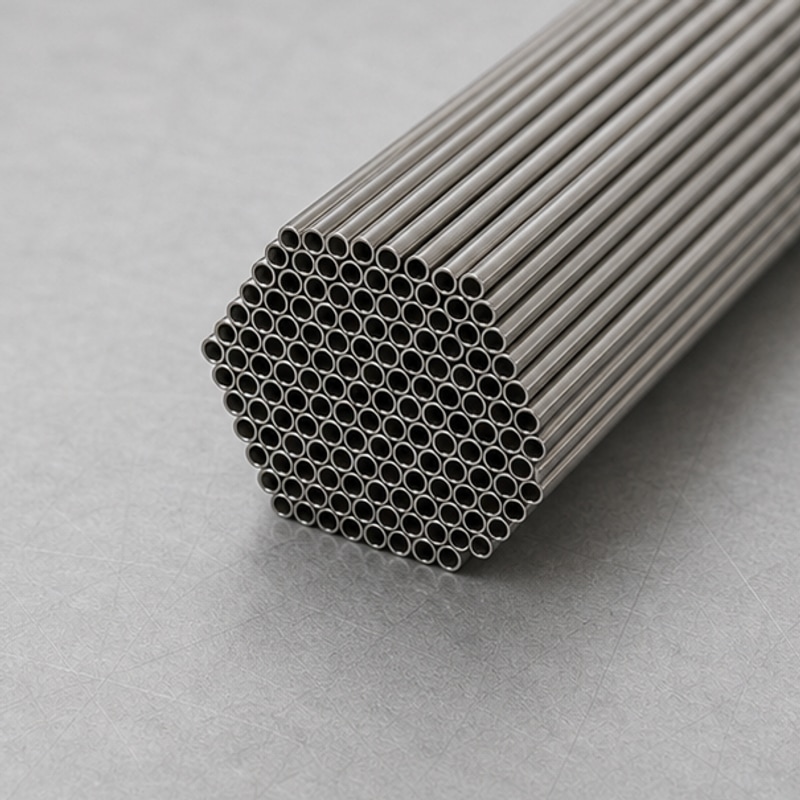
What Inconel 825 Is — and Why the “SS” Label Is Misleading
Inconel 825 (UNS N08825, also sold as Incoloy 825) is a nickel-iron-chromium alloy with additions of molybdenum and copper. It is not a stainless steel in the metallurgical sense, even though it is often grouped with corrosion-resistant stainless grades in procurement systems. The nickel content is typically 38–46%, which is what drives its resistance to reducing acids and chloride stress corrosion cracking.
Typical composition ranges per ASTM B423 / ASME SB423 include:
- Nickel: 38.0–46.0%
- Chromium: 19.5–23.5%
- Iron: balance (minimum 22%)
- Molybdenum: 2.5–3.5%
- Copper: 1.5–3.0%
- Titanium: 0.6–1.2%
- Carbon: 0.05% max
These ranges are specified in ASTM B423 for seamless and welded Ni-Fe-Cr-Mo-Cu alloy pipe and tube. Always confirm the applicable revision and condition with your supplier, because mechanical property requirements change with cold work and heat treatment.
Inconel 825 vs. 316L, 904L, and Alloy 20
If your application is mildly corrosive and cost-sensitive, 316L capillary tube is usually sufficient. Inconel 825 becomes relevant when you are dealing with:
- Sulfuric acid at moderate temperatures and concentrations
- Phosphoric acid process streams
- Seawater and chloride-rich environments where pitting or SCC is a risk
- Mixed acid environments where 316L and even 904L show unacceptable corrosion rates
Alloy 20 (UNS N08020) is a common alternative with comparable acid resistance but different mechanical behavior. The choice depends on your specific chemistry, temperature, and pressure — not on a generic “best material” ranking.
Applicable Scenarios and Industries
Inconel 825 capillary tube shows up in applications where the tube wall is thin but the corrosion environment is aggressive:
- Chemical processing: sample lines, impulse lines for pressure transmitters, injection quills
- Oil and gas: downhole instrumentation, capillary tubing for pressure and temperature sensing in sour or high-chloride wells
- Pollution control: flue gas desulfurization systems, scrubber internals
- Marine and offshore: sensor housings and hydraulic control lines exposed to seawater
- Pharmaceutical and fine chemical: pilot-plant transfer lines where 316L corrodes too quickly
It is not typically specified for implantable medical devices. If your application requires implant-grade material, you need to specify the appropriate ASTM F-series standard and verify supplier traceability separately.
OD, ID, Wall Thickness, and Length Considerations
Capillary tube dimensions for Inconel 825 are usually driven by flow rate, pressure drop, and the mechanical space available. Common capillary OD ranges fall between 0.5 mm and 6.35 mm (0.020″ to 0.250″), but the exact envelope depends on the mill and the drawing.
| Parameter | Typical Capillary Range | Notes |
|---|---|---|
| Outer diameter (OD) | 0.5–6.35 mm | Smaller OD increases fragility; larger OD reduces flexibility |
| Inner diameter (ID) | 0.2–4.0 mm | Determined by OD minus 2× wall |
| Wall thickness | 0.10–1.00 mm | Thin walls require careful draw scheduling |
| Length | Coils or straight lengths | Straight lengths limited by shipping and straightening capability |
The ID is often the critical dimension because it controls flow. If you specify OD and wall, you are implicitly specifying ID — and the tolerance stack-up matters. State which dimension is functional and which is reference.
Tolerances for Inconel 825 Capillary Tube
Capillary tolerances are tighter than standard tube tolerances. Typical commercial ranges for cold-drawn small-diameter tubing are:
- OD: ±0.05 mm to ±0.10 mm on small diameters, depending on size and condition
- ID: ±0.05 mm to ±0.15 mm, or specified as a flow-based acceptance criterion
- Wall: ±10% is common, but thinner walls may require wider percentage bands
- Concentricity: often expressed as a percentage of wall thickness
- Straightness: typically 0.5–1.0 mm per meter for straight lengths
These are general industry ranges, not a guarantee. Actual achievable tolerances depend on drawing, material condition, process route, and mutual agreement between parties. If your application requires tighter than standard, say so explicitly in the RFQ and be prepared to discuss cost and yield implications.
End Condition and Burr Control
Inconel 825 is work-hardening and tough. Burr control on cut ends is more difficult than with 316L, especially on thin walls. Specify one of the following:
- Clean cut with deburr — standard for most capillary applications
- Square cut to a specified perpendicularity
- Chamfered ID/OD for insertion into fittings
- Polished or electropolished ends for sanitary or high-purity service
If burrs can break free and travel downstream, state a maximum burr height or require a validated deburring process. Do not assume “deburred” means the same thing to every supplier.
Surface Finish and Cleanliness
Surface finish requirements for Inconel 825 capillary tube depend on the service:
- General industrial: as-drawn or pickled, with mill scale removed
- High-purity chemical: internal surface finish specified as Ra, often 0.4–0.8 µm or better
- Seawater or sour service: freedom from embedded iron and contaminants is critical
- Medical or pharmaceutical: cleanliness level must be defined by the customer, not assumed from the material grade
Inconel 825 is not inherently clean or medical-grade. Cleanliness is a process and verification requirement. Specify the test method — for example, particulate count, hydrocarbon residue, or visual inspection under magnification — and the acceptance criteria.
Inspection Documentation
For Inconel 825 capillary tube, the documentation package is often as important as the tube itself. Typical requirements include:
- Material test certificate (MTC) per EN 10204 3.1, traceable to heat number
- Chemical composition report confirming UNS N08825
- Mechanical property report — tensile, yield, elongation, hardness as applicable
- Dimensional inspection report with actual measured values, not just pass/fail
- Surface finish report if Ra is specified
- Cleanliness verification if required by the application
- Heat number traceability on the tube or packaging
If you need third-party inspection or a specific witness point, state it in the RFQ. Do not assume it is included.
Packaging Considerations
Inconel 825 capillary tube can be damaged by improper handling. Packaging should address:
- Coils supported to prevent kinking and flattening
- Straight lengths in rigid tubes or channels with end protection
- Interleaving or separation to prevent abrasion
- Moisture protection if the surface finish is critical
- Labeling with heat number, dimensions, and quantity
For thin-wall capillary, coil diameter matters. Too small a coil can ovalize the tube. Specify a minimum coil diameter if the tube will be uncoiled and used straight.
RFQ Information Checklist
To get a usable quote for Inconel 825 capillary tube, include:
- Material grade and standard: UNS N08825, ASTM B423 or equivalent
- Dimensions: OD, ID, wall thickness, length, with tolerances
- Quantity: total length or number of pieces, plus any annual usage forecast
- Condition: annealed, cold drawn, or as-specified
- End condition: cut, deburred, chamfered, polished
- Surface finish: internal and external, with Ra or visual criteria
- Cleanliness: test method and acceptance criteria
- Inspection: documentation package, third-party requirements, witness points
- Packaging: coil or straight, coil diameter, protection level
- Delivery: destination, required date, shipping constraints
The more of these you define, the fewer clarification cycles you will have.
To request a quotation for Inconel 825 SS capillary tube, submit your drawings, material grade, quantity, tolerance, surface finish, and inspection requirements through the Healsmed website. The engineering team will review and respond with a technical evaluation.

Healsmed
Leading Stainless Steel Capillary Tube Factory. 1,400+ standard sizes IN STOCK & ready to ship worldwide! High precision, factory-direct price.