Inconel 600 Stainless Steel Capillary Tubing: Material Properties, Manufacturing Tolerances, and Application Guide
When engineers search for Inconel 600 stainless steel capillary tubing, they are typically sourcing a small-diameter, thin-wall tube that must survive high-temperature oxidation, corrosive process media, or repeated thermal cycling where standard austenitic stainless grades would fail prematurely. Despite the common search phrasing, Inconel 600 is a nickel-chromium-iron alloy (UNS N06600), not a stainless steel grade, and this distinction matters for specification, welding, and inspection. This guide addresses what buyers and design engineers actually need to evaluate: alloy behaviour, realistic capillary dimensions, tolerance expectations, end conditioning, cleanliness, and the documentation package required for a defensible purchase order.
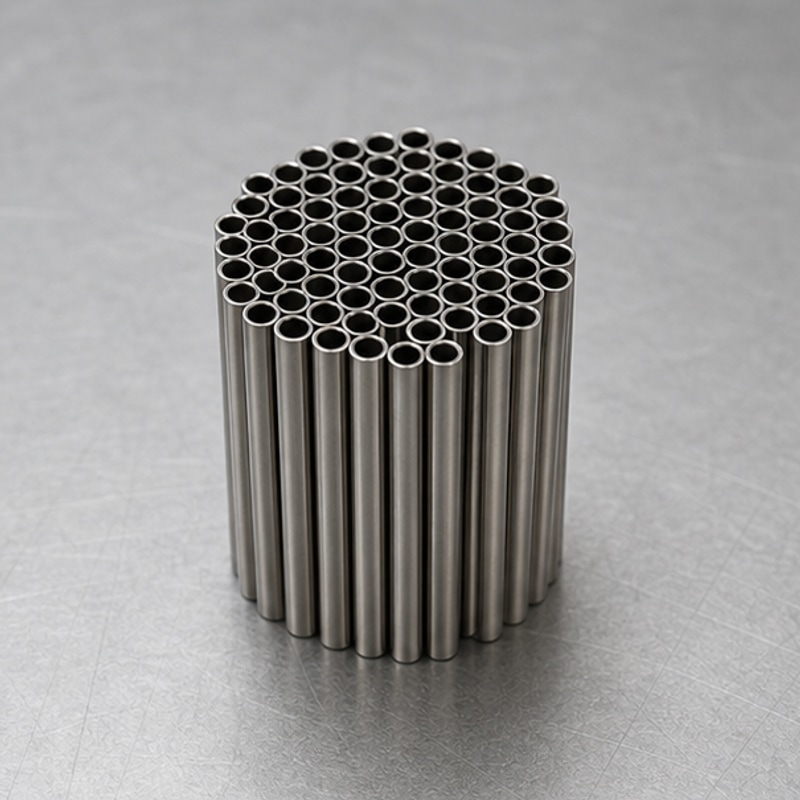
Inconel 600 vs. Stainless Steel Capillary Grades
Inconel 600 (UNS N06600, Werkstoff 2.4816) is a solid-solution strengthened Ni-Cr-Fe alloy with roughly 72% nickel, 14–17% chromium, and 6–10% iron. It is specified under ASTM B167 (seamless and welded tube) and covered by ASME SB-167 for pressure service. Because it is not a stainless steel, it should not be substituted against 304, 316L, 316Ti, or 321 on a like-for-like basis without engineering review.
Where standard stainless capillary grades are adequate — general laboratory flow control, ambient-temperature instrumentation, or mildly corrosive fluids — 304/304L and 316L remain the cost-effective choice. Inconel 600 becomes relevant when the application involves:
- Continuous service in oxidizing atmospheres at elevated temperature, where chromium oxide formation provides resistance to scaling
- Chloride-bearing environments where stress-corrosion cracking of 300-series austenitics is a concern
- Cyclic thermal loading where low thermal expansion and retained ductility are beneficial
- High-purity gas or process lines requiring resistance to dry chlorine, hydrogen chloride, or certain organic media
- Nuclear and furnace-adjacent instrumentation where the alloy’s heritage in those industries is already qualified
Note that Inconel 600 is not a molybdenum-bearing alloy. For severe reducing acids or high-chloride pitting service, grades such as C-276 or 625 are usually more appropriate. Material selection should always be confirmed against the actual media, temperature, and pressure.
Typical Capillary Dimensions and Wall Thickness
Capillary tubing is generally understood as small-diameter tube, commonly from about 0.5 mm up to roughly 6.35 mm (1/4 in) OD, with wall thickness typically between 0.05 mm and 1.0 mm. Exact availability depends on drawing, material condition, process route, and mutual agreement between parties.
| Parameter | Common Range | Notes |
|---|---|---|
| Outer diameter (OD) | ~0.5 mm to 6.35 mm | Larger OD possible on request |
| Inner diameter (ID) | Derived from OD minus 2× wall | ID tolerance usually tighter than OD |
| Wall thickness | ~0.05 mm to 1.0 mm | Thin walls require careful handling |
| Length | Cut-to-length or coil | Depends on drawing and handling limits |
Because Inconel 600 work-hardens rapidly, thin-wall capillary is often supplied in the annealed or bright-annealed condition to preserve formability for subsequent bending, flaring, or swaging. Buyers should state the required temper explicitly — half-hard, full-hard, or annealed — since mechanical properties and bend radius capability change accordingly.
Tolerances for Inconel 600 Capillary Tubing
Capillary tolerances are tighter than those for standard instrumentation tubing because the tube often functions as a metering element or fits into a precision connector. Typical commercial expectations, subject to drawing and agreement, are:
- OD tolerance: commonly ±0.025 mm to ±0.05 mm for small diameters; tighter on request
- Wall tolerance: typically ±10% of nominal wall, or a fixed ±0.02 mm to ±0.05 mm depending on size
- ID tolerance: often controlled indirectly via OD and wall, or specified separately when flow rate is critical
- Concentricity: wall eccentricity should be defined if the tube is used for flow or pressure integrity
- Straightness: specified as mm per metre or as a total indicator reading over a defined length
- Length tolerance: typically ±0.5 mm to ±1.0 mm on cut lengths, depending on saw or laser method
All values above are indicative. Final tolerance must be confirmed on the drawing and agreed between purchaser and supplier, because achievable limits depend on alloy temper, mandrel or plug drawing route, and inspection method.
End Condition and Burr Control
For capillary tubing, the end condition frequently determines whether the part assembles cleanly. Common end finishes include:
- Clean-cut square ends with deburred ID and OD
- Chamfered ends for connector insertion
- Bevelled ends for welding
- Sealed, plugged, or capped ends for shipping
Burr specification should be stated numerically — for example, maximum burr height or a requirement for burr-free ID — because ‘deburred’ alone is not measurable. Inconel 600 tends to produce a work-hardened burr that is difficult to remove without damaging the bore, so the cutting method (precision saw, laser, EDM, or abrasive) should be agreed in advance.
Surface Finish and Cleanliness
Inconel 600 capillary is typically supplied with a bright annealed, pickled, or mechanically polished surface. Surface roughness is commonly expressed as Ra, with fine capillary often specified in the 0.4 µm to 0.8 µm Ra range, though tighter finishes are achievable depending on process route. Cleanliness requirements vary widely:
- General industrial: mill finish, residual drawing lubricant removed
- Instrumentation and analytical: degreased, free of loose particles
- High-purity gas or semiconductor-adjacent: specified cleaning and packaging per customer procedure
Do not assume a supplier’s standard cleaning meets a regulated application. State the cleanliness specification, verification method, and any residue limits on the RFQ.
Inspection and Documentation
A defensible purchase of Inconel 600 capillary tubing should include, at minimum:
- Material test certificate (EN 10204 3.1 or equivalent) with heat number and chemical analysis
- Mechanical property report (tensile, yield, elongation) if required by drawing
- Dimensional inspection report covering OD, ID, wall, length, and straightness
- Surface finish report where Ra is specified
- Cleanliness or particle count report where applicable
- Traceability linking the tube to the heat and to the purchase order
Hydrostatic or pneumatic pressure testing, eddy current, or ultrasonic inspection may be specified for pressure-containing capillary. These should be requested explicitly; they are not implied by a material certificate alone.
Packaging Considerations
Thin-wall Inconel 600 capillary is easily kinked and its surface easily marred. Typical protective packaging includes:
- Rigid tubes or sleeves to prevent bending
- Individual end caps or plugs to protect bores and sealing surfaces
- VCI or desiccant protection where corrosion during transit is a risk
- Cleanroom-compatible bagging where cleanliness is specified
- Labelling with heat number, size, and quantity for traceability
Packaging requirements should be stated on the RFQ, particularly for long lengths or tight-tolerance bores.
RFQ Information Checklist
To receive an accurate quotation for Inconel 600 capillary tubing, include the following:
- Alloy and specification (e.g., Inconel 600, UNS N06600, ASTM B167)
- OD, ID, and wall thickness with tolerances
- Length and length tolerance, or coil requirement
- Temper/condition (annealed, half-hard, etc.)
- End condition and burr requirement
- Surface finish (Ra) and cleanliness specification
- Inspection and documentation requirements
- Packaging and labelling requirements
- Quantity and any scheduled delivery expectations
- Applicable drawing number and revision
To request a quotation for Inconel 600 stainless steel capillary tubing, submit your drawings, material grade, quantity, tolerance, surface finish, and inspection requirements through the Healsmed website. The engineering team will review and respond with a technical evaluation.

Healsmed
Leading Stainless Steel Capillary Tube Factory. 1,400+ standard sizes IN STOCK & ready to ship worldwide! High precision, factory-direct price.