347H Thin Wall Capillary Tube: Material Properties, Manufacturing Tolerances, and Application Guide
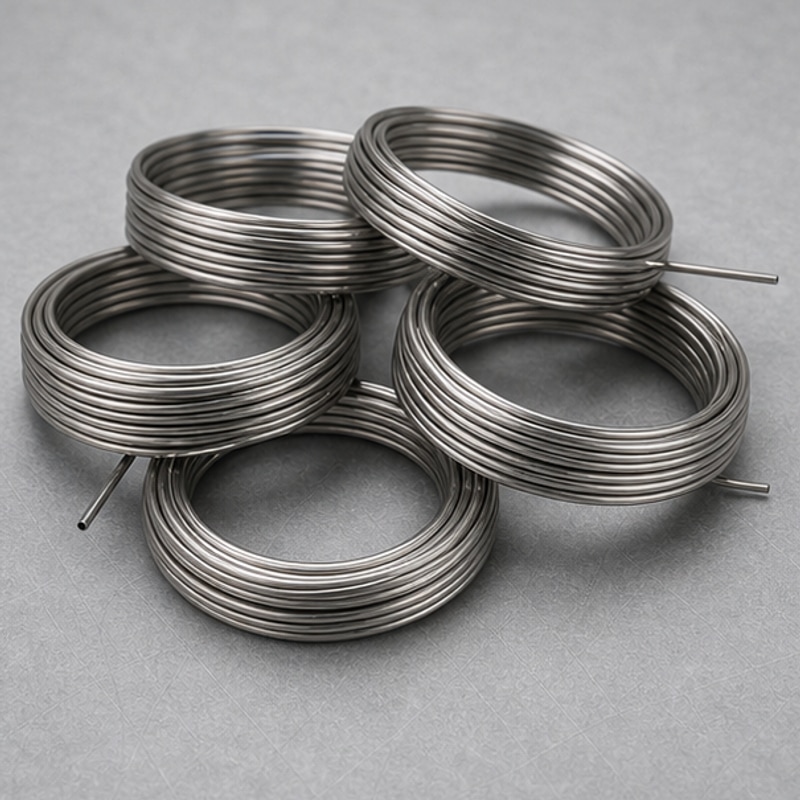
Selecting a 347H thin wall capillary tube requires a clear understanding of how stabilized austenitic chemistry, dimensional limits, and high-temperature service interact. For procurement engineers and sourcing specialists, this guide outlines the metallurgical rationale, achievable tolerances, and inspection criteria that matter when specifying small-diameter, thin-wall tubing for elevated-temperature or corrosive environments.
Metallurgical Basis of Grade 347H
Grade 347H is a niobium-stabilized austenitic stainless steel with a controlled carbon range of 0.04% to 0.10% (per ASTM A213/A213M). The “H” designation indicates higher carbon content relative to standard 347, which enhances creep strength and rupture life at temperatures above 538°C (1000°F). Niobium (columbium) is added at a minimum of 8× the carbon content, typically 0.32% to 1.00%, to prevent chromium carbide precipitation at grain boundaries.
Why Stabilization Matters in Thin Walls
In a thin wall capillary tube (wall thickness under 0.5 mm), the surface-to-volume ratio is high. Sensitization—the depletion of chromium near grain boundaries—can compromise corrosion resistance more rapidly than in heavier sections. The niobium stabilization in 347H ensures that carbon preferentially forms niobium carbides, leaving chromium in solid solution. This is critical for applications involving intermittent heating between 425°C and 815°C (797°F to 1499°F), where unstabilized grades like 304H or 316H would be susceptible to intergranular attack.
Manufacturing Tolerances for Thin Wall Capillary Tubes
Tolerances for 347H thin wall capillary tubes are not governed by a single universal standard. Instead, they follow ASTM A213/A213M for seamless tubes or ASTM A249/A249M for welded tubes, with supplementary requirements from the purchaser. For capillary dimensions, the following limits are commonly achievable, but exact values depend on drawing and mutual agreement.
- Outer diameter (OD): ±0.025 mm for OD under 3.0 mm; ±0.05 mm for OD 3.0–6.0 mm. Tighter control to ±0.013 mm is possible with centerless grinding, subject to quantity and drawing review.
- Wall thickness: ±10% of nominal wall for walls above 0.2 mm; for walls between 0.1 mm and 0.2 mm, ±0.02 mm is typical, but this depends on drawing and mutual agreement.
- Length: +1.0 mm / 0.0 mm for cut lengths under 1000 mm; longer lengths follow standard mill tolerances unless specified otherwise.
- Straightness: 1.0 mm per 1000 mm maximum, with tighter bow limits (0.5 mm/m) available for precision assemblies.
- Surface finish: Bright annealed (Ra ≤ 0.8 µm) or pickled (Ra ≤ 2.0 µm), as specified. For capillary applications, a smoother finish (Ra ≤ 0.4 µm) is achievable via electropolishing, but this is a secondary operation.
Seamless vs. Welded Construction
For 347H thin wall capillary tubes, seamless construction (ASTM A213) is preferred for high-pressure or cyclic thermal service because there is no weld seam to act as a failure initiation site. Welded and drawn tubes (ASTM A249) can be used for lower-pressure instrumentation lines, but the weld zone must be fully re-stabilized by post-weld annealing at 1065°C (1950°F) minimum, followed by rapid cooling. The presence of a weld seam reduces burst pressure by approximately 15–20% compared to seamless, so design engineers should account for this in their safety factors.
Mechanical and Physical Properties at Temperature
The value of 347H lies in its long-term creep resistance. At 650°C (1202°F), the allowable stress for 347H per ASME Boiler and Pressure Vessel Code Section II, Part D, is approximately 74 MPa (10.7 ksi) for seamless tube. This is roughly 20% higher than standard 347 at the same temperature. For thin wall capillary tubes, where the load-bearing cross-section is small, this difference is significant.
- Modulus of elasticity: 193 GPa at 20°C, decreasing to 152 GPa at 600°C.
- Thermal expansion coefficient: 16.6 × 10⁻⁶ /°C (20–100°C); 18.5 × 10⁻⁶ /°C (20–600°C).
- Thermal conductivity: 14.4 W/m·K at 20°C; 21.5 W/m·K at 500°C.
- Maximum continuous service temperature: approximately 815°C in oxidizing atmospheres, but this is reduced in sulfur-bearing or reducing environments.
Application Criteria and Selection Logic
High-Temperature Pressure Sensing
In aircraft engine nacelle probes or turbine exhaust gas temperature sensors, a 347H thin wall capillary tube transmits pneumatic pressure from a hot zone to a remote transducer. The thin wall (0.15–0.30 mm) minimizes thermal conduction along the tube, reducing measurement error. The stabilized chemistry prevents embrittlement after thousands of thermal cycles.
Chemical Injection and Sampling
For petrochemical processes where the medium contains chlorides or polythionic acids (e.g., hydrodesulfurization units), 347H offers better resistance to polythionic acid stress corrosion cracking than 321H, provided the material is in the annealed condition. A thin wall capillary tube is used for continuous sampling or reagent injection at elevated temperatures, where a larger bore would cause excessive dead volume.
Nuclear Instrumentation
In nuclear reactor coolant systems, 347H is specified for its resistance to neutron-induced swelling and its stable austenitic structure. Thin wall capillary tubes serve as guide tubes for neutron flux detectors. The requirement for tight OD tolerance and smooth internal bore is critical for the free movement of the detector. Here, the procurement specification must include ultrasonic testing for wall thickness uniformity, as eccentricity above 10% can affect detector response.
Inspection and Quality Assurance Considerations
When ordering 347H thin wall capillary tubes, define the following verification points in your purchase order:
- Chemical analysis: Per heat, with a mill certificate confirming carbon content between 0.04% and 0.10%, and niobium ≥ 8× carbon.
- Mechanical testing: Room-temperature tensile test per ASTM A370. Yield strength (0.2% offset) minimum 205 MPa, tensile strength minimum 515 MPa. For thin walls, flattening and flaring tests are often omitted due to dimensional constraints; this depends on drawing and mutual agreement.
- Hydrostatic or pneumatic test: Each tube is typically tested at a pressure calculated from the allowable stress. For capillary tubes with very thin walls, a pneumatic test under water (bubble test) may be substituted, but this must be agreed upon in advance.
- Non-destructive examination: Eddy current testing per ASTM E309 or ultrasonic testing per ASTM E213 is recommended for wall thickness and longitudinal defects, especially for tubes below 1.0 mm OD where visual inspection is impractical.
Procurement Specification Checklist
To avoid ambiguity, your drawing or specification should include the following fields:
- Grade: 347H (UNS S34709).
- Condition: Annealed (solution treated at 1065°C minimum, water quenched).
- OD and wall tolerance: state nominal values and whether you require positive/negative or symmetric tolerance.
- Surface finish: bright annealed or pickled; specify Ra value.
- End finish: square cut, deburred, or chamfered.
- Straightness requirement per 1000 mm.
- Quantity and cut length with tolerance.
- Required certificates: EN 10204 3.1, heat traceability, and NDT reports.
If any dimension falls outside the standard mill capabilities (e.g., wall thickness below 0.10 mm or OD below 0.5 mm), the manufacturing route may require multiple cold drawing passes with intermediate annealing. This increases lead time and cost, but it is feasible. The final tolerance for such extreme dimensions depends on drawing and mutual agreement.
Final Note on Handling and Installation
Thin wall capillary tubes are easily kinked or collapsed during bending. Use a mandrel for any bend radius less than 3× OD. For installation, avoid using pipe wrenches; use a backup wrench on the hex fitting only. The material work-hardens rapidly, so any deformation should be done in a single continuous motion. After installation, a low-pressure leak test with dry nitrogen is recommended before system startup.
For your next project, ensure that your specification includes the actual service temperature, pressure, and media composition. These three parameters determine the appropriate wall thickness and heat treatment. We do not provide generic recommendations; we evaluate each drawing against the intended operating envelope.
Submit your drawings for evaluation only. We will review the dimensional feasibility, suggest achievable tolerances, and confirm the manufacturing route—without obligation. Send your RFQ with a detailed drawing or a clear dimensioned sketch to our engineering team.

Healsmed
Leading Stainless Steel Capillary Tube Factory. 1,400+ standard sizes IN STOCK & ready to ship worldwide! High precision, factory-direct price.