347H SS Capillary Tubing: Material Properties, Manufacturing Tolerances, and Application Guide
For engineers and procurement specialists sourcing small-diameter tubing that must retain mechanical strength and oxidation resistance at elevated temperatures, 347H stainless steel capillary tubing offers a stabilized austenitic structure with enhanced creep resistance. This material is designed for applications where prolonged exposure to temperatures between 800°F and 1500°F (425°C–815°C) could cause sensitization in standard 304 or 316 grades. Understanding the material properties, manufacturing tolerances, and appropriate applications is critical for selecting the right capillary tube for your project.
Applicable Scenarios and Industries
347H capillary tubing is specified where the tube must resist intergranular corrosion and maintain strength during thermal cycling and continuous high-temperature service. Common industries include:
- Petrochemical and chemical processing – thermowells, sensing lines, catalyst injection tubes.
- Power generation – boiler instrumentation, superheater elements, thermocouple sheaths.
- Aerospace and defense – hydraulic and pneumatic control lines near engine exhausts.
- Pharmaceutical and specialty chemicals – process sampling lines requiring high-purity and corrosion resistance.
Material Grade Designations and Properties
347H corresponds to UNS S34709, covered under ASTM A213 (seamless ferritic and austenitic alloy-steel boiler, superheater, and heat-exchanger tubes) and ASTM A269 (seamless and welded austenitic stainless steel tubing for general service). The “H” designation indicates a higher carbon content (0.04–0.10%) compared to standard 347 (0.08% max), providing improved high-temperature strength and creep resistance.
Chemical Composition (%, per ASTM A213)
| Element | Range or Maximum |
|---|---|
| Carbon (C) | 0.04 – 0.10 |
| Manganese (Mn) | 2.00 max |
| Phosphorus (P) | 0.045 max |
| Sulfur (S) | 0.030 max |
| Silicon (Si) | 1.00 max |
| Chromium (Cr) | 17.00 – 19.00 |
| Nickel (Ni) | 9.00 – 13.00 |
| Columbium + Tantalum (Nb+Ta) | 10 × C min – 1.10 max |
Mechanical Properties (Annealed Condition)
| Property | Value |
|---|---|
| Tensile Strength, min | 75 ksi (515 MPa) |
| Yield Strength (0.2% offset), min | 30 ksi (205 MPa) |
| Elongation in 2 in. (50 mm), min | 30% |
Compared to 321H (Ti-stabilized), 347H offers better high-temperature carbide stabilization because niobium carbides are more stable than titanium carbides above 1600°F. It is also preferred when welding is involved, as it resists sensitization in the heat-affected zone.
OD / ID / Wall Thickness / Length Considerations
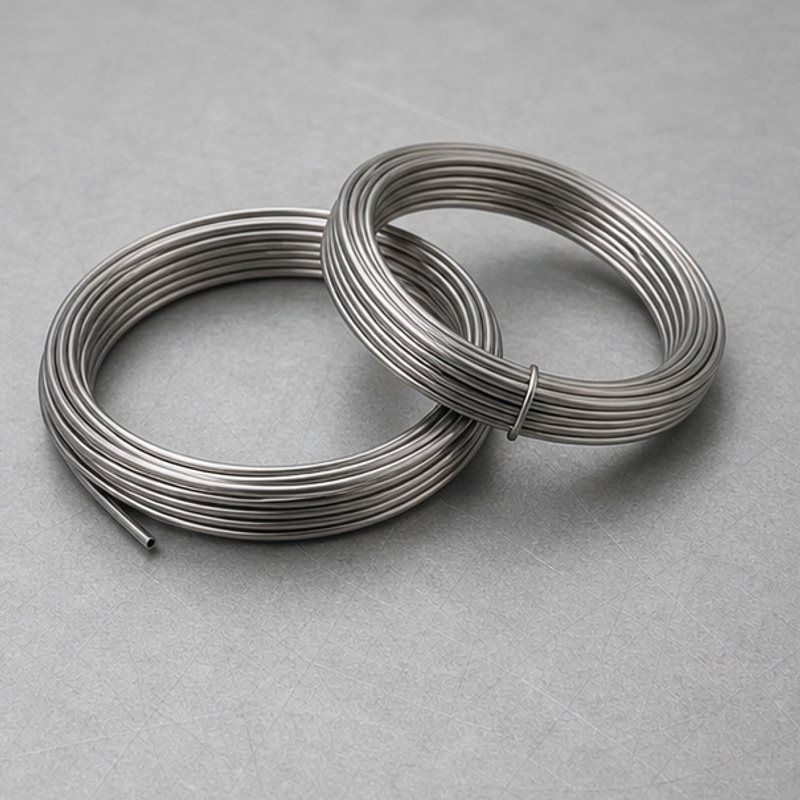
Capillary tubing is defined by small outer diameters, typically ranging from 0.020 in. (0.51 mm) to 0.125 in. (3.18 mm). Wall thicknesses commonly fall between 0.004 in. (0.10 mm) and 0.028 in. (0.71 mm), with corresponding inner diameters determined by the OD and wall. Typical lengths for capillary are supplied in straight pieces up to 20 ft (6.1 m) or coiled for larger quantities. For 347H, these dimensional ranges are available as standard, but custom sizes depend on the drawing, material condition, process route, and mutual agreement between parties.
Tolerances for Capillary Tube
Manufacturing tolerances for 347H capillary tubing are governed by ASTM A269 and A213, with additional customer-specified tight controls for precision applications.
- Outside Diameter (OD): ±0.003 in. (0.076 mm) for diameters under 0.125 in. Tighter tolerances (e.g., ±0.001 in.) are achievable with secondary processing and must be agreed upon.
- Inside Diameter (ID): ±0.002 in. (0.051 mm) typical, but can be held to ±0.001 in. for critical flow applications.
- Wall Thickness: ±10% of nominal thickness, or ±0.0015 in. (0.038 mm), whichever is tighter per mutual agreement.
- Length: ±1/8 in. (3.2 mm) for straight lengths under 10 ft; longer lengths by agreement.
End Condition and Burr Control
For capillary tubing used in sensor ports, connectors, or weld fittings, the cut ends must be square and free from significant burrs. Standard end finishing includes deburred (burr height < 0.003 in.), chamfered (45°), or polished ends. Burr control is critical to prevent obstruction of the small ID or contamination of the fluid system. Ends can be inspected using a profile projector or optical comparator.
Surface Finish and Cleanliness
Internal and external surface finishes depend on the application. A typical internal surface finish for 347H capillary is 32 Ra (0.8 μm) or better, achieved through annealing in a controlled atmosphere plus chemical or electropolishing. For high-purity or oxygen-service applications, cleanliness levels per ASTM G93 are specified. The tube is typically supplied free of oil, grease, and particulate; ultrasonic cleaning and double bagging can be arranged as per drawing requirements.
Inspection Documentation
Standard documentation for 347H capillary tubing includes:
- Material Test Report (MTR) certifying chemical analysis and mechanical properties per ASTM A213/A269.
- Dimensional inspection report listing OD, ID, wall at multiple points.
- Surface finish report if specified.
- Non-destructive testing (NDT) reports – eddy current or ultrasonic per ASTM E426, or hydrostatic testing per ASTM A269.
All documentation is traceable to the heat number and is available upon request.
Packaging Considerations
Capillary tubing is susceptible to bending and surface damage. Standard packaging consists of individual straight lengths bundled in foam-lined cardboard or wooden crates, or wound onto coils with internal diameter support. Each tube is separated with interleaving material to prevent scratching. For longer pieces, end caps and moisture barrier bags are applied. If orbital welding or press-fitting is intended, packaging must prevent any distortion of the ends.
RFQ Information Checklist
To ensure an accurate quotation and timely delivery of 347H SS capillary tubing, provide the following details:
- Material grade: 347H (UNS S34709) and applicable standard (ASTM A213 or A269).
- OD, ID, wall thickness, and length – include nominal and tolerances.
- Surface finish specification (Ra value or equivalent).
- End condition requirements (square, deburred, chamfered).
- Quantity (total length or number of pieces).
- Inspection and documentation requirements.
- Packaging method (straight lengths, coiled, moisture protection).
- Intended application (for internal guidance on process selection).
To request a quotation for 347H SS capillary tubing, submit your drawings, material grade, quantity, tolerance, surface finish, and inspection requirements through the Healsmed website. The engineering team will review and respond with a technical evaluation.

Healsmed
Leading Stainless Steel Capillary Tube Factory. 1,400+ standard sizes IN STOCK & ready to ship worldwide! High precision, factory-direct price.