316Ti Seamless Capillary Tube: Material Properties, Manufacturing Tolerances, and Application Guide
When an engineering specification calls for 316Ti seamless capillary tube, the buyer is typically seeking a balance of corrosion resistance, mechanical strength, and dimensional stability in small-diameter tubing. This stabilized austenitic stainless steel grade offers distinct advantages over standard 316L in applications where sensitization or intergranular corrosion is a concern during welding or high-temperature exposure. Understanding the material properties, manufacturing tolerances, and appropriate applications of 316Ti seamless capillary tube is essential for engineers specifying components for medical devices, analytical instruments, or industrial process equipment.
Chemical Composition and Mechanical Properties of 316Ti
316Ti (UNS S31635) is a titanium-stabilized version of 316 stainless steel. The addition of titanium (Ti) in a minimum ratio of 5 × (C + N) prevents chromium carbide precipitation at grain boundaries during welding or service in the 425–900°C range. The typical chemical composition limits for 316Ti seamless capillary tube are shown below.
| Element | Range (wt%) |
|---|---|
| Carbon | ≤ 0.08 |
| Manganese | ≤ 2.00 |
| Silicon | ≤ 1.00 |
| Phosphorus | ≤ 0.045 |
| Sulfur | ≤ 0.030 |
| Chromium | 16.0 – 18.0 |
| Nickel | 10.0 – 14.0 |
| Molybdenum | 2.00 – 3.00 |
| Titanium | 5 × (C + N) min – 0.70 |
Mechanical properties for 316Ti seamless capillary tube in the annealed condition typically meet the following values: tensile strength ≥ 515 MPa, yield strength (0.2% offset) ≥ 205 MPa, and elongation in 50 mm ≥ 40%. These values are comparable to 316L, but 316Ti retains better creep strength and resistance to intergranular corrosion at elevated temperatures up to about 800°C in continuous service.
Why Seamless Construction Matters for 316Ti Capillary Tubing
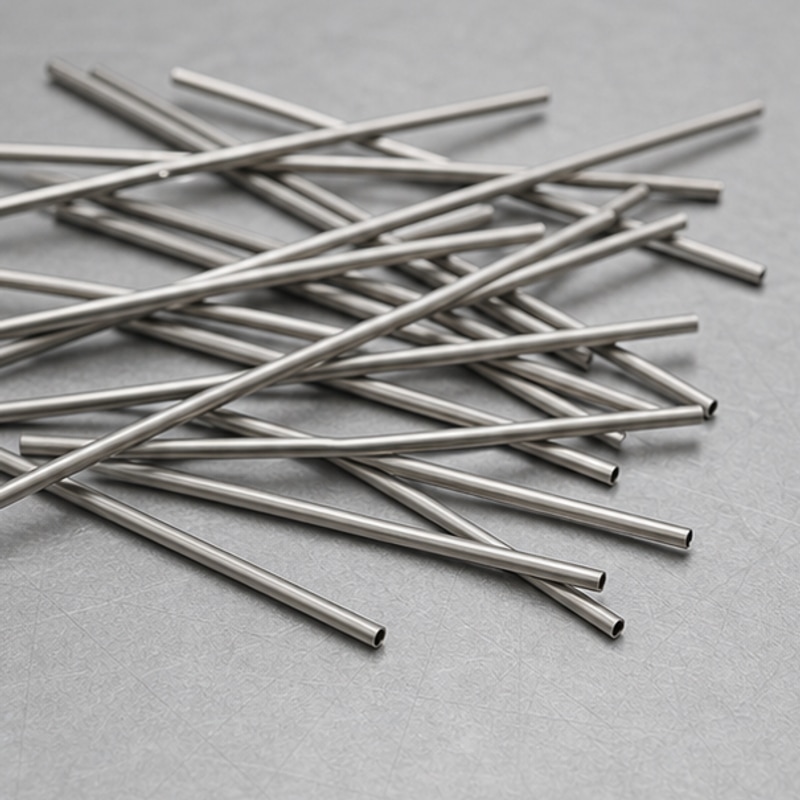
Seamless capillary tubing is produced by cold drawing a solid billet or hollow bar through a series of dies without any longitudinal weld seam. For 316Ti, seamless construction eliminates the weld zone that can become a preferential site for sensitization or reduced corrosion resistance in welded tubing. The uniform grain structure throughout the tube wall ensures consistent mechanical properties and pressure integrity. In applications such as high-pressure fluid delivery in analytical chromatography or medical gas lines, the absence of a weld seam reduces the risk of leakage under cyclic pressure or thermal stress. Seamless 316Ti capillary tube also exhibits better ovality and wall concentricity compared to welded and drawn tubing, which is critical for precise flow control.
Dimensional Specifications and Tolerance Classes
316Ti seamless capillary tube is typically available in outside diameters (OD) ranging from 0.5 mm to 12.7 mm, with wall thicknesses from 0.05 mm to 2.0 mm. Tolerances depend on the drawing process and final application. Standard commercial tolerances for cold-drawn capillary tubing are ±0.05 mm on OD for sizes under 6 mm, and ±0.10 mm for larger diameters. For precision applications such as medical catheters or microfluidic devices, tighter tolerances of ±0.025 mm on OD and ±0.03 mm on wall thickness are achievable through multiple cold drawing passes and intermediate annealing.
| OD Range (mm) | Standard OD Tolerance (mm) | Precision OD Tolerance (mm) |
|---|---|---|
| 0.5 – 3.0 | ±0.05 | ±0.025 |
| 3.1 – 6.0 | ±0.05 | ±0.025 |
| 6.1 – 12.7 | ±0.10 | ±0.05 |
Wall thickness tolerances are typically ±10% of nominal for standard grades, and ±5% for precision drawn tubing. Straightness is specified as 1 mm per 1000 mm length unless otherwise requested.
Corrosion Resistance and Service Temperature Limits
316Ti offers corrosion resistance similar to 316L in most aqueous environments, including organic acids, dilute sulfuric acid, and chloride-containing solutions up to moderate concentrations. The titanium stabilization provides superior resistance to intergranular corrosion after welding or exposure in the sensitization range (425–900°C). In pitting corrosion tests per ASTM G48, 316Ti typically shows critical pitting temperatures (CPT) around 20–25°C in 6% FeCl3 solution, which is slightly lower than 316L due to the titanium addition. Maximum service temperature in continuous service is approximately 800°C, while intermittent service can reach 870°C. Above these temperatures, scaling and loss of mechanical strength become limiting factors.
Industry-Specific Applications for 316Ti Seamless Capillary Tube
In medical device manufacturing, 316Ti seamless capillary tube is used for guidewire shafts, biopsy needles, and endoscopic instruments where the combination of corrosion resistance, strength, and biocompatibility is required. For analytical instrumentation, the tubing serves as sample loops, transfer lines, and reactor coils in gas chromatography and high-performance liquid chromatography (HPLC) systems operating at pressures up to 600 bar. Industrial applications include thermowell sheaths, pressure sensor ports, and fluidic connectors in chemical processing and oil & gas equipment where resistance to intergranular corrosion after welding is critical.
Quality Control and Inspection Protocol
Standard inspection for 316Ti seamless capillary tube includes dimensional verification using laser micrometers and air gauges, surface finish assessment via visual inspection and profilometry (typical Ra 0.4–0.8 µm for medical grade), and pressure testing per ASTM A1016 or customer-specified hydrostatic or pneumatic tests. For critical applications, eddy current testing or ultrasonic testing can be performed to detect subsurface defects. Chemical composition is verified by optical emission spectrometry (OES) or combustion analysis. Each production lot should be accompanied by a material test certificate (EN 10204 3.1 or 3.2) confirming grade, heat number, mechanical properties, and dimensional results.
Procurement Checklist for 316Ti Seamless Capillary Tube
When sourcing 316Ti seamless capillary tube, engineers should specify the following: material grade (UNS S31635), condition (annealed), OD and wall dimensions with tolerance class, length or coil format, surface finish requirement (e.g., bright annealed, pickled, or polished), and any additional testing or certification requirements. It is also advisable to confirm the titanium-to-carbon ratio, as some suppliers may under-stabilize the material. For welded assemblies, request that the tubing be supplied in the stabilized annealed condition to ensure optimum corrosion resistance.
For more information about 316Ti seamless capillary tube, contact Healsmed’s engineering team with your material grade, drawing, tolerance requirements, and quantity. Submit inquiries through the Healsmed website for prompt technical review and quotation.
Conclusion
316Ti seamless capillary tube provides a reliable material solution for applications requiring resistance to intergranular corrosion after welding or high-temperature exposure. The seamless manufacturing route ensures uniform grain structure, consistent mechanical properties, and superior pressure integrity compared to welded alternatives. With dimensional tolerances as tight as ±0.025 mm on OD, this tubing meets the demanding requirements of medical devices, analytical instruments, and industrial process equipment.
When selecting 316Ti for capillary applications, engineers should verify the titanium stabilization ratio, specify appropriate tolerance classes, and confirm that inspection protocols align with the intended service conditions. As with any precision component, clear communication of requirements during procurement reduces the risk of material mismatch and ensures reliable performance in the final assembly.

Healsmed
Leading Stainless Steel Capillary Tube Factory. 1,400+ standard sizes IN STOCK & ready to ship worldwide! High precision, factory-direct price.