316Ti SS Capillary Tubing: Material Properties, Manufacturing Tolerances, and Application Guide
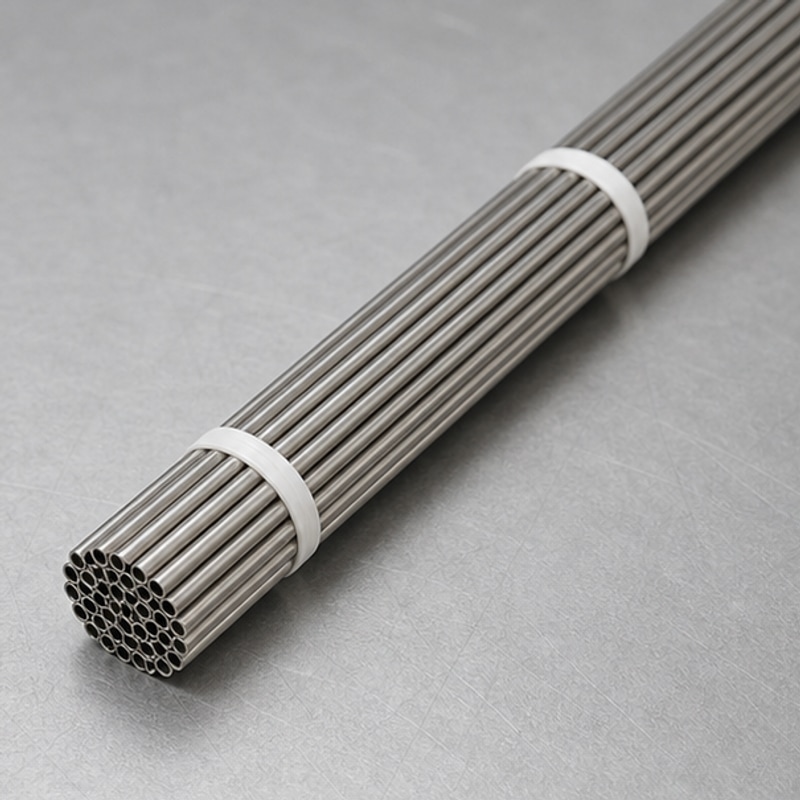
316Ti SS capillary tubing is a stabilized austenitic stainless steel grade specified for applications requiring enhanced resistance to intergranular corrosion at elevated temperatures. Unlike standard 316 or 316L, 316Ti contains a titanium addition (typically 5×%C minimum) that prevents chromium carbide precipitation during welding or service between 425°C and 815°C. This article provides engineers and procurement professionals with a technical overview of 316Ti capillary tubing—covering its material properties, manufacturing tolerances, corrosion behavior, and practical application considerations for medical devices, analytical instrumentation, and industrial OEM systems.
Chemical Composition and Mechanical Properties of 316Ti
The titanium stabilization in 316Ti SS capillary tubing distinguishes it from non-stabilized grades. Typical composition ranges per ASTM A269/A213 are as follows:
| Element | 316Ti (wt%) | 316L (wt%) for reference |
|---|---|---|
| Carbon | ≤ 0.08 | ≤ 0.03 |
| Chromium | 16.0 – 18.0 | 16.0 – 18.0 |
| Nickel | 10.0 – 14.0 | 10.0 – 14.0 |
| Molybdenum | 2.0 – 3.0 | 2.0 – 3.0 |
| Titanium | 5×%C min – 0.70 | — |
| Iron | Balance | Balance |
Mechanical properties for annealed 316Ti capillary tubing (per ASTM A269): Tensile strength ≥ 515 MPa (75 ksi), yield strength (0.2% offset) ≥ 205 MPa (30 ksi), elongation in 50 mm ≥ 35%. The titanium addition does not significantly alter room-temperature strength relative to 316L, but it preserves ductility and corrosion resistance after sensitization heat treatments. Maximum continuous service temperature is approximately 870°C in non-cyclic conditions, though creep strength becomes a limiting factor above 540°C for thin-wall capillary sections.
Manufacturing Process: Cold Drawing, Annealing, Straightening, and Cutting
Capillary tubing production for 316Ti follows a multi-stage cold drawing process. Starting from annealed and pickled hollows, the tube is drawn through carbide or diamond dies with a mandrel to reduce OD and wall thickness incrementally. Each pass typically achieves 10–20% area reduction. Between drawing passes, the tube undergoes solution annealing at 1020°C–1120°C followed by rapid quenching to maintain the austenitic structure and dissolve any carbides. The titanium addition ensures that during subsequent welding or elevated-temperature service, carbon preferentially forms TiC rather than Cr23C6 at grain boundaries.
After final drawing, straightening is performed using a rotary straightener or multi-roll straightener to achieve the required camber tolerance (typically ≤ 1 mm per meter). Cutting to length is done via abrasive saw, laser, or shear cutting depending on OD and wall thickness. For capillary dimensions below 1.0 mm OD, laser cutting is preferred to minimize burr and end deformation.
Seamless vs Welded 316Ti Capillary Tubing: Selection Criteria
Both seamless and welded manufacturing routes are available for 316Ti SS capillary tubing. Seamless tubing is produced from a solid billet via extrusion or rotary piercing, followed by cold drawing. Welded tubing starts from strip that is roll-formed and longitudinally welded (TIG or plasma) before drawing. For capillary applications where OD is below 6.35 mm (1/4 inch), seamless is more common because weld seam integrity becomes difficult to maintain at thin walls. Welded-and-drawn tubing can be acceptable for larger capillary sizes (OD ≥ 6.35 mm) provided the weld zone is fully recrystallized during annealing and non-destructive examination (eddy current or hydrostatic) is performed. The primary trade-off: seamless offers no weld seam and better pressure integrity for high-cycle or corrosive service; welded offers lower raw material cost but requires tighter process control to avoid preferential corrosion at the weld zone. For most medical and analytical applications, seamless 316Ti capillary tubing is specified.
Dimensional Specifications and Tolerance Classes
316Ti SS capillary tubing is available in the following typical dimensional range:
- Outer Diameter (OD): 0.5 mm to 12.7 mm
- Wall Thickness: 0.05 mm to 2.0 mm
- Length: Custom cut lengths from 10 mm to 6000 mm
Tolerance expectations depend on the drawing schedule and final annealing condition. Standard commercial tolerances are ±0.05 mm on OD for sizes above 3.0 mm, and ±0.025 mm for precision-drawn capillary below 3.0 mm OD. Wall thickness tolerance is typically ±10% of nominal. For applications requiring tighter control (e.g., HPLC columns or gas chromatography), special tolerance classes can be specified: ±0.0125 mm on OD and ±5% on wall. Ovality is held to 80% of OD tolerance. Straightness: 1 mm per meter for standard, 0.5 mm per meter for precision.
| OD Range | Standard Tolerance | Precision Tolerance |
|---|---|---|
| 0.5 – 3.0 mm | ±0.025 mm | ±0.012 mm |
| 3.1 – 6.35 mm | ±0.05 mm | ±0.025 mm |
| 6.36 – 12.7 mm | ±0.05 mm | ±0.038 mm |
Corrosion Resistance and Stabilization Effect
The primary advantage of 316Ti over 316 or 316L in capillary tubing is its resistance to intergranular corrosion after welding or exposure to the sensitization temperature range (425°C–815°C). In standard 316, carbon diffuses to grain boundaries and forms chromium carbides, depleting adjacent chromium and creating a path for corrosive attack. 316Ti’s titanium addition forms stable titanium carbides, leaving chromium in solid solution. This makes 316Ti suitable for applications involving repeated sterilization (autoclaving at 121°C–134°C) or intermittent high-temperature process streams. In chloride-containing environments (e.g., saline, bleach, or seawater), 316Ti offers pitting resistance equivalent to 316L—PREN (Pitting Resistance Equivalent Number) is approximately 24–26. It is not recommended for highly reducing acids (e.g., hydrochloric acid) or environments with >1000 ppm chlorides at elevated temperatures without careful testing.
Industry-Specific Applications for 316Ti Capillary Tubing
Medical device applications include fluidic pathways in surgical instruments, biopsy needles, and drug delivery catheters where autoclave sterilization cycles are required. The stabilization prevents sensitization during repeated steam exposure. In analytical instrumentation, 316Ti capillary tubing is used in gas chromatography columns, liquid chromatography transfer lines, and sample injection loops where thermal cycling (e.g., column oven heating to 300°C–400°C) occurs. Industrial OEM applications include thermowell sheaths, sensor probes, and hydraulic control lines in chemical processing or pharmaceutical manufacturing where intermittent process temperatures exceed 400°C. The titanium addition also provides better creep resistance than 316L at temperatures above 500°C, though for continuous service above 540°C, higher-alloy grades (e.g., 321 or 347) are often preferred.
Quality Control and Inspection Protocol
Procurement of 316Ti SS capillary tubing should specify inspection requirements aligned with ASTM A269 (general seamless/welded tubing) or ASTM A213 (seamless boiler/superheater tubing). Key QC steps include: chemical composition verification via OES or combustion analysis, mechanical testing (tensile and flattening), dimensional inspection using laser micrometers and pin gauges, and surface finish assessment (typically 0.8 μm Ra or better for medical capillary). Non-destructive examination options: eddy current testing for surface and near-surface defects, hydrostatic testing for pressure integrity, and helium leak testing for ultra-high-purity applications. For critical medical devices, 100% dimensional inspection with statistical process control documentation is often required.
Common Specification Mistakes to Avoid
Three frequent errors occur when specifying 316Ti capillary tubing. First, assuming 316Ti is interchangeable with 316L for all applications—while both resist sensitization, 316Ti achieves it via stabilization, whereas 316L relies on low carbon content. In heavy-section welds or prolonged thermal exposure, 316L can still sensitize; 316Ti is more robust. Second, failing to specify the titanium-to-carbon ratio—ASTM requires 5×%C minimum, but some end users require 7×%C for added margin. Third, neglecting to define the annealing condition: 316Ti must be solution annealed (not stress-relieved only) to ensure carbide dissolution and uniform stabilization. Always state the governing standard (ASTM A269 or A213) and any supplementary requirements (e.g., NACE MR0175 for sour service).
For more information about 316Ti SS capillary tubing, contact Healsmed’s engineering team with your material grade, drawing, tolerance requirements, and quantity. Submit inquiries through the Healsmed website for prompt technical review and quotation.
Conclusion
316Ti SS capillary tubing offers a distinct advantage for applications where thermal exposure during fabrication or service could otherwise compromise corrosion resistance. Its titanium stabilization prevents intergranular attack while maintaining the mechanical and fabricability characteristics of the 316 family. Engineers specifying capillary tubing for medical sterilization cycles, analytical instrument thermal cycling, or industrial process lines should consider 316Ti when service temperatures cross the sensitization range or when repeated welding is required.
From a procurement perspective, clear specification of dimensional tolerances, annealing condition, and inspection protocol is essential to ensure the tubing meets application demands. Healsmed supplies 316Ti capillary tubing in seamless and welded configurations, with precision tolerances down to ±0.012 mm on OD, supporting OEM requirements across medical, analytical, and industrial sectors.

Healsmed
Leading Stainless Steel Capillary Tube Factory. 1,400+ standard sizes IN STOCK & ready to ship worldwide! High precision, factory-direct price.