347 Stainless Steel Capillary Tubing: Material Properties, Manufacturing Tolerances, and Application Guide
When designing or sourcing capillary tubing for applications involving elevated temperatures, cyclic thermal exposure, or post-weld service in corrosive environments, standard austenitic grades like 304 or 316L may not provide sufficient resistance to intergranular corrosion. This is where 347 stainless steel capillary tubing becomes the engineering solution. Stabilized with niobium (columbium), grade 347 maintains corrosion resistance in the heat-affected zone after welding and performs reliably in continuous service up to 800°C (1472°F). This article covers the material properties, manufacturing tolerances, and application considerations to help medical device engineers and procurement teams evaluate 347 capillary tubing for their specific requirements.
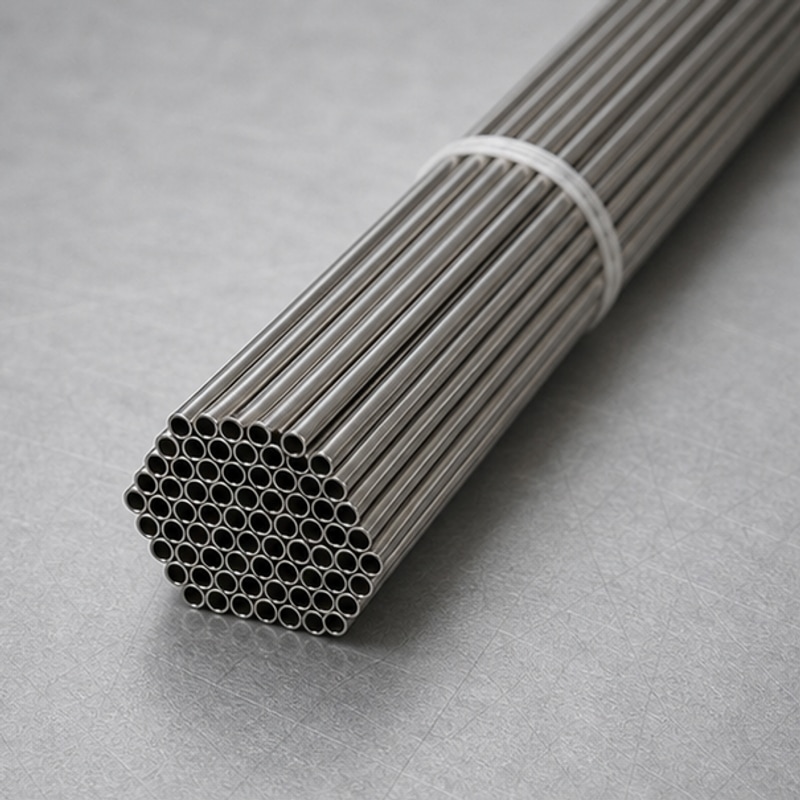
Applicable Scenarios and Industries
347 stainless steel capillary tubing is selected in environments where sensitization and intergranular corrosion are risks—typically above 427°C (800°F) or where welding is part of the fabrication process. Common applications include:
- Heat exchangers and thermocouple sheaths in chemical processing
- Instrumentation lines in oil and gas downstream equipment
- Exhaust gas sampling systems in power generation
- Medical device components that undergo post-assembly brazing or welding
- Aerospace fuel and hydraulic capillary lines requiring oxidation resistance
While 347 is not typically used in implantable or long-term body-contact devices, its high-temperature stability makes it a candidate for surgical instrument components or sterilization equipment that must resist repeated thermal cycling.
Material Grades and Designations
347 is a niobium-stabilized austenitic stainless steel. The table below compares it with other grades relevant to capillary tubing selection.
| Grade | Stabilizer | Key Attribute | Typical Use in Capillary |
|---|---|---|---|
| 304 | None | General corrosion resistance | Low-temperature, non-welded |
| 316L | None (low carbon) | Resistance to chlorides | Medical fluids, moderate temp |
| 316Ti | Titanium | Stabilized, similar to 347 | Welded assemblies, moderate temp |
| 321 | Titanium | Stabilized, up to 816°C | Aerospace exhaust, heater tubes |
| 347 | Niobium | Stabilized, better creep strength | High-temp welding, cyclic service |
Chemical composition of 347 per ASTM A213/A269 (weight %):
- Carbon: 0.08 max
- Manganese: 2.00 max
- Phosphorus: 0.045 max
- Sulfur: 0.030 max
- Silicon: 0.75 max
- Chromium: 17.0 – 19.0
- Nickel: 9.0 – 13.0
- Niobium + Tantalum: 10 × C min to 1.00 max
OD / ID / Wall Thickness / Length Considerations
Capillary tubing is defined by small outside diameters (typically 0.250 in / 6.35 mm and below) with proportional wall thicknesses. For 347 capillary, standard dimensions follow ASTM A269 or customer-specific drawings.
- Outside Diameter (OD): Common ranges 0.020 in – 0.250 in (0.51 mm – 6.35 mm). Exact availability depends on manufacturing route.
- Wall Thickness: Typically 0.004 in – 0.049 in (0.10 mm – 1.24 mm). Thin walls require careful control of ovality and concentricity.
- Inner Diameter (ID): Calculated as OD minus 2 × wall thickness. ID tolerance is critical for fluid flow and pressure drop calculations.
- Length: Cut lengths from 1 in (25 mm) to continuous coils of several hundred feet, depending on drawing and processing capabilities.
Tolerances
Tolerance specification for 347 capillary tubing depends on the governing standard and the degree of precision required. Typical industry expectations include:
| Parameter | Common Range | Notes |
|---|---|---|
| OD tolerance | ±0.001 in to ±0.005 in (±0.025 mm to ±0.127 mm) | Tighter tolerances require custom drawing or grinding |
| Wall thickness tolerance | ±10% of nominal (per ASTM A213) or tighter per agreement | Thin walls <0.010 in may require ±0.001 in |
| Ovality (out-of-round) | Depends on drawing, material condition, process route, and mutual agreement between parties | Critical for precision capillary applications |
| Length tolerance | ±0.020 in (0.5 mm) for cut lengths; ±1% for coils | As-specified on purchase order |
Note that exact tolerances must be defined in the drawing or specification; standard mill tolerances may not satisfy precision medical device requirements.
End Condition and Burr Control
Capillary tubing ends often require deburring to prevent flow obstruction, particulate generation, or damage to seals. Common end conditions include:
- Square cut with burrs removed – meets a maximum burr height (e.g., 0.003 in or 0.076 mm) as specified.
- Chamfered ends – typically 0.005–0.010 in chamfer at 45°.
- Custom end forms – flared, swaged, or reduced ends for connector attachment.
Burr control is verified by visual inspection or profilometry. For medical applications, particulate cleanliness may require additional passivation or ultrasonic cleaning.
Surface Finish and Cleanliness Requirements
Surface finish influences corrosion resistance, fluid flow, and biocompatibility in medical device assemblies. Common specifications for 347 capillary tubing:
- Bright annealed (BA) – smooth surface, typical Ra < 0.5 μm (20 μin).
- Pickled or chemically cleaned – removes oxidation scale, moderate finish.
- Mechanically polished – for improved cleanability and aesthetics, Ra < 0.25 μm (10 μin).
Cleanliness standards may require oil-free, residue-free surfaces, verified by water-break test or solvent wipe. For oxygen service or medical gas lines, degreasing and packaging in clean-room bags are specified.
Inspection Documentation
Standard inspection documentation for 347 capillary tubing includes:
- Material test certificate (MTC) per EN 10204, ASTM A1016, or equivalent, showing heat number, chemical analysis, and mechanical properties.
- Dimensional inspection report – OD, ID, wall thickness, length, and ovality measurements.
- Surface finish report (if requested) – Ra readings and method used.
- Burst or hydrostatic test report – applicable for pressure-rated tubing.
Certificates must be traceable to the specific heat and manufacturing lot. Third-party inspection (e.g., by SGS, TÜV) can be arranged as per customer requirements.
Packaging Considerations
Packaging for 347 capillary tubing must prevent damage, contamination, and corrosion during transit. Typical approaches:
- Individual poly bags or shrink wrap for cut lengths.
- Coils secured on spools or in wooden reels with anti-corrosion paper.
- Foam-lined boxes for delicate thin-wall or close-tolerance pieces.
- Clean-room packaging (double bagging, desiccant) if specified.
Packaging method and material should be agreed upon in the purchase order to avoid disputes over surface damage or cleanliness.
RFQ Information Checklist
To ensure accurate quotation and delivery of 347 stainless steel capillary tubing, include the following in your request for quotation (RFQ):
- Material specification (ASTM A269, A213, or customer drawing)
- Grade: 347 (UNS S34700)
- OD, wall thickness (or ID), and length(s) with tolerances
- End condition requirements (square, deburred, chamfered)
- Surface finish and cleanliness level
- Quantity (total length or piece count)
- Inspection documentation required (MTC, dimensional report, etc.)
- Packaging and delivery requirements
- Any special testing (e.g., pressure test, corrosion test)
To request a quotation for 347 stainless steel capillary tubing, submit your drawings, material grade, quantity, tolerance, surface finish, and inspection requirements through the Healsmed website. The engineering team will review and respond with a technical evaluation.

Healsmed
Leading Stainless Steel Capillary Tube Factory. 1,400+ standard sizes IN STOCK & ready to ship worldwide! High precision, factory-direct price.