347 Stainless Steel Capillary Tube: Material Properties, Manufacturing Tolerances, and Application Guide
When specifying a capillary tube for high-temperature service or environments prone to intergranular corrosion, standard austenitic grades like 304 or 316L may not provide the long-term stability your process demands. Engineers sourcing small-diameter tubing for exhaust gas sensors, thermowells, chemical injection lines, or aerospace fluid systems often require a stabilized grade that resists sensitization during welding or sustained exposure at 800–1500°F. The 347 stainless steel capillary tube, stabilized with niobium (columbium), meets this requirement by preventing chromium carbide precipitation at grain boundaries. This article examines the material properties, manufacturing tolerances, and application considerations for 347 capillary tubing to help you evaluate its suitability for your design.
Applicable Scenarios and Industries
347 capillary tube is primarily specified where the assembly:
- Will be welded and cannot undergo post-weld heat treatment.
- Operates in the sensitization temperature range of 800–1500°F.
- Requires oxidation resistance up to 1650°F (intermittent) or 1500°F (continuous).
- Is exposed to mildly corrosive media where niobium stabilization is preferred over titanium (321) due to welding characteristics.
Common industries include:
- Power generation – combustion gas sampling probes, boiler instrumentation.
- Chemical processing – catalyst injection, high-temperature sampling.
- Aerospace – bleed air sensing, hydraulic control lines near hot zones.
- Analytical instrumentation – gas chromatograph columns, thermal conductivity detectors.
Material Grades and Designations
347 stainless steel is an austenitic grade stabilized with niobium (Nb) plus tantalum (Ta). It is chemically similar to 321 (stabilized with titanium) but offers better creep strength above 1000°F and easier weldability because niobium does not volatilize during arc welding.
Common designations for 347 tubing:
| Standard | Designation |
|---|---|
| ASTM A213 | TP347 (seamless) |
| ASTM A269 | 347 (seamless and welded) |
| ASTM A249 | 347 (welded) |
| UNS | S34700 |
| EN | 1.4550 (X6CrNiNb18-10) |
For capillary tubing, the exact standard depends on the manufacturing method and final use. ASTM A269 is commonly referenced for small-diameter, thin-wall tubing. If the tube is produced from cold-drawn seamless hollows, ASTM A213 applies.
Comparison with Other Austenitic Grades
Engineers often evaluate 347 against 304, 316L, 316Ti, and 321 for capillary applications. Key differences:
- 304/304L – suitable for general corrosion resistance up to 800°F; not stabilized.
- 316L – improved pitting resistance from molybdenum; low carbon reduces sensitization but does not eliminate it in heavy sections.
- 321 – stabilized with titanium; good for intermittent service to 1600°F, but titanium can be lost during welding in air.
- 347 – niobium is retained in the weld; better high-temperature strength and resistance to polythionic acid stress corrosion cracking in refinery service.
OD / ID / Wall Thickness / Length Considerations
Capillary tubes are typically defined by outside diameter (OD) and wall thickness. 347 stainless steel capillary tubing is available in OD ranges from approximately 0.020 in. to 0.500 in. (0.50 mm to 12.7 mm) with wall thicknesses as light as 0.004 in. (0.10 mm). The exact limits depend on the manufacturer’s drawing capability, material condition, and heat treatment.
Common supply forms include:
- Straight lengths – 1 ft to 20 ft (0.3 m to 6 m).
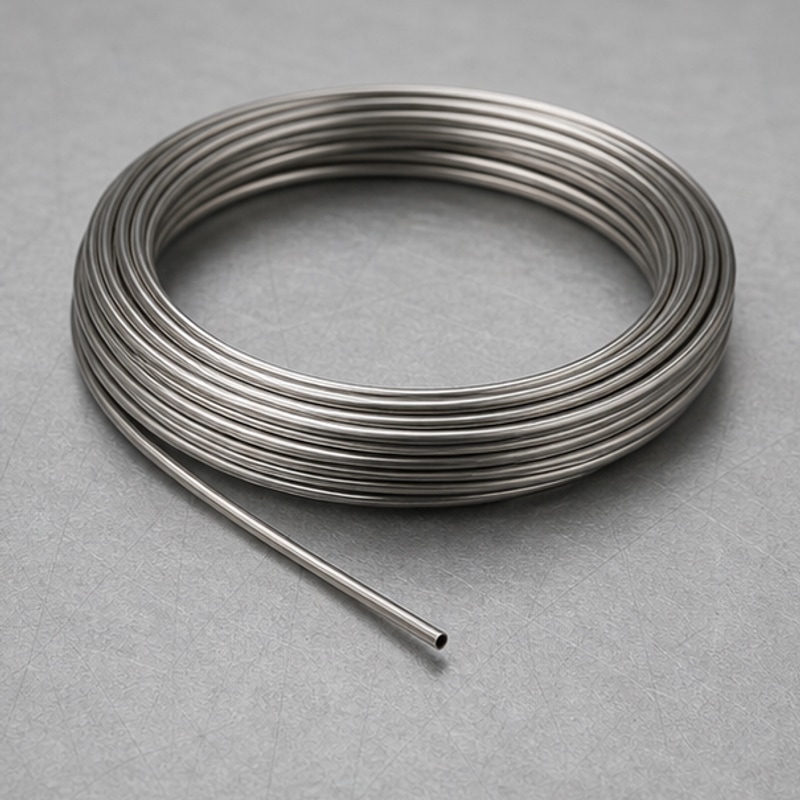
- Coiled lengths – up to several hundred feet for small ODs, subject to coil diameter and handling constraints.
The inner diameter (ID) is a function of OD and wall. For precision metering or chromatography, customers often specify an ID tolerance tighter than ±0.001 in. (±0.025 mm). This is achievable on drawn capillary but must be requested explicitly.
Tolerances
Manufacturing tolerances for 347 capillary tube follow general industry guidelines, with tighter limits possible through secondary drawing operations.
| Parameter | Typical Tolerance (ASTM A269 / customary practice) |
|---|---|
| Outside Diameter | ±0.003 in. for OD < 0.125 in.; ±0.005 in. for OD 0.125–0.500 in. |
| Wall Thickness | ±10% of nominal wall (minimum 0.001 in.) |
| Straightness | 0.030 in./ft for straight lengths; coiled lengths unrestrained |
| Length | +0.125 in. / –0.000 in. for cut lengths, or as agreed |
For capillary tubing requiring tighter control (e.g., ±0.0005 in. on OD), these tolerances are negotiable and depend on the final drawing pass, material condition, and mutual agreement between parties. The same applies to ovality and eccentricity.
End Condition and Burr Control
Capillary tube ends are often critical for fluid connections or welding. Standard end finishes include:
- Cut-off – square cut with minimal burr (deburred on request).
- Deburred – inside and outside edges chamfered to a maximum specified radius (e.g., 0.005 in. max).
- Swaged / reduced – for interference-fit joints, typically done on a per-drawing basis.
Burr control is especially important in medical device and analytical applications where loose particles can contaminate the fluid path. The acceptable burr size depends on the application and should be agreed upon during quotation.
Surface Finish and Cleanliness
347 capillary tubes are typically supplied with a bright annealed surface finish after final cold drawing. Alternative finishes include:
- Pickled – matte surface, oxide removed.
- Electropolished – smooth, passive surface; often specified for cleanliness-critical systems.
- Mechanically polished – available on request.
Cleanliness levels can be specified to a target (e.g., particulate count, hydrocarbon residue). Standard cleaning methods include ultrasonic or solvent wash followed by nitrogen blow-down. If cleanliness certification is required, the acceptance criteria should be stated at the quoting stage.
Inspection Documentation
Standard documentation for 347 capillary tubing includes:
- Material test report (MTR) – per ASTM A213 or A269, showing heat analysis and mechanical properties.
- Dimensional inspection report – OD, ID, wall, length, and straightness readings at defined sampling intervals.
- Surface finish verification – if applicable, Ra or other roughness measurements.
- Certificate of conformance (CoC) – confirming compliance with the applicable standard and customer specifications.
Additional testing (e.g., hydrostatic, eddy current, dye penetrant, burst pressure) can be requested but requires prior agreement on acceptance limits and additional costs.
Packaging Considerations
Packaging for 347 capillary tubes is selected to prevent surface damage and maintain cleanliness during shipping. Options include:
- Plastic sleeves for individual straight lengths.
- Bundled and banded with interleaving material.
- Coils on spools or in boxes for long lengths.
- Sealed bags with desiccant for moisture-sensitive applications.
The packaging method should be specified in the RFQ, especially if the tubes will be used in a cleanroom environment.
RFQ Information Checklist
To ensure accurate pricing and lead-time for 347 stainless steel capillary tube, include the following in your inquiry:
- Drawing or specification detailing dimension, tolerance, and end condition.
- Material grade (347) and applicable standard (ASTM A213, A269, etc.).
- Quantity (number of pieces or total length).
- Required tolerances (OD, wall, ID if critical, length, straightness).
- Surface finish and cleanliness requirements.
- Inspection documentation requirements (MTR, dimensional report, etc.).
- Packaging and labeling instructions.
To request a quotation for 347 stainless steel capillary tube, submit your drawings, material grade, quantity, tolerance, surface finish, and inspection requirements through the Healsmed website. The engineering team will review and respond with a technical evaluation.

Healsmed
Leading Stainless Steel Capillary Tube Factory. 1,400+ standard sizes IN STOCK & ready to ship worldwide! High precision, factory-direct price.