321H Miniature Tubing: Material Properties, Manufacturing Tolerances, and Application Guide
When designing or sourcing miniature tubing for high-temperature medical devices, chemical sensing probes, or exhaust gas sampling systems, the material choice directly impacts service life and reliability. Standard 304 or 316L may suffer from carbide precipitation or reduced creep strength above 500 °C. The engineering challenge is to find a stainless steel that retains oxidation resistance, resists sensitization, and offers improved creep and stress-rupture performance at elevated temperatures—all in a capillary or small-diameter form. This is exactly the problem 321H miniature tubing solves: a higher-carbon variant of Type 321 stabilized with titanium, delivering enhanced high-temperature mechanical properties while maintaining corrosion resistance for demanding miniature tubing applications.
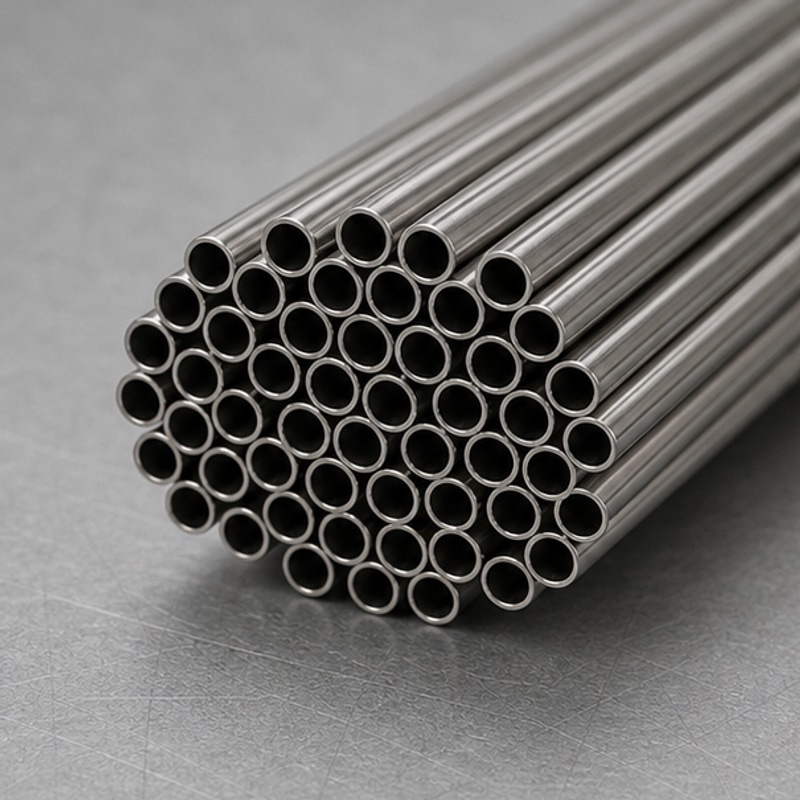
Applicable Scenarios and Industries
321H miniature tubing is specified where components must withstand intermittent or continuous service temperatures between 500 and 900 °C. Common applications include:
- Thermocouple sheaths and temperature sensor probes in medical sterilization equipment or industrial furnaces
- Chemical injection lines for aggressive media at elevated temperatures
- Exhaust gas sampling tubes in combustion analysis systems
- Miniature heat exchangers for medical fluid handling
- Structural components in surgical instruments that require periodic autoclaving
The higher carbon content (compared to standard 321) provides better creep and stress-rupture strength, making 321H the preferred grade when the tubing wall is thin and the operating temperature is near the upper limit of austenitic stainless steels.
Material Grades and Designations
321H corresponds to UNS S32109 and is defined in ASTM A213 and ASTM A269 for seamless and welded tubing. The key difference from standard 321 (UNS S32100) is the carbon range:
| Element | 321 (UNS S32100) wt% | 321H (UNS S32109) wt% |
|---|---|---|
| Carbon | 0.08 max | 0.04 – 0.10 |
| Manganese | 2.00 max | 2.00 max |
| Silicon | 1.00 max | 1.00 max |
| Phosphorus | 0.045 max | 0.045 max |
| Sulfur | 0.030 max | 0.030 max |
| Chromium | 17.0 – 19.0 | 17.0 – 19.0 |
| Nickel | 9.0 – 12.0 | 9.0 – 12.0 |
| Titanium | 5×C min – 0.70 | 5×C min – 0.70 |
Stabilization with titanium prevents chromium carbide formation during welding or prolonged high-temperature exposure. The higher carbon in 321H improves high-temperature strength while maintaining stabilization, as long as the Ti:C ratio stays at least 4:1 per ASTM A213.
Mechanical properties for annealed 321H miniature tubing per ASTM A213/A269 (minimum values): tensile strength 515 MPa (75 ksi), yield strength 205 MPa (30 ksi), elongation 35% in 50 mm. These values are identical to standard 321 at room temperature; the advantage of 321H becomes evident under creep and stress-rupture conditions above 500 °C.
OD / ID / Wall Thickness / Length Considerations
For miniature tubing, 321H is typically produced in outside diameters from 0.5 mm to 6.0 mm (0.020″ to 0.250″). Wall thickness ranges from 0.05 mm to 1.0 mm, depending on the drawing schedule. Inside diameter is a function of OD and wall; for capillary applications, the ID may be as small as 0.2 mm. Standard lengths are up to 6 meters, but cut pieces as short as 10 mm are common for sensor assemblies. Custom lengths are defined by the customer drawing.
Tolerances
Tolerances for 321H miniature tubing follow industry standards for small-diameter stainless steel tubing, typically as specified in ASTM A269. Representative ranges include:
- OD tolerance: ±0.05 mm for OD ≤ 3.0 mm; ±0.10 mm for OD 3.01–6.0 mm
- Wall thickness tolerance: ±10% of nominal wall
- Length tolerance: ±0.5 mm for cut pieces ≤ 300 mm; ±1.0 mm for longer pieces
- Straightness: 1.0 mm/m or as agreed
For applications requiring tighter control—such as ±0.025 mm on OD or ±0.02 mm on ID—the achievable tolerance depends on the drawing, material condition, process route, and mutual agreement between parties.
End Condition and Burr Control
Miniature tubing is often supplied with square-cut ends, free of burrs that could obstruct flow or compromise sealing. Burr height limits are typically specified on the drawing (e.g., max 0.05 mm). Cutting methods include abrasive sawing, laser cutting, or micro-turning, followed by mechanical or electrochemical deburring. For medical device applications, the end condition must be documented and verified with a burr inspection report.
Surface Finish and Cleanliness Requirements
Standard surface finishes for 321H miniature tubing include bright annealed, pickled, or electrophished. Typical surface roughness values:
- Bright annealed: Ra ≤ 0.6 µm
- Pickled: Ra ≤ 0.8 µm
- Electropolished: Ra ≤ 0.2 µm (achievable on inner and outer surfaces)
Cleanliness is critical for medical and analytical applications. Tubing can be supplied degreased, free of particulate contamination, and packaged in clean-room conditions. The specific cleanliness level (e.g., ISO 14644 class) depends on the customer specification.
Inspection Documentation
Typical documentation available for 321H miniature tubing includes:
- Material test certificate per EN 10204 Type 3.1 or 3.2 (or ASTM A213/A269 compliance statement)
- Dimensional inspection report showing OD, ID, wall, length, and ovality
- Surface finish measurement report (Ra)
- Burr height inspection report
- Hydrostatic test certificate if required (per ASTM A269)
All documentation is issued based on the order requirements; no standard certifications are implied without verification.
Packaging Considerations
To prevent damage during transit, 321H miniature tubing is packaged according to length and quantity. Options include individual polybags, foam-lined boxes, or spool winding for small diameters. For clean-room applications, tubing can be double-bagged and sealed with desiccant. Packaging must be clearly labeled with grade, dimensions, heat number, and quantity.
RFQ Information Checklist
When submitting a request for quotation for 321H miniature tubing, include the following details to ensure an accurate technical evaluation:
- Material grade: 321H (UNS S32109)
- Outside diameter (OD) and tolerance
- Inside diameter (ID) or wall thickness, with tolerance
- Cut length(s) and length tolerance
- Quantity required
- Surface finish requirement (e.g., annealed, pickled, electropolished)
- End condition and maximum burr height
- Inspection documentation needed (material cert, dimensional report, etc.)
- Packaging specification (individual, bulk, clean-room)
All other custom requirements—such as special tolerances, cleanliness levels, or non-destructive testing—should be noted on the drawing or purchase order.
To request a quotation for 321H miniature tubing, submit your drawings, material grade, quantity, tolerance, surface finish, and inspection requirements through the Healsmed website. The engineering team will review and respond with a technical evaluation.

Healsmed
Leading Stainless Steel Capillary Tube Factory. 1,400+ standard sizes IN STOCK & ready to ship worldwide! High precision, factory-direct price.