347 Small Diameter Tubing: Material Properties, Manufacturing Tolerances, and Application Guide
If you are evaluating 347 small diameter tubing for a high-temperature or corrosive environment, you are likely designing components that must resist intergranular corrosion after welding or exposure to elevated service temperatures. Stabilized with columbium (niobium) and tantalum, 347 stainless steel offers a dependable alternative to 321 and 316L when carbide precipitation is a primary concern. This article covers material properties, applicable industries, dimensional tolerances, surface finish, and the documentation your procurement team should expect from a precision tubing supplier.
Applicable Scenarios and Industries
347 small diameter tubing is specified where the assembly will be repeatedly heated into the sensitization range (800–1500°F / 427–816°C) or where welding cannot be followed by post-weld heat treatment. Common applications include:
- Heat exchangers and boiler tubes in chemical processing and power generation
- Thermocouple sheaths and sensor probes in refinery furnaces
- Exhaust systems and manifold components in aerospace and heavy equipment
- Capillary lines for sampling, injection, or metering in aggressive chemical media
- Medical device sub-assemblies that require corrosion resistance at moderate temperatures (e.g., sterilization cycles)
Material Grade: 347 Stainless Steel
347 is an austenitic stainless steel stabilized with columbium (Cb, also noted as Nb) and tantalum. The stabilization prevents chromium carbide formation at grain boundaries during welding or prolonged high-temperature exposure, maintaining corrosion resistance. Key designations:
- UNS S34700
- ASTM A269 (general-purpose seamless and welded tubing)
- ASTM A213 (seamless ferritic and austenitic alloy-steel boiler, superheater, and heat-exchanger tubes)
- EN 1.4550 (X6CrNiNb18-10)
Comparison with similar grades:
| Grade | Stabilization Element | Key Difference vs. 347 |
|---|---|---|
| 304 | None | Susceptible to sensitization; not recommended for welded high-temp service |
| 316L | Low carbon (max 0.03% C) | Corrosion resistance in chlorides better, but lower creep strength above 800°F |
| 321 | Titanium | Similar stabilization; 347 has higher creep strength at 900–1200°F |
| 316Ti | Titanium | Used when titanium stabilization is preferred over columbium |
Chemical composition (per ASTM A269):
- Carbon: 0.08% max
- Manganese: 2.00% max
- Phosphorus: 0.045% max
- Sulfur: 0.030% max
- Silicon: 0.75% max
- Chromium: 17.0–19.0%
- Nickel: 9.0–13.0%
- Columbium + Tantalum: 10× Carbon content minimum
Mechanical properties (annealed condition, typical for small diameter tubing):
- Tensile Strength: 75 ksi (515 MPa) min
- Yield Strength (0.2% offset): 30 ksi (205 MPa) min
- Elongation in 2 in. or 50 mm: 40% min
OD / ID / Wall Thickness / Length Considerations
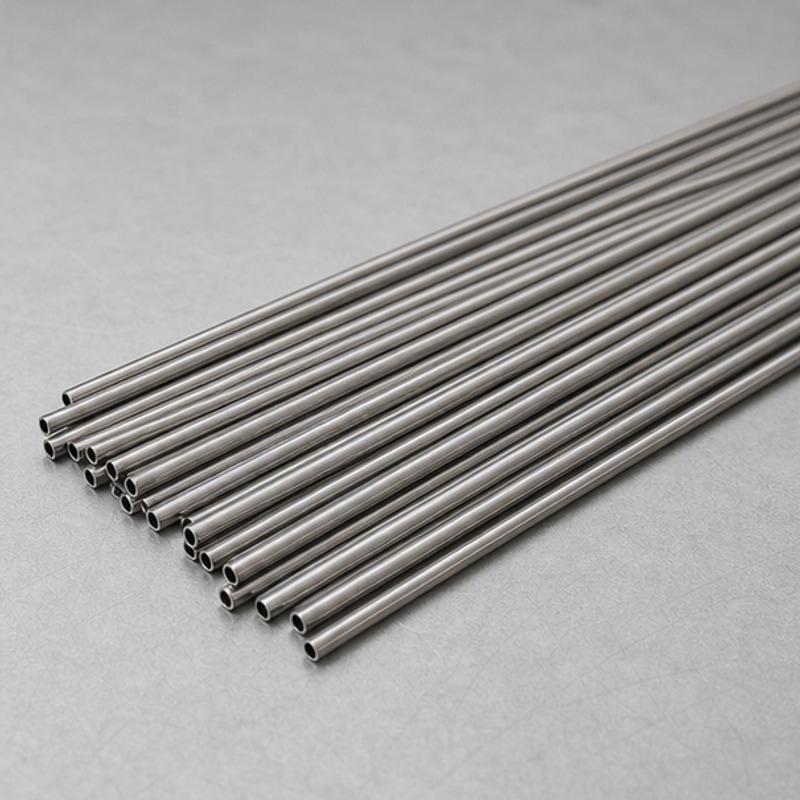
347 small diameter tubing is available in both seamless (preferred for capillary-sized dimensions) and welded-and-drawn configurations. Typical outer diameters range from 0.020″ (0.5 mm) to 0.500″ (12.7 mm). Wall thicknesses can be as thin as 0.006″ (0.15 mm) in drawn conditions. Lengths are commonly supplied as random mill lengths (10–20 ft) or cut to exact specifications.
The choice of OD and wall depends on internal pressure, flow rate, and mechanical support. For capillary applications requiring precise internal bore, ID tolerance is often the controlling dimension and may require a custom drawing pass.
Tolerances (Typical Ranges for Capillary Tube)
Tolerances for 347 small diameter tubing are governed by the specified standard or customer drawing. When no drawing is provided, ASTM A269 tolerances apply:
| Parameter | ASTM A269 (seamless, OD < 0.500") | Customer Drawing (typical capillary) |
|---|---|---|
| OD tolerance | ±0.005″ (0.13 mm) | ±0.002″ to ±0.0005″ |
| Wall tolerance | ±10% of nominal | ±10% or tighter per pass |
| Length tolerance | +0.125″ / -0″ (cut lengths) | As agreed |
| Ovality (per inch of OD) | 0.010″ max | Depends on drawing |
For dimensions outside these ranges, tolerances depend on drawing, material condition, process route, and mutual agreement between parties.
End Condition and Burr Control
Small diameter tubing for medical, instrumentation, or precision assemblies requires clean, burr-free ends to prevent particle generation and flow disruption. Standard end conditions include:
- Square cut (cutoff wheel or abrasive saw)
- Deburred outside and inside (manual or mechanical)
- Chamfered or beveled per customer specification
Burr height limits should be defined on the drawing. For capillary tubing with ID below 0.030″, internal burrs can cause clogging and must be removed during secondary finishing.
Surface Finish and Cleanliness Requirements
Surface finish for 347 small diameter tubing is typically supplied in the annealed and pickled condition, which produces a dull matte surface. For applications requiring a smooth interior for fluid flow or friction reduction, bright annealed finish (hydrogen atmosphere) or electropolishing can be specified.
Cleanliness levels are set by the end use. Standard oxygen-cleaning or degreasing per ASTM G93 is available. For medical or analytical applications, particulate and hydrocarbon limits must be stated on the purchase order; Healsmed can review acceptance criteria upon request.
Inspection Documentation
For 347 small diameter tubing, inspection documents typically include:
- Material test report (MTR) / EN 10204 3.1 certificate
- Dimensional inspection report (OD, ID, wall, length, ovality)
- Surface finish measurement (Ra in microinches or micrometers)
- Burr height verification (if specified)
- Hydrostatic or pneumatic pressure test (when required by ASTM A269)
- EDM or alternative test (if alloy verification is needed)
Additional nondestructive testing (eddy current, ultrasonic) can be applied upon agreement. All documentation is traceable to the heat lot.
Packaging Considerations
Packaging must protect the tubing from mechanical damage and contamination during transport:
- Straight lengths: bundled with end caps or protective sleeves
- Coiled lengths (for continuous capillary runs): wound on spools or in protective containers
- Individual poly-bagging or heat-sealed packaging for cleanroom-compatible delivery
- Desiccant and vacuum sealing for long-term storage protection
Packaging requirements should be specified with the order, especially if the tubing will be used in a controlled environment.
RFQ Information Checklist
To receive an accurate technical evaluation and quotation for 347 small diameter tubing, provide the following:
- Material grade (347, UNS S34700)
- OD, ID, and wall thickness (or OD and wall)
- Length and quantity (straight or coiled)
- Required tolerances (especially if tighter than standard)
- Surface finish (annealed/pickled, bright annealed, electropolished, etc.)
- End condition (square-cut, deburred, chamfered)
- Cleanliness or packaging requirements
- Inspection documentation requested (MTR, dimensional report, etc.)
- Any applicable welding, bending, or post-processing needs
- Delivery timeline expectations
To request a quotation for 347 small diameter tubing, submit your drawings, material grade, quantity, tolerance, surface finish, and inspection requirements through the Healsmed website. The engineering team will review and respond with a technical evaluation.

Healsmed
Leading Stainless Steel Capillary Tube Factory. 1,400+ standard sizes IN STOCK & ready to ship worldwide! High precision, factory-direct price.