321H Precision Capillary Tubing: Material Properties, Manufacturing Tolerances, and Application Guide
Engineering teams working with high-temperature instrumentation, chemical injection systems, or exhaust sampling often encounter a specific sourcing challenge: a capillary tube that maintains dimensional stability and corrosion resistance above 500°C. Standard 321 stainless steel (0.08% C max) loses creep strength under sustained thermal and mechanical load. 321H precision capillary tubing, with its controlled carbon range of 0.04%–0.10%, addresses this gap by providing improved high-temperature tensile and creep properties while retaining the oxidation resistance and fabricability of the 321 family. This article covers material properties, manufacturing tolerances, and application considerations to help engineers and procurement professionals evaluate 321H capillary tubing for their designs.
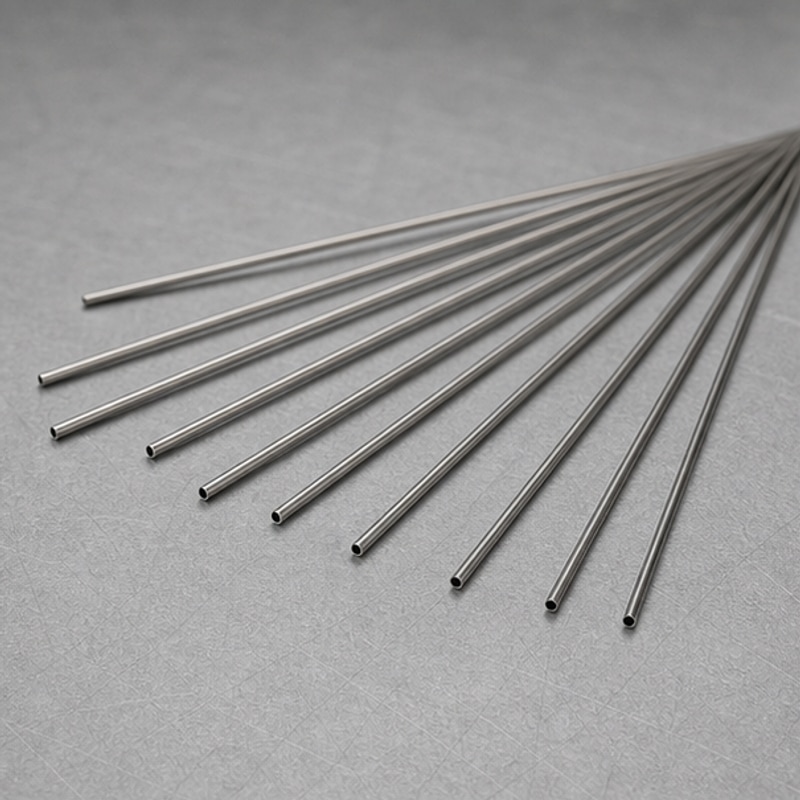
Applicable Scenarios and Industries
321H capillary tubing is specified in applications where the tube will be exposed to intermittent or continuous service temperatures between 500°C and 900°C in mildly oxidizing or corrosive environments. Typical uses include:
- Thermocouple sheaths and sensor probes in process furnaces, gas turbines, and petrochemical reactors.
- Chemical injection lines for catalyst, inhibitor, or sample delivery at elevated process temperatures.
- Exhaust gas sampling in automotive, marine, and industrial stack monitoring systems.
- Heat exchangers where small-diameter, high-strength tubes are needed in counter-flow designs.
- Medical and analytical instrumentation when combined with sterilization cycles that exceed 300°C (e.g., autoclaving), although biocompatibility claims require separate validation.
Material Grades and Designations
321H is a titanium-stabilized austenitic stainless steel with the following key designations:
| Standard | Designation |
|---|---|
| ASTM A240 / A269 / A213 | TP321H (UNS S32109) |
| EN 10088-1 | 1.4878 (X6CrNiTi18-10) |
| ISO 15510 | X6CrNiTi18-10 |
The primary difference from standard 321 (UNS S32100) is the carbon content:
- 321 (TP321): C ≤ 0.08%
- 321H (TP321H): C = 0.04% – 0.10%
The higher carbon range, combined with titanium stabilization (Ti ≥ 5 × (C + N)), ensures that carbide precipitation is controlled during welding and high-temperature service. Typical chemical composition (per ASTM A240, for plate – tubing composition is per A269 or A213):
| Element | Content (wt%) |
|---|---|
| Carbon | 0.04 – 0.10 |
| Manganese | ≤ 2.00 |
| Silicon | ≤ 0.75 |
| Chromium | 17.0 – 19.0 |
| Nickel | 9.0 – 13.0 |
| Titanium | ≥ 5 × (C + N), max 0.70 |
| Phosphorus | ≤ 0.045 |
| Sulfur | ≤ 0.030 |
Mechanical properties for annealed 321H tubing (typical per ASTM A269 for TP321, extended to TP321H where applicable):
| Property | Value (min) |
|---|---|
| Tensile strength | 515 MPa |
| Yield strength (0.2% offset) | 205 MPa |
| Elongation in 50 mm | 35% |
Note: Actual values depend on tube dimensions, heat treatment, and drawing condition. Consult the material certification for the specific lot.
OD / ID / Wall Thickness / Length Considerations
Capillary tubing is defined by small outside diameters and precise internal diameters. Typical dimensions for 321H capillary tubes are:
- Outside diameter (OD): 0.5 mm to 6.0 mm (0.020″ to 0.236″)
- Wall thickness: 0.05 mm to 1.0 mm (0.002″ to 0.040″)
- Inside diameter (ID): derived from OD minus 2 × wall thickness; minimum ID of 0.2 mm is common but depends on formability.
- Length: normally supplied in random mill lengths of 1–6 m. For smaller capillaries, coils of 30 m or more are available if the material condition permits.
When selecting wall thickness, note that 321H has slightly higher work-hardening rates than 304L or 316L; this may affect drawing schedules and achievable tolerances. The manufacturer should be consulted early for non-standard combinations.
Tolerances (Typical Ranges for Capillary Tube)
Tolerances for precision capillary tubing depend on the drawing process, material condition (annealed or hard), and the specific requirements of the application. Typical industry ranges for 321H:
| Parameter | Typical Tolerance | Notes |
|---|---|---|
| OD | ±0.05 mm (for OD ≤ 3 mm) ±0.10 mm (for OD 3–6 mm) |
Tighter tolerances (e.g., ±0.02 mm) are achievable but depend on drawing capability and quantity. |
| Wall thickness | ±10% of nominal wall (down to ±0.02 mm on thin walls) | Eccentricity may add variation; concentricity requirements should be specified. |
| ID | Derived from OD and wall tolerances; typically ±0.10 mm or better | For critical flow applications, specify ID tolerance directly. |
| Length | +5 mm / 0 mm for cut-to-length pieces ±1 mm for close tolerance pieces |
Agreed at time of order. |
Final tolerance values are subject to mutual agreement between the buyer and the manufacturer based on the drawing, material condition, and process route.
End Condition and Burr Control
Capillary tubing ends must be clean and burr-free to prevent particle generation and to allow secure fitting in connectors, ferrules, or weld joints. Common end conditions for 321H capillary tubing include:
- Square cut with deburred OD and ID — suitable for most compression and ferrule connections.
- Chamfered ends for easier insertion during assembly.
- Ground or polished ends when a smooth transition is required (e.g., for flush sealing).
Burr control is especially important for IDs below 1 mm, where even a small burr can restrict flow or cause fouling. Visual inspection under 10×–20× magnification is standard; for critical medical or analytical applications, end inspection may be supplemented with a go/no-go pin gauge.
Surface Finish and Cleanliness Requirements
The internal and external surface finish of 321H capillary tubing affects fluid flow, ease of cleaning, and resistance to fouling. Typical surface finish requirements:
- Outside surface: bright annealed, pickled, or mechanically polished depending on application. Roughness Ra values from 0.2 µm to 0.8 µm are common for instrumentation grade.
- Inside surface: often specified as “clean and bright” with no scale or heavy oxide layer. For high-purity lines (e.g., chemical injection), an internal finish of Ra ≤ 0.4 µm may be requested.
Cleanliness after final processing should be specified: degreased, ultrasonically cleaned, or bagged in a cleanroom environment. No standard “medical grade” surface exists; the appropriate finish must be defined by the user.
Inspection Documentation
Each shipment of 321H precision capillary tubing should be accompanied by relevant documentation to confirm material and dimensional conformance. Typical documents include:
- Material Test Certificate (MTC) per EN 10204 Type 3.1 or 3.2, showing chemical analysis and mechanical properties.
- Dimensional Inspection Report listing OD, ID, wall thickness, and length measurements.
- Surface finish report (if specified) with Ra values and measurement method.
- Certificate of Conformance confirming that the product meets the purchase order requirements.
Additional nondestructive testing (e.g., eddy current, hydrostatic, or air pressure) can be specified but adds cost and lead time.
Packaging Considerations
321H capillary tubing must be packaged to prevent mechanical damage, surface contamination, and corrosion during transit and storage. Common packaging methods include:
- Individual sleeves or tubes for small-diameter fragile pieces.
- Coiling on spools for long continuous lengths (e.g., 30 m coils).
- Anti-static or cleanroom-grade plastic bags for medical or analytical applications.
- Anti-corrosion paper or VCI (volatile corrosion inhibitor) when extended storage is expected.
Packaging details should be agreed during the RFQ stage.
RFQ Information Checklist
To obtain an accurate quotation for 321H precision capillary tubing, provide the following information:
- Material grade: 321H (UNS S32109) or EN 1.4878
- Outside diameter (mm or inch) and tolerance
- Inside diameter (mm or inch) or wall thickness and tolerance
- Length (cut-to-length or coil)
- Quantity (pieces or total length)
- End condition and burr control requirements
- Surface finish (outside and inside, Ra if relevant)
- Cleanliness specification
- Inspection documentation required (MTC type, dimensional report, etc.)
- Packaging preference
To request a quotation for 321H precision capillary tubing, submit your drawings, material grade, quantity, tolerance, surface finish, and inspection requirements through the Healsmed website. The engineering team will review and respond with a technical evaluation.

Healsmed
Leading Stainless Steel Capillary Tube Factory. 1,400+ standard sizes IN STOCK & ready to ship worldwide! High precision, factory-direct price.