321H Welded Capillary Tube: Material Properties, Manufacturing Tolerances, and Application Guide
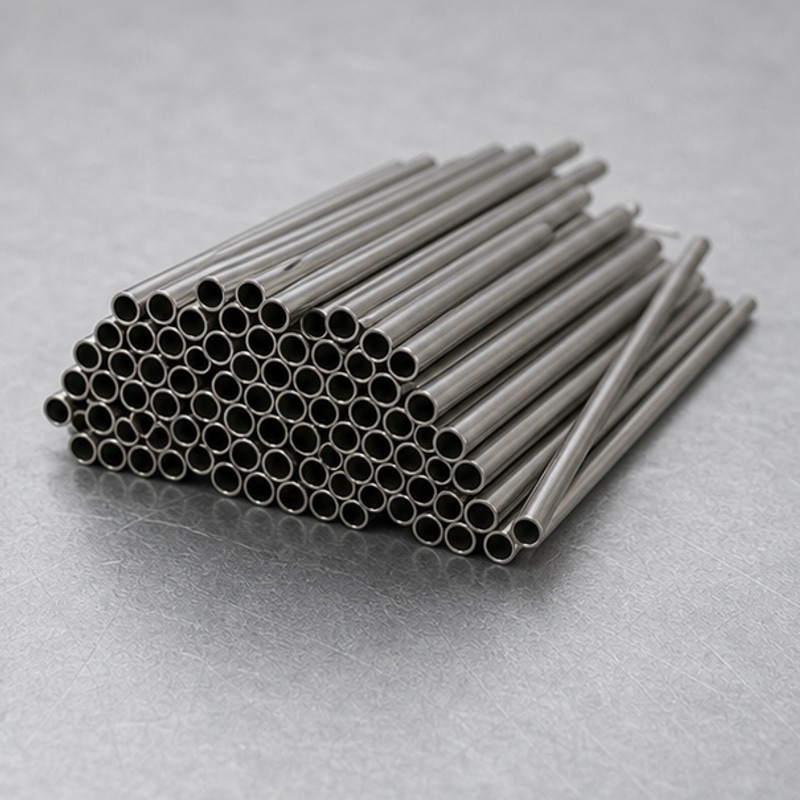
When designing or sourcing a 321H welded capillary tube, the primary engineering challenge is balancing the material’s elevated-temperature strength and carbide stabilization against the tight dimensional tolerances and weld integrity required for small-diameter fluid or gas transmission. 321H—the high-carbon variant of Type 321 stainless steel—is specified when service temperatures exceed the creep-rupture limits of standard 304 or 316L, or when repeated thermal cycling demands stable microstructure. This article covers the relevant material properties, manufacturing tolerances, end-condition requirements, and procurement considerations for engineers and buyers evaluating 321H welded capillary tube for their applications.
Applicable Scenarios and Industries
321H welded capillary tube is used where the assembly will see sustained temperatures between 500°C and 870°C (932°F to 1598°F), or where intergranular corrosion resistance after welding or stress relieving is required. Typical applications include:
- Thermocouple sheaths and temperature sensor probes in industrial furnaces
- Heat exchanger tubing in chemical processing and refinery instrumentation
- Exhaust gas sampling lines for emissions monitoring equipment
- Hydraulic and pneumatic control lines in high-temperature aerospace ground support equipment
- Capillary columns for analytical instrumentation where thermal stability is critical
321H is not typically specified for medical implantable devices or food-contact surfaces; those applications normally require 316L or specialized alloys. The selection of 321H is driven by thermal and corrosion requirements, not by biocompatibility.
Material Grade Designations and Chemistry
321H is covered under ASTM A249/A249M (welded austenitic steel boiler, superheater, heat-exchanger, and condenser tubes) and ASTM A269 (seamless and welded austenitic stainless steel tubing for general service). The “H” grade requires a controlled carbon content of 0.04–0.10%, versus the standard 321 limit of 0.08% max. Key chemical composition ranges per ASTM A240/A240M (applicable to plate and sheet used in tube production):
| Element | Composition (%) |
|---|---|
| Carbon | 0.04 – 0.10 |
| Manganese | 2.00 max |
| Phosphorus | 0.045 max |
| Sulfur | 0.030 max |
| Silicon | 0.75 max |
| Chromium | 17.0 – 19.0 |
| Nickel | 9.0 – 12.0 |
| Titanium | 5 × (C + N) min – 0.70 max |
| Nitrogen | 0.10 max |
The titanium addition stabilizes carbides, preventing sensitization during welding or service in the 500–800°C range. The higher carbon content in 321H improves creep strength compared to 321 or 316L at elevated temperatures.
OD / ID / Wall Thickness / Length Considerations
For capillary tube, “small diameter” typically means outside diameter (OD) from 0.5 mm (0.020 in) up to 6.35 mm (0.250 in). Wall thicknesses range from 0.10 mm (0.004 in) to 0.89 mm (0.035 in). ID is a function of OD minus twice the wall thickness. Lengths are commonly supplied in random mill lengths (typically 6–10 m) or cut-to-length per drawing, with a tolerance on cut length of +1.6 mm / -0 mm or as agreed upon.
When specifying 321H welded capillary tube, the wall thickness must be sufficient to maintain column strength and burst pressure at the intended service temperature. At 870°C, the allowable stress for 321H per ASME Section II, Part D is significantly lower than at room temperature; consult the applicable code or design standard for derating factors.
Tolerances (Typical Ranges for Capillary Tube)
Tolerances depend on the governing standard (ASTM A269 or A249) and the agreed specification between buyer and supplier. Typical values for welded capillary tube:
| Parameter | Typical Tolerance |
|---|---|
| OD | ±0.05 mm (for OD ≤ 3.0 mm); ±0.08 mm (for OD 3.0–6.35 mm) |
| Wall thickness | ±10% of nominal (for wall ≥ 0.25 mm); tighter tolerances depend on drawing and mutual agreement |
| ID | Not directly toleranced; derived from OD and wall tolerances |
| Length (cut-to-length) | +1.6 mm / -0 mm; tighter by agreement |
| Straightness | 3 mm per meter max; tighter by agreement |
| Ovality | Depends on drawing, material condition, process route, and mutual agreement between parties |
For applications requiring precise ID control (e.g., capillary flow restrictors), specify the ID tolerance directly on the drawing, as the as-welded bead may require internal reaming or cold drawing to achieve the desired bore size.
End Condition and Burr Control
Cut ends of 321H welded capillary tube must be deburred both internally and externally to prevent particulate generation and flow disruption. Common end conditions include:
- Plain cut, deburred (standard)
- Square cut to ±0.5° perpendicularity
- Chamfered or beveled end for welding
- Closed end (for thermocouple sheath applications)
Burr height is typically specified as ≤ 0.05 mm (0.002 in). For critical cleanliness applications, specify “free of burrs, chips, and loose particles” on the purchase order.
Surface Finish and Cleanliness Requirements
321H welded capillary tube is typically supplied in the as-welded or annealed condition. Surface finish is not inherently smooth; the weld seam may have a visible bead on the OD and ID. Common surface finish specifications:
- As-welded: no mechanical polishing; surface roughness Ra 1.6–3.2 µm
- Annealed and pickled: Ra 0.8–1.6 µm, free of heavy oxide scale
- Bright annealed (hydrogen atmosphere): Ra 0.4–0.8 µm, clean surface
For applications requiring hydrocarbon-free surfaces (e.g., oxygen service or analytical instrumentation), specify “clean for oxygen service” or “degreased and packaged in clean-room conditions.” The supplier should confirm the cleaning process and verification method (e.g., water-break test or solvent residue analysis).
Inspection Documentation
Standard documentation for 321H welded capillary tube includes:
- Mill test certificate (EN 10204 Type 3.1 or 3.2) showing chemical analysis and mechanical properties
- Dimensional inspection report (OD, wall, length, straightness)
- Flattening, flaring, and flange test results per ASTM A249 (if specified)
- Hydrostatic or pneumatic pressure test report (if required)
- Surface finish measurement report
- Certification of compliance to the applicable ASTM or EN standard
For 321H, the certificate must show the carbon content within 0.04–0.10% and the titanium content meeting the stabilization ratio. If the tube will be used in ASME Section VIII or B31.3 applications, a material certificate with traceability to the heat number is mandatory.
Packaging Considerations
321H welded capillary tube must be packaged to prevent mechanical damage, moisture ingress, and contamination during transit. Typical packaging options:
- Bundled and strapped in plastic sleeves for short lengths
- Coiled on spools for long continuous lengths (minimize bending radius to avoid kinking)
- Individual polybagging with desiccant for clean-room applications
- Wooden crates or boxes for fragile cut lengths
Specify if the tube requires sealed packaging with humidity indicator cards or nitrogen purge for long-term storage.
RFQ Information Checklist
To receive an accurate quotation for 321H welded capillary tube, include the following in your request:
- Applicable standard (ASTM A269, A249, or customer-specific specification)
- OD, wall thickness, and length (with tolerances)
- Quantity (pieces, total meters, or kilograms)
- Surface finish and cleanliness requirement
- End condition (cut, deburred, chamfered, closed)
- Inspection documentation required (cert type, dimensional report, tests)
- Packaging specification
- Intended service temperature (if >500°C, note for design review)
Provide a drawing whenever possible; the engineering team can then verify that the specified tolerances are achievable with the welded process route and material condition.
To request a quotation for 321H welded capillary tube, submit your drawings, material grade, quantity, tolerance, surface finish, and inspection requirements through the Healsmed website. The engineering team will review and respond with a technical evaluation.

Healsmed
Leading Stainless Steel Capillary Tube Factory. 1,400+ standard sizes IN STOCK & ready to ship worldwide! High precision, factory-direct price.