321H SS Capillary Tubing: Material Properties, Manufacturing Tolerances, and Application Guide
When your design calls for capillary tubing that must resist intergranular corrosion after sustained exposure at 500–800 °C (930–1470 °F), or when repeated thermal cycling makes standard 321 stainless steel unpredictable, 321H SS capillary tubing is the material you need. Engineers sourcing small-diameter tubing for high-temperature sensors, thermowells, exhaust-gas sampling lines, or heat-exchanger components are often solving the same problem: maintaining mechanical integrity and corrosion resistance where carbon precipitation would otherwise weaken the material. This article covers the material properties, manufacturing tolerances, and application considerations that matter when specifying 321H capillary tubing for demanding environments.
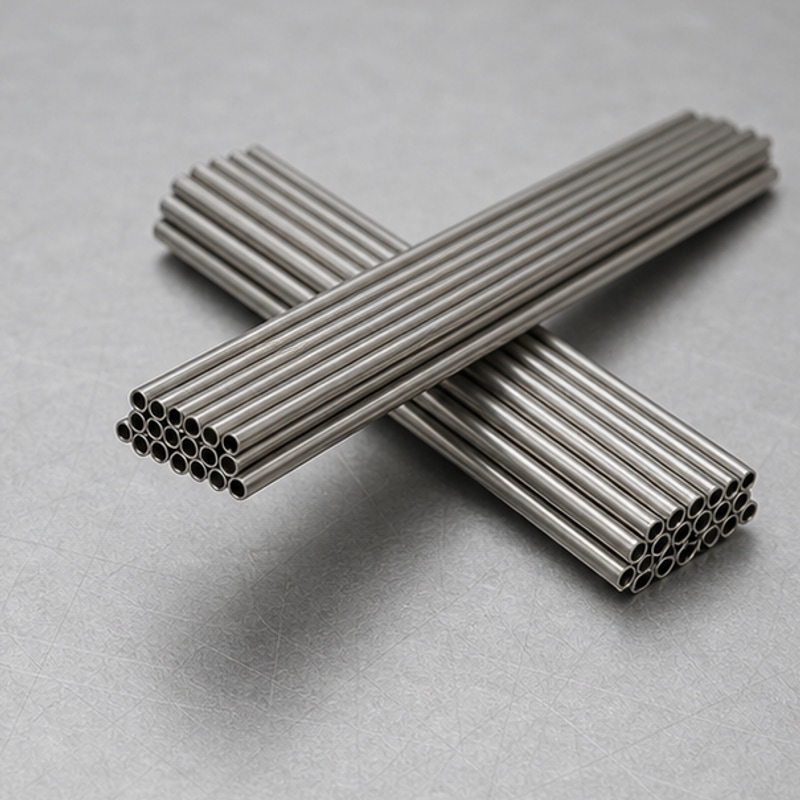
Applicable Scenarios and Industries
321H capillary tubing is selected primarily for elevated-temperature service where standard austenitic grades (304, 316L) would suffer sensitization and subsequent intergranular attack. Typical applications include:
- Thermocouple protection sheaths and thermowells in process heaters, furnaces, and gas turbines
- Exhaust-gas sampling and emissions monitoring probes operating above 500 °C
- Small-diameter heat-exchanger tubes for waste-heat recovery or superheated steam
- Pneumatic and hydraulic control lines in high-temperature industrial ovens
- Medical-device components that undergo repeated steam sterilization (autoclaving) where 321H’s stabilized structure prevents sensitization
Industries that commonly specify 321H include aerospace (engine bleed-air systems), power generation (gas turbines, boilers), chemical processing (catalyst sampling), and medical equipment manufacturing (sterilizable instrumentation).
Material Grades and Designations
321H is a stabilized austenitic stainless steel with a controlled higher carbon content (0.04–0.10 %) compared to standard 321 (0.08 % max). The “H” designation per ASTM A213 / ASME SA-213 indicates the carbon range is intentionally held higher to improve high-temperature creep strength. Key designations:
- UNS S32109 (321H per ASTM A213)
- EN 1.4878 (X6CrNiTi18-10, the European equivalent for 321H, though composition limits vary slightly; always confirm with the supplier)
- Werkstoff Nr. 1.4878
For comparison, 321 (UNS S32100) has a carbon maximum of 0.08 % and lower minimum yield strength at elevated temperatures. 316Ti (UNS S31635) is another stabilized grade but contains molybdenum for enhanced pitting resistance; it is not a direct substitute for 321H in high-temperature strength applications. 304 and 316L are not stabilized and should be avoided above 425 °C (800 °F) where sensitization can occur.
Typical Composition (ASTM A213, 321H)
| Element | Composition (wt %) |
|---|---|
| Carbon | 0.04 – 0.10 |
| Manganese | 2.00 max |
| Phosphorus | 0.045 max |
| Sulfur | 0.030 max |
| Silicon | 0.75 max |
| Chromium | 17.0 – 19.0 |
| Nickel | 9.0 – 12.0 |
| Titanium | 5 × (C + N) min to 0.70 max |
Titanium content is critical: it must be at least five times the carbon-plus-nitrogen content to effectively stabilize the structure. The supplier should provide a mill certificate showing actual Ti, C, and N values.
OD / ID / Wall Thickness / Length Considerations
Capillary tubing in 321H is manufactured in small diameters, typically:
- Outside diameter (OD): 0.020 in (0.508 mm) up to 0.500 in (12.70 mm). Larger diameters up to 1.000 in (25.4 mm) are possible but are not always drawn to capillary tolerances.
- Wall thickness: 0.005 in (0.127 mm) to 0.065 in (1.65 mm). Thin walls (≤0.010 in) require careful handling and may limit bending capability.
- Length: Random mill lengths (typically 10–20 ft / 3–6 m) or cut-to-length as specified. For capillary applications, lengths up to 20 ft are common; longer runs may require welded joints or custom drawing.
When selecting dimensions, consider that 321H has slightly lower thermal conductivity than 304 or 316L, which can affect heat-transfer designs. The higher carbon content also increases yield strength at temperature, so wall thickness can sometimes be reduced compared to 304 for the same pressure rating.
Tolerances (Typical Ranges for Capillary Tube)
Tolerances for 321H capillary tubing depend on the manufacturing standard (ASTM A213, ASTM A269, or customer-specific drawing). Typical ranges:
| Parameter | Typical Tolerance | Notes |
|---|---|---|
| OD | ±0.002 in (0.05 mm) for OD ≤ 0.125 in; ±0.003 in (0.08 mm) for larger | Tighter tolerances (e.g., ±0.001 in) depend on drawing and process route |
| ID | ±0.002 in (0.05 mm) or as agreed | ID is a calculated value; direct measurement may require nondestructive methods |
| Wall thickness | ±10 % of nominal | Tighter (e.g., ±5 %) depends on drawing and mutual agreement |
| Length | +1/8 in / -0 for cut lengths | Standard; closer tolerances available on request |
| Straightness | 0.030 in/ft (2.5 mm/m) max | Can be improved with straightening passes at additional cost |
These values are typical for seamless cold-drawn tubing. If your application requires tighter tolerances (e.g., for precision interference fits or flow control), specify them on the drawing. The supplier will confirm feasibility based on the material condition (annealed, stress-relieved, or full-hard) and the drawing sequence.
End Condition and Burr Control
Capillary tubing ends must be cleanly cut and deburred, both inside and outside, to prevent flow obstructions or contamination. Standard options:
- Plain cut (square end): Suitable for most applications; burrs removed manually or by tumbling.
- Deburred ID/OD: Specified when the tube will be used in fluid or gas systems where any loose burr could break free.
- Chamfered or beveled: For welding or press-fit connections.
For 321H, burr removal must be performed carefully to avoid work-hardening the surface. The supplier should document the end-condition process (e.g., “ends deburred to 0.005 in max residual burr”).
Surface Finish and Cleanliness Requirements
Surface finish is typically specified for capillary tubing used in medical or analytical instruments. Common finishes:
- Bright annealed (BA): Smooth, reflective surface; typical Ra ≤ 0.5 µm (20 µin). Suitable for clean-room assembly.
- Pickled (2B or 2D): Matte finish; Ra 0.6–1.0 µm (25–40 µin). Acceptable for many industrial applications.
- Electropolished (EP): Ra ≤ 0.25 µm (10 µin) possible; removes a thin layer of material, improving corrosion resistance and cleanability.
Cleanliness requirements should be stated (e.g., “free of oil, grease, and particulate; packaged in a clean-room environment”). For medical devices, the supplier must confirm that the cleaning process does not introduce contaminants that would affect biocompatibility—but note that Healsmed does not claim FDA approval or biocompatibility unless verifiable evidence is provided.
Inspection Documentation
When ordering 321H capillary tubing, request the following documentation to verify conformance:
- Mill test certificate (EN 10204 Type 3.1 or 3.2): Includes heat analysis, mechanical properties (tensile, yield, elongation), and corrosion test results if required.
- Dimensional inspection report: OD, ID, wall, length, straightness, and ovality for each lot or per agreed sampling plan.
- Surface finish measurement: Ra values per ASTM B912 or ISO 4287.
- Hydrostatic or pneumatic test certificate: If pressure-rated.
- Certificate of conformance (CoC): Stating material grade, condition, and specification.
All documentation must be traceable to the specific heat and lot number.
Packaging Considerations
Capillary tubing is susceptible to surface damage and corrosion if improperly packaged. Typical packaging methods:
- Individual poly-bagging: For small-diameter, short-length pieces.
- Foam-lined wooden crates or cardboard boxes: For longer lengths (up to 20 ft).
- End caps: To protect cut ends and prevent debris entry.
- Desiccant and VCI (vapor corrosion inhibitor): Recommended for export or humid environments.
Specify packaging requirements clearly in the RFQ, especially if the tubing will be used in a clean-room environment.
RFQ Information Checklist
To obtain an accurate quotation for 321H SS capillary tubing, provide the following:
- Material grade: 321H (UNS S32109) or equivalent
- Specification: ASTM A213 / ASME SA-213, ASTM A269, or customer drawing
- Dimensions: OD, wall thickness (or ID), length, tolerance requirements
- Quantity: total length or number of pieces
- Condition: annealed, stress-relieved, or as-drawn
- Surface finish: BA, pickled, electropolished, or as specified
- End condition: plain cut, deburred, chamfered
- Inspection documentation required: mill cert, dimensional report, etc.
- Packaging requirements
- Application (optional but helpful for process optimization)
Any special requirements (e.g., tighter tolerances, custom lengths, non-destructive testing) should be noted on the drawing or in the RFQ notes.
To request a quotation for 321H SS capillary tubing, submit your drawings, material grade, quantity, tolerance, surface finish, and inspection requirements through the Healsmed website. The engineering team will review and respond with a technical evaluation.

Healsmed
Leading Stainless Steel Capillary Tube Factory. 1,400+ standard sizes IN STOCK & ready to ship worldwide! High precision, factory-direct price.