321 Welded Capillary Tube: Material Properties, Manufacturing Tolerances, and Application Guide
When designing small-diameter fluid or gas delivery systems for high-temperature or corrosive environments, specifying a 321 welded capillary tube addresses a specific engineering challenge: maintaining oxidation resistance and mechanical stability in applications where intermittent heating between 800°F and 1500°F (427°C to 816°C) is expected. Unlike standard 304 or 316L grades, 321 stainless steel contains a titanium stabilizer that prevents chromium carbide precipitation during welding and subsequent thermal exposure. This article reviews the material properties, manufacturing tolerances, and application considerations that engineers and procurement teams evaluate when sourcing 321 welded capillary tubing.
Applicable Scenarios and Industries
321 welded capillary tube is typically specified in applications where the tubing will be exposed to repeated thermal cycling or sustained temperatures above 800°F (427°C). Common industry segments include:
- Aerospace and defense: Sensor probes, hydraulic lines, and bleed air systems where thermal stability is critical.
- Chemical processing: Thermowells, sample lines, and catalyst injection tubes handling corrosive media at elevated temperatures.
- Power generation: Instrumentation lines in gas turbines, boilers, and exhaust systems.
- Automotive and motorsport: Exhaust gas recirculation (EGR) tubing, turbocharger oil lines, and emission sensor ports.
While 321 is not inherently a medical-grade material, it may appear in medical device sterilization equipment or high-temperature processing tools where the tubing does not contact tissue or implant surfaces.
Material Grades and Designations
The primary specification for 321 stainless steel tubing is ASTM A269 / ASME SA269 (seamless and welded austenitic tubing for general service) and ASTM A249 / ASME SA249 (welded austenitic boiler, superheater, heat-exchanger, and condenser tubes). Key chemical composition ranges per ASTM A240 (plate, sheet, and strip for pressure vessels) include:
| Element | Composition Range (wt%) |
|---|---|
| Carbon | 0.08 max |
| Manganese | 2.00 max |
| Phosphorus | 0.045 max |
| Sulfur | 0.030 max |
| Silicon | 1.00 max |
| Chromium | 17.0 – 19.0 |
| Nickel | 9.0 – 12.0 |
| Titanium | 5 × (C + N) min, 0.70 max |
The titanium stabilizer (Ti) is the distinguishing feature of 321 versus 304 (no Ti) or 316L (low carbon, no Ti). For welded capillary tube, the titanium content ensures that the heat-affected zone (HAZ) remains resistant to intergranular corrosion after welding and during service at sensitization temperatures.
OD, ID, Wall Thickness, and Length Considerations
Capillary tube is generally defined by an outer diameter (OD) of 3.0 mm (0.118 in) or smaller. For 321 welded capillary tube, common sizes range from 0.5 mm (0.020 in) to 3.0 mm (0.118 in) OD. Wall thicknesses typically fall between 0.10 mm (0.004 in) and 0.50 mm (0.020 in). The ID is calculated as OD minus twice the wall thickness, but the weld bead profile may reduce the effective ID slightly in small diameters.
Standard lengths for capillary tube are often 1,000 mm, 2,000 mm, or random mill lengths (1,500–4,000 mm). Custom cut lengths are possible, but the supplier should be consulted regarding minimum order quantities and cut tolerance.
Tolerances
Tolerances for 321 welded capillary tube depend on the governing standard and the tube diameter. Typical ranges for small-diameter welded tubing per ASTM A269 include:
| Parameter | Typical Tolerance |
|---|---|
| OD (≤ 3.0 mm) | ±0.05 mm to ±0.10 mm |
| Wall thickness | ±10% of nominal |
| Length (cut) | +2 / -0 mm or as agreed |
| Straightness | 1.0 mm per 1,000 mm length |
For tighter tolerances (e.g., ±0.02 mm on OD), the tube may require secondary drawing or centerless grinding. These tighter tolerances are not standard and must be specified on the drawing along with the applicable conditions (annealed or cold-drawn).
End Condition and Burr Control
Welded capillary tube is typically supplied with cut ends. Burr control is critical when the tube is used in assemblies with compression fittings, ferrule connections, or when the ID must be free of debris. Common end conditions include:
- Plain cut (square end): Acceptable for many applications, but burrs may be present on the ID and OD.
- Deburred ends: Burrs removed on both ID and OD (typically to 0.10 mm max residual burr height).
- Chamfered ends: A 45° chamfer on the OD for easier insertion into fittings.
The method of deburring (mechanical, chemical, or thermal) should be specified if the tube is destined for clean or high-purity systems.
Surface Finish and Cleanliness Requirements
321 welded capillary tube is often supplied in the annealed condition, which produces a dull, matte surface. If a brighter finish is needed, a bright anneal (hydrogen atmosphere) or electropolishing can be applied. Typical surface finish values for capillary tube range from 0.4 µm Ra (mirror finish) to 1.6 µm Ra (standard annealed).
Cleanliness requirements vary by application. For general industrial use, the tube may be degreased and dried. For oxygen service or high-purity gas systems, additional cleaning (e.g., ultrasonic cleaning in a solvent or aqueous bath) and packaging in sealed bags may be required.
Inspection Documentation
Standard documentation for 321 welded capillary tube includes:
- Material test report (MTR / EN 10204 3.1): Certifies heat number, chemical composition, and mechanical properties (tensile strength, yield strength, elongation).
- Dimensional inspection report: Records OD, ID, wall thickness, and length measurements for the lot.
- Hydrostatic or pneumatic test report: If required by the specification (ASTM A249 requires hydrostatic testing for some pressure applications).
- Surface finish measurement: Ra or RMS values if specified.
Additional non-destructive testing (e.g., eddy current, ultrasonic) can be requested, but the method and acceptance criteria must be defined in the purchase order.
Packaging Considerations
Packaging for 321 welded capillary tube depends on tube diameter, length, and cleanliness level. Common packaging methods include:
- Bundled and strapped for standard lengths (common for lengths > 1,000 mm).
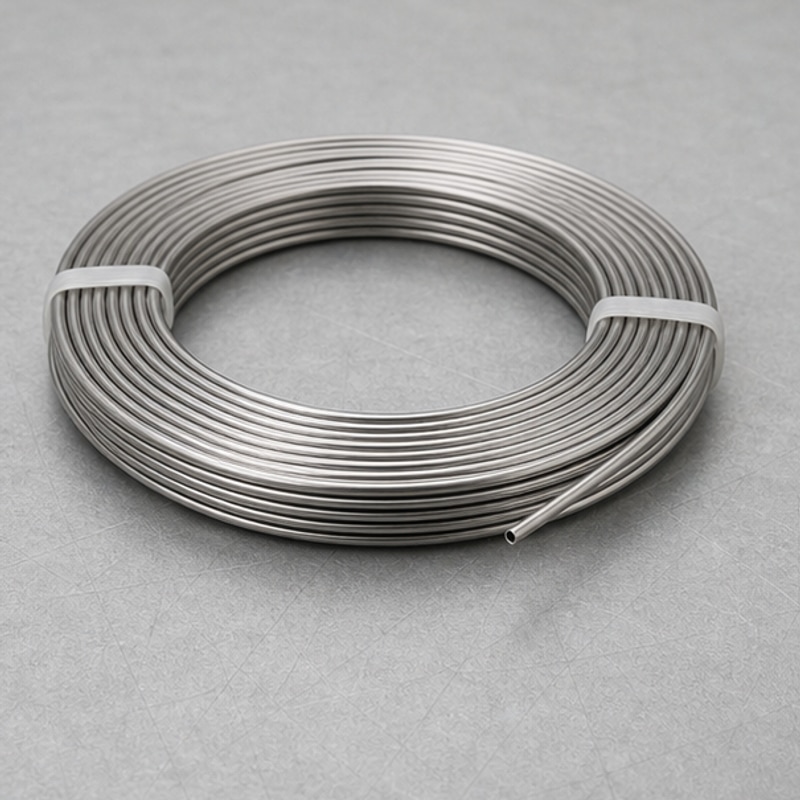
- Coiled for very small OD tubes (e.g., 0.5 mm OD) in continuous lengths.
- Individual sealed polyethylene bags for clean or high-purity applications.
- Wooden crates or corrugated boxes for export shipment to prevent bending or crushing.
If the tube requires oil-free or oxygen-clean packaging, this must be stated in the RFQ.
RFQ Information Checklist
To ensure accurate quoting and manufacturing of 321 welded capillary tube, the following information should be included in the request for quotation:
- Material grade (321) and applicable specification (ASTM A269 or A249).
- OD, wall thickness, and length (with tolerance limits).
- Quantity (total length or number of pieces).
- End condition (plain cut, deburred, chamfered).
- Surface finish requirement (Ra value and measurement method).
- Cleanliness level (degreased, oxygen-clean, etc.).
- Inspection documentation required (MTR, dimensional report, NDT).
- Packaging instructions (individual bagging, crating, etc.).
- Any special testing (hydrostatic, eddy current, burst test).
To request a quotation for 321 welded capillary tube, submit your drawings, material grade, quantity, tolerance, surface finish, and inspection requirements through the Healsmed website. The engineering team will review and respond with a technical evaluation.

Healsmed
Leading Stainless Steel Capillary Tube Factory. 1,400+ standard sizes IN STOCK & ready to ship worldwide! High precision, factory-direct price.