321 Small Diameter Tubing: Material Properties, Manufacturing Tolerances, and Application Guide
When your medical device design or industrial instrumentation requires resistance to intergranular corrosion in the 800°F to 1500°F (427°C to 816°C) range, standard 304 or 316L stainless steel may fail due to chromium carbide precipitation. This is the engineering problem that 321 small diameter tubing solves. You are sourcing a stabilized austenitic stainless steel capillary tube that maintains corrosion resistance after welding or exposure to elevated temperatures, without relying on post-weld heat treatment.
Applicable Scenarios and Industries
321 small diameter tubing is specified where the assembly will see sustained service temperatures or where welding is unavoidable and sensitization must be prevented. Common applications include:
- Thermowell sheaths and temperature sensor probes in exhaust or process gas streams
- Heat exchanger capillary bundles in pharmaceutical and chemical processing
- Hydraulic and pneumatic control lines in aerospace actuation systems
- Medical device components requiring ethylene oxide (EtO) or autoclave sterilization cycles
- Sample loops and transfer lines in analytical instrumentation (gas chromatography, mass spectrometry)
- Exhaust gas recirculation (EGR) and turbocharger oil lines in heavy-duty diesel engines
The key differentiator from 304 or 316L is the addition of titanium (Ti ≈ 5× C content minimum), which forms titanium carbides preferentially, leaving chromium in solid solution. This prevents sensitization and subsequent intergranular attack.
Material Grade and Designation
321 small diameter tubing corresponds to UNS S32100 and is covered under ASTM A269 (general-purpose seamless and welded tubing) and ASTM A213 (seamless ferritic and austenitic alloy-steel boiler, superheater, and heat-exchanger tubes). For capillary dimensions, ASTM A269 is the most commonly invoked standard.
| Element | Composition Range (wt%) per ASTM A269 |
|---|---|
| Carbon | 0.08 max |
| Manganese | 2.00 max |
| Phosphorus | 0.045 max |
| Sulfur | 0.030 max |
| Silicon | 1.00 max |
| Chromium | 17.0 – 19.0 |
| Nickel | 9.0 – 12.0 |
| Titanium | 5× (C + N) min, 0.70 max |
Note that 321H (UNS S32109, carbon 0.04–0.10) is specified when higher creep strength is needed above 1000°F, but for small diameter capillary tubing, standard 321 is typical.
OD / ID / Wall Thickness / Length Considerations
Small diameter 321 tubing is defined as outside diameter (OD) from 0.020″ (0.508 mm) up to 0.500″ (12.7 mm). Wall thickness can be as thin as 0.004″ (0.102 mm) for capillary applications, depending on drawing and process route. Lengths are typically supplied in random mill lengths (6–20 ft) or cut-to-length per drawing.
For precision applications, specify OD and ID tolerances together because thin-wall tubing (wall < 0.010") is more sensitive to ovality and concentricity variations. The ID is often the critical flow path in medical and analytical devices.
Tolerances (Typical Ranges for Capillary Tube)
For 321 small diameter tubing manufactured to ASTM A269, standard tolerances apply. Precision tolerances (often called “hypodermic” or “capillary” tolerances) require additional processing and are agreed upon between buyer and supplier.
| Parameter | Standard Tolerance (per ASTM A269) | Precision Tolerance (negotiated) |
|---|---|---|
| OD | ±0.005″ (for OD < 0.500") | ±0.001″ or tighter |
| Wall thickness | ±10% of nominal | ±5% of nominal or ±0.0005″ |
| Length | +1/8″ / -0″ for cut lengths | ±0.010″ (depending on drawing) |
| Straightness | 0.030″ per 3 ft (typical) | 0.005″ per ft (negotiated) |
These values depend on drawing, material condition, process route, and mutual agreement between parties. Always confirm with the supplier that the tolerance stack-up meets your assembly requirements.
End Condition and Burr Control
For 321 small diameter tubing, end condition is critical when the tube is used as a fluid path or welding prep. Standard ends are cut square with deburred OD and ID. For capillary dimensions (ID < 0.020"), burr removal from the ID is difficult but necessary to prevent flow restriction or particle entrapment. Specify “ID deburred” or “burr-free both ends” on your drawing. Laser cutting or precision abrasive cutting can achieve burr-free ends without secondary operations.
Surface Finish and Cleanliness Requirements
321 tubing is typically supplied in annealed condition (ASTM A269) with a bright annealed or pickled surface finish. For medical and analytical applications, specify:
- Surface roughness: Ra ≤ 16 µin (0.4 µm) ID and OD, or as required by your cleaning protocol.
- Cleanliness: Degreased and free of mill oils, chips, or abrasive media. Some applications require ultrasonic cleaning and packaging in a cleanroom environment.
- Passivation: Per ASTM A967, to remove free iron and restore the passive chromium oxide layer.
Do not assume “medical grade” finish; define your surface finish and cleanliness requirements explicitly in the RFQ.
Inspection Documentation
Standard documentation for 321 small diameter tubing includes:
- Mill test report (MTR) per ASTM A269 / EN 10204 3.1, showing heat number, chemical analysis, and mechanical properties (tensile, yield, elongation).
- Dimensional inspection report for OD, ID, wall, ovality, and length (sample or 100% as agreed).
- Surface finish report (if specified).
- Hydrostatic or pneumatic pressure test report (if required by your application).
For critical medical or aerospace applications, request a positive material identification (PMI) report to verify grade 321 composition on the finished tube.
Packaging Considerations
Small diameter 321 tubing is susceptible to kinking and surface damage during transit. Standard packaging includes:
- Individual tube sleeves or interleaving for cut lengths.
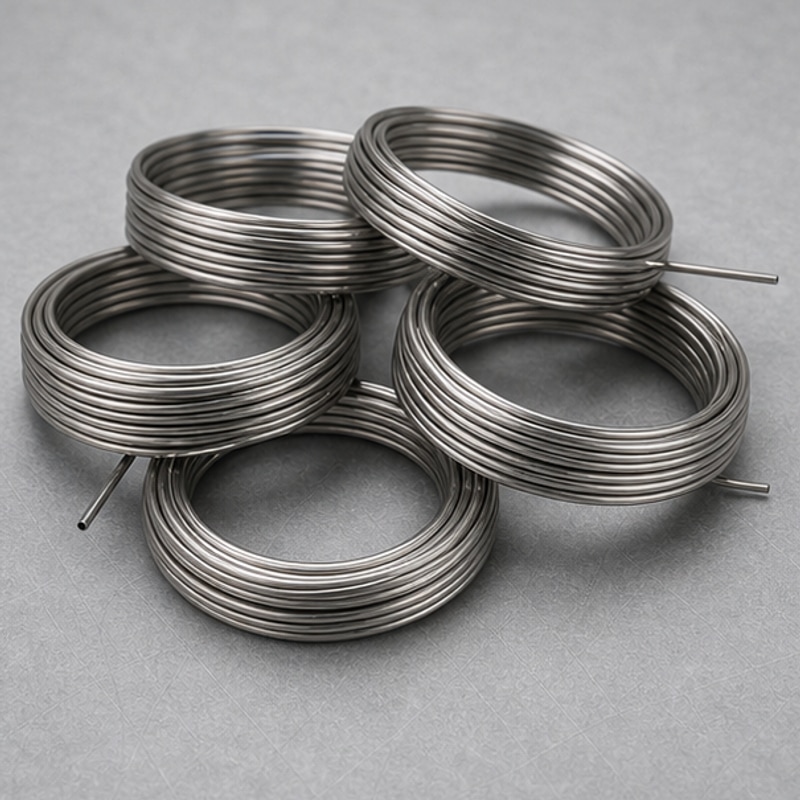
- Coils (if continuous length) on spools with controlled bend radius to prevent ovality.
- Foam-lined boxes or wooden crates for fragile capillary dimensions.
- Desiccant and sealed poly bags for cleanliness-sensitive applications.
Specify if you require cleanroom-level packaging (double bagged, Class 100 environment) or vacuum sealing for oxygen-sensitive assemblies.
RFQ Information Checklist
To receive an accurate technical evaluation for 321 small diameter tubing, include the following in your inquiry:
- Drawing or sketch with OD, ID (or wall), length, and tolerance callouts
- Material grade: 321 (UNS S32100) or 321H (if applicable)
- Quantity (pieces or total length in feet/meters)
- Surface finish: Ra value, ID/OD, and any passivation requirement
- End condition: square cut, deburred, chamfered, or special
- Inspection requirements: MTR, dimensional report, PMI, pressure test
- Packaging: standard, cleanroom, or vacuum-sealed
- Application context (e.g., thermowell, medical catheter, analytical line) – this helps the supplier evaluate fit-for-purpose
To request a quotation for 321 small diameter tubing, submit your drawings, material grade, quantity, tolerance, surface finish, and inspection requirements through the Healsmed website. The engineering team will review and respond with a technical evaluation.

Healsmed
Leading Stainless Steel Capillary Tube Factory. 1,400+ standard sizes IN STOCK & ready to ship worldwide! High precision, factory-direct price.