316L Welded Capillary Tube: Material Properties, Manufacturing Tolerances, and Application Guide
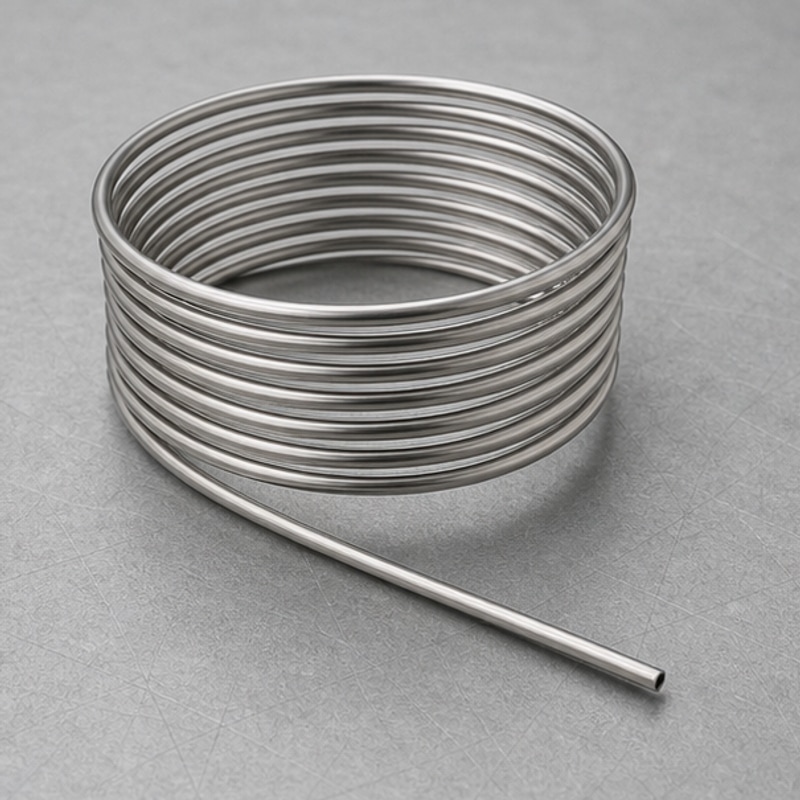
316L welded capillary tube is a precision component manufactured from flat strip that is roll-formed, longitudinally welded, and then drawn to achieve final dimensions. This process offers an alternative to seamless tube for applications where weld integrity is assured through proper process control and inspection. For buyers evaluating material options, understanding the distinctions in manufacturing route, material properties, and tolerance capabilities is essential for matching product performance to application requirements.
Understanding 316L Welded Capillary Tube: Material Selection Rationale
316L is a low-carbon version of 316 stainless steel, with a maximum carbon content of 0.03%, which minimizes sensitization during welding and prevents intergranular corrosion in heat-affected zones. The “L” designation is critical for welded products because the forming and welding process introduces thermal cycles that can otherwise precipitate chromium carbides at grain boundaries. For capillary tube applications, where wall thicknesses often fall below 0.5 mm, even localized carbide precipitation can compromise corrosion resistance. The austenitic structure of 316L also provides good toughness at cryogenic temperatures and adequate strength up to approximately 800°F (427°C) in continuous service.
Chemical Composition and Mechanical Properties of 316L
The table below lists the nominal chemical composition ranges for 316L stainless steel according to ASTM A240 and ASTM A269, which are common specifications for welded capillary tube. Actual composition varies by heat, but these limits define the material grade.
| Element | Composition Range (wt%) |
|---|---|
| Carbon (C) | 0.030 max |
| Manganese (Mn) | 2.00 max |
| Phosphorus (P) | 0.045 max |
| Sulfur (S) | 0.030 max |
| Silicon (Si) | 0.75 max |
| Chromium (Cr) | 16.0 – 18.0 |
| Nickel (Ni) | 10.0 – 14.0 |
| Molybdenum (Mo) | 2.00 – 3.00 |
| Iron (Fe) | Balance |
Typical mechanical properties for 316L welded capillary tube in the as-drawn condition (not annealed) are: tensile strength 485–620 MPa, yield strength (0.2% offset) 170–310 MPa, and elongation 30–40% in 2 inches. These values depend on the degree of cold work imparted during the drawing process. For applications requiring maximum ductility, a full anneal at 1900–2050°F followed by rapid cooling is specified.
Manufacturing Process: Strip, Weld, and Draw
The production of 316L welded capillary tube begins with precision-slit strip of controlled width. The strip is continuously formed into a tubular shape and joined by gas tungsten arc welding (GTAW) or laser welding. After welding, the bead is removed either by scarfing or by cold drawing, which reduces the weld zone to a homogeneous cross-section. Drawing passes are performed on a bull block or drawbench with intermediate anneals as needed. Typical starting OD for welded tube is 3–15 mm, and final capillary dimensions can be as small as 0.5 mm OD with wall thicknesses from 0.05 mm to 2.0 mm. The drawing process refines the grain structure and improves dimensional consistency, making the weld virtually indistinguishable from the base metal in the finished product.
Dimensional Specifications and Tolerance Classes
Capillary tube dimensional tolerances are governed by the drawing process and the number of passes. Standard commercial tolerances for 316L welded capillary tube are ±0.05 mm on OD for diameters up to 6.35 mm, and ±0.025 mm for precision-graded products. Wall thickness tolerance is typically ±10% of nominal, though tighter control is achievable with additional drawing passes. The table below summarizes typical tolerance classes available from Healsmed.
| OD Range (mm) | Standard Tolerance (mm) | Precision Tolerance (mm) |
|---|---|---|
| 0.50 – 3.00 | ±0.05 | ±0.025 |
| 3.01 – 6.35 | ±0.05 | ±0.025 |
| 6.36 – 12.70 | ±0.08 | ±0.05 |
Ovality is controlled to within half the OD tolerance for most applications. Straightness is specified as 1 mm per meter for standard, with tighter values available on request.
Welded vs Seamless: When to Specify 316L Welded Capillary Tube
The choice between welded and seamless capillary tube depends on application pressure, corrosion environment, and cost constraints. Seamless tube is formed by piercing a solid billet, which produces a homogeneous structure without a weld seam. It is preferred for high-pressure hydraulic lines and applications where any weld zone is considered a risk. Welded and drawn tube, however, offers several advantages: tighter dimensional tolerances (since the starting strip width is precisely controlled), lower cost per meter, and availability in longer continuous lengths. For many medical device and analytical instrumentation applications, where operating pressures are below 1000 psi and the primary concern is fluid flow consistency rather than burst strength, welded tube is entirely acceptable. The key is that the weld must be fully consolidated during drawing and verified by nondestructive examination such as eddy current testing or hydrostatic pressure testing.
Corrosion Resistance and Surface Finish Requirements
316L welded capillary tube offers excellent resistance to pitting and crevice corrosion in chloride-containing environments, thanks to the 2–3% molybdenum content. In marine atmospheres or biomedical implant contexts, 316L performs well, though for extended exposure to high-chloride solutions at elevated temperatures, higher-alloy grades such as 317L or 904L may be specified. Surface finish for capillary tube is typically specified as bright annealed (BA) or pickled (matte). BA finish provides a smooth, reflective surface with lower friction for fluid flow and easier cleaning. For applications requiring internal cleanliness—such as HPLC or gas chromatography—the tube is often supplied with an internal surface roughness of Ra ≤ 0.4 µm and cleaned to remove oils and particulate.
Quality Control and Inspection Protocol
Inspection of 316L welded capillary tube typically includes dimensional verification using laser micrometers and air gauges, eddy current testing to detect weld defects or pinholes, and pressure testing per ASTM A269 or customer-specified standards. For medical device applications, additional requirements may include 100% visual inspection under magnification, cleanliness testing per ISO 13485, and material traceability from melt to finished tube. Healsmed maintains in-house metallographic examination capability for weld zone evaluation on qualification samples.
Industry-Specific Applications for 316L Welded Capillary Tube
Common applications include: fluid transfer lines in gas chromatography and mass spectrometry instruments; catheter components and guidewire delivery systems in interventional medical devices; sensor housings and thermocouple sheaths in industrial process control; and miniature heat exchangers for semiconductor fabrication equipment. In each case, the combination of corrosion resistance, dimensional precision, and cost-effectiveness makes 316L welded capillary tube a practical choice where the weld zone is not subjected to cyclic fatigue at stress levels above the endurance limit of the base metal.
Procurement Checklist for 316L Welded Capillary Tube
When specifying 316L welded capillary tube, confirm the following: material certification to ASTM A269 or ASTM A213; dimensional tolerance class (standard or precision); surface finish (BA or pickled); internal cleanliness requirement; inspection and test reports required (eddy current, pressure test, dimensional report); and length requirements (cut-to-length or coil). Also verify whether the tube will be annealed after final drawing, as this affects mechanical properties and corrosion resistance.
For more information about 316L welded capillary tube, contact Healsmed’s engineering team with your material grade, drawing, tolerance requirements, and quantity. Submit inquiries through the Healsmed website for prompt technical review and quotation.
Conclusion
316L welded capillary tube provides a reliable and economical solution for applications where precision dimensions, corrosion resistance, and weld integrity are required. The welded and drawn manufacturing process yields consistent geometry and a homogeneous cross-section when properly controlled. Engineers should evaluate application pressure, corrosion exposure, and inspection requirements when deciding between welded and seamless routes.
With appropriate material certification, dimensional tolerances, and nondestructive testing, 316L welded capillary tube meets the performance demands of medical devices, analytical instruments, and industrial systems. Healsmed offers this product in a range of sizes from 0.5 mm to 12.7 mm OD, with wall thicknesses from 0.05 mm to 2.0 mm, and supports custom tolerance and finish requirements.

Healsmed
Leading Stainless Steel Capillary Tube Factory. 1,400+ standard sizes IN STOCK & ready to ship worldwide! High precision, factory-direct price.