316L Seamless Capillary Tubing: Material Properties, Manufacturing Tolerances, and Application Guide
When specifying 316L seamless capillary tubing for precision fluid delivery, sensor isolation, or medical device components, engineers evaluate a material that balances corrosion resistance with mechanical reliability. This article examines the metallurgical properties, manufacturing tolerances, and application-specific considerations for 316L seamless capillary tubing, providing procurement and design teams with the technical data needed for informed material selection.
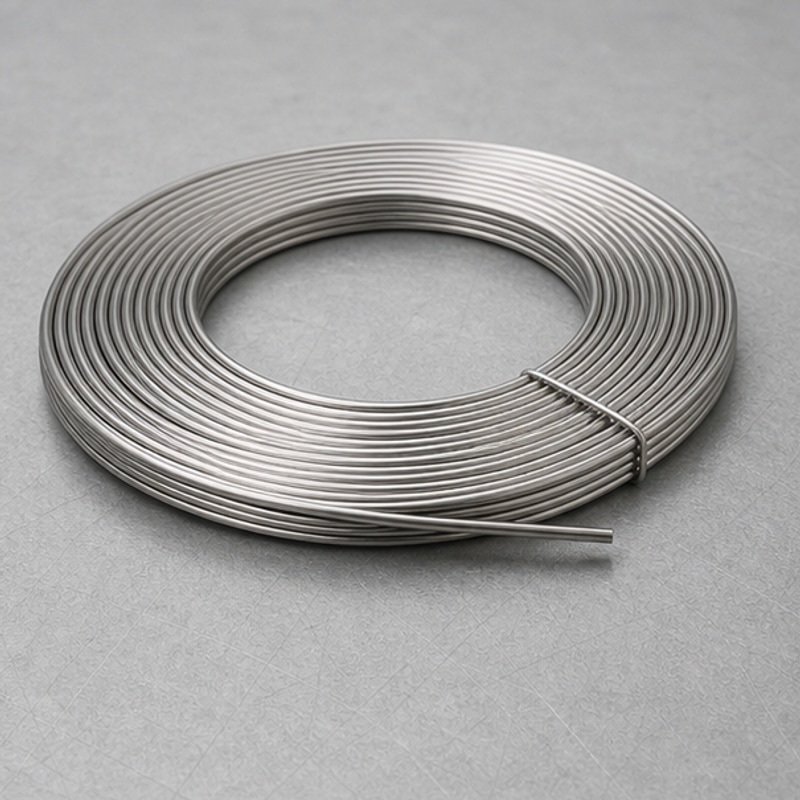
Chemical Composition and Mechanical Properties of 316L
316L is a low-carbon austenitic stainless steel (UNS S31603) with a maximum carbon content of 0.03% by weight, which distinguishes it from standard 316 (max 0.08% C). The reduced carbon minimizes chromium carbide precipitation during welding or thermal exposure, preserving corrosion resistance in as-welded or drawn conditions. Typical chemical composition ranges for 316L capillary tubing are:
| Element | Weight % (Range) |
|---|---|
| Chromium (Cr) | 16.0 – 18.0 |
| Nickel (Ni) | 10.0 – 14.0 |
| Molybdenum (Mo) | 2.0 – 3.0 |
| Carbon (C) | 0.03 max |
| Manganese (Mn) | 2.0 max |
| Silicon (Si) | 0.75 max |
| Phosphorus (P) | 0.045 max |
| Sulfur (S) | 0.030 max |
| Iron (Fe) | Balance |
Mechanical properties for annealed 316L seamless capillary tubing typically meet: tensile strength 485 MPa minimum, yield strength (0.2% offset) 170 MPa minimum, elongation 40% minimum in 50 mm. Hardness is typically 95 HRB max. These values provide sufficient ductility for bending and flaring while maintaining adequate burst pressure for high-pressure fluidic systems.
Why Seamless Construction Matters for 316L Capillary Tubing
Seamless tubing is produced by piercing a solid billet and drawing it through dies without any longitudinal weld seam. For 316L capillary tubing, the absence of a weld zone eliminates a common failure initiation site. In welded tubing, the weld bead and heat-affected zone can exhibit altered grain structure, residual stresses, and potential chromium carbide precipitation—even with L-grade material if welding parameters are not controlled. Seamless drawn tubing provides a uniform, equiaxed grain structure throughout the wall cross-section. This uniformity translates to more predictable burst pressure, consistent corrosion resistance across the entire circumference, and no risk of weld-line cracking during subsequent bending or swaging operations. For applications demanding pressure integrity, such as HPLC columns, gas chromatography, or hydraulic sensing lines, seamless 316L capillary tubing is the preferred procurement specification.
Dimensional Specifications and Tolerance Classes
316L seamless capillary tubing is available in a broad range of dimensions suited to precision instrumentation. Typical outer diameters range from 0.5 mm to 12.7 mm, with wall thicknesses from 0.05 mm to 2.0 mm. Tolerances depend on the drawing process and final annealing condition. Standard commercial tolerances for cold-drawn capillary tubing are ±0.025 mm to ±0.05 mm on outer diameter, with tighter tolerances achievable by specifying precision-drawn or centerless ground finishes. Wall thickness tolerances are typically ±10% of nominal wall for standard drawing, and ±5% for close-tolerance orders. Straightness is a critical parameter for capillary tubing; standard straightness is 1 mm per 1000 mm length, with tighter straightness available for automated assembly. The following table summarizes typical tolerance classes:
| Tolerance Class | OD Tolerance (mm) | Wall Tolerance | Typical Application |
|---|---|---|---|
| Commercial | ±0.05 | ±10% | General fluid transfer |
| Precision | ±0.025 | ±5% | Analytical instrumentation |
| High-Precision | ±0.012 | ±3% | Medical device cannula |
Corrosion Resistance and Service Temperature
316L seamless capillary tubing offers superior corrosion resistance to 304L in chloride-containing environments due to the 2-3% molybdenum addition. In laboratory tests, 316L resists pitting and crevice corrosion in solutions containing up to 2000 ppm chloride at ambient temperatures, whereas 304L may show initiation above 200 ppm. For applications in biomedical devices, analytical chemistry, or offshore instrumentation, this makes 316L a safer choice. Maximum service temperature for continuous use in oxidizing atmospheres is approximately 870°C, although for capillary tubing used in heated GC columns or process analyzers, sustained use above 425°C should be evaluated for sensitization risk despite the low carbon content. Scaling resistance begins to degrade above 800°C.
Manufacturing Process: From Billet to Drawn Capillary
The production of 316L seamless capillary tubing begins with an extruded or rotary-pierced hollow shell from a continuously cast or wrought billet. The shell is then cold drawn through a series of dies with intermediate annealing to restore ductility. For capillary sizes, multiple drawing passes are required to achieve the final OD and wall combination. Each pass reduces cross-sectional area by 15-30%, with full annealing at 1040-1120°C followed by rapid cooling (water quench or forced air) to maintain the austenitic structure and prevent carbide precipitation. Final drawing passes may be performed without intermediate anneal (hard drawn) to achieve higher tensile strength, or with a final bright anneal in a hydrogen atmosphere for a clean, oxide-free surface. Surface finish after drawing is typically 0.4-0.8 µm Ra for standard tubing, with electropolishing available for applications requiring internal cleanliness below 0.2 µm Ra.
Industry-Specific Applications for 316L Seamless Capillary Tubing
In medical devices, 316L seamless capillary tubing is used for hypodermic needles, catheter components, and minimally invasive surgical instruments where corrosion resistance to bodily fluids, clean surfaces, and lot traceability are critical. The seamless construction eliminates crevices that could harbor bacteria or cause hemolysis. In analytical instrumentation, 316L capillary tubing serves as columns for gas chromatography, transfer lines for liquid chromatography, and sample loops for process analyzers. Dimensional consistency and internal surface finish directly impact peak resolution and flow repeatability. For industrial applications, 316L seamless capillary tubing is specified for pneumatic control lines, hydraulic pressure sensing, and chemical injection systems in petrochemical and pharmaceutical plants. The combination of pressure rating (burst pressure can exceed 1000 bar for small OD thick-wall configurations) and chemical resistance makes it a standard choice for OEM designers.
Quality Control and Inspection Protocol
Procurement of 316L seamless capillary tubing should specify inspection criteria. Common quality control steps include: chemical composition verification via optical emission spectrometry (OES) or combustion analysis; mechanical testing per ASTM A1016 (tensile, flattening, flange, and hardness); dimensional gauging using laser micrometers or air gauges for OD, and ultrasonic thickness measurement for wall; eddy current or ultrasonic testing for surface and subsurface flaws (per ASTM E213 or E309); and hydrostatic or pneumatic pressure testing for leak integrity. For tubing governed by medical device quality agreements, additional requirements may include cleanliness testing (particulate count, organic residue), surface roughness measurement, and certification of raw material traceability. Buyers should request a material test report (MTR) per EN 10204 Type 3.1 or 3.2 for full traceability.
Procurement Checklist for 316L Seamless Capillary Tubing
When sourcing 316L seamless capillary tubing, verify the following: material specification (ASTM A269 for general service, ASTM A213 for boiler/superheater, or ASTM A511 for mechanical tubing); dimensional tolerances as per your drawing; surface finish requirement (as-drawn, bright annealed, electropolished); straightness and length tolerance; packaging (individual sleeves, coiled, or cut lengths); and certification level. Confirm that the supplier can provide a seamless product—some suppliers may offer welded-and-drawn tubing that resembles seamless but retains a fused seam. Request a cross-sectional micrograph or eddy current test report to verify seamless construction if the tubing is small diameter.
For more information about 316L seamless capillary tubing, contact Healsmed’s engineering team with your material grade, drawing, tolerance requirements, and quantity. Submit inquiries through the Healsmed website for prompt technical review and quotation.
Conclusion
316L seamless capillary tubing remains a reliable material choice for applications requiring corrosion resistance, dimensional precision, and pressure integrity. The low-carbon chemistry combined with seamless drawing delivers a product free from weld-zone weaknesses, with uniform mechanical properties suitable for bending, flaring, and high-cycle pressure service. Engineers specifying this material should pay attention to tolerance class, surface finish, and manufacturing route—seamless drawn versus welded-and-drawn—to ensure the tubing meets the application’s performance requirements.
For OEM buyers, establishing clear dimensional and inspection criteria at the procurement stage reduces the risk of field failures and ensures consistent production output. By understanding the material’s limits and manufacturing capabilities, design teams can confidently specify 316L seamless capillary tubing for medical, analytical, and industrial fluid systems.

Healsmed
Leading Stainless Steel Capillary Tube Factory. 1,400+ standard sizes IN STOCK & ready to ship worldwide! High precision, factory-direct price.