Super Duplex 2507 Small Diameter Tubing: Material Properties, Manufacturing Tolerances, and Application Guide
Engineers sourcing super duplex 2507 small diameter tubing are typically working on instrumentation, hydraulic control lines, or heat exchanger circuits where chloride stress corrosion cracking and pitting resistance are the limiting design factors. The challenge is not finding the alloy — it is finding a supplier who can deliver capillary-scale dimensions in a material that is notoriously difficult to cold draw, while holding tolerances, surface finish, and documentation that match the drawing. This guide covers what buyers and designers should specify, verify, and expect when sourcing UNS S32750 tubing in small diameters.
Why Super Duplex 2507 Instead of 316L or 6Mo
Super duplex 2507 (UNS S32750) is a ferritic-austenitic stainless steel with a PREN (Pitting Resistance Equivalent Number) typically above 40, depending on the exact composition and calculation method used. That places it well above 316L and meaningfully above standard duplex 2205. The practical consequence for small diameter tubing is that it can tolerate chloride-bearing environments, seawater exposure, and elevated temperatures where 316L would be expected to pit or crack.
Compared with 6Mo super austenitic grades, 2507 offers higher mechanical strength and better thermal conductivity, but it is harder to cold form and more sensitive to improper heat treatment. For capillary and small-diameter tubing, that trade-off is the central engineering decision.
Applicable Scenarios and Industries
- Downhole and subsea instrumentation and chemical injection lines
- Hydraulic and pneumatic control tubing on offshore and marine equipment
- Heat exchanger and cooling coil tubing in chlorinated or brackish water systems
- Process analyzer and sampling lines in petrochemical and refining service
- Pressure sensing and impulse lines in high-chloride environments
Super duplex is generally not the right choice for strong reducing acids, high-temperature caustic service, or applications above the temperature range where the 50/50 ferrite-austenite balance is maintained. Those cases usually point to a nickel alloy instead.
Material Grade and Designations
Buyers should confirm the exact designation on the purchase order, because several closely related grades are sometimes quoted interchangeably.
| UNS | S32750 |
| Common trade name | Super Duplex 2507, SAF 2507 |
| EN / W. Nr. | 1.4410 |
| Product form | Seamless or welded-and-drawn small diameter tubing |
| Typical specification | ASTM A789 / A790 for tubing; ASTM A276 for bar stock |
Confirm with the supplier which specification governs the finished tube, since welded-and-drawn product is often certified to a different specification than seamless. Chemical composition limits should be verified against the applicable ASTM or EN standard for the specific product form and heat.
OD, ID, Wall Thickness, and Length Considerations
Small diameter super duplex tubing is commonly requested in the range of roughly 1.5 mm to 25 mm OD, with wall thicknesses from about 0.2 mm upward. The exact achievable combination depends on the drawing route, the required mechanical properties, and the surface finish specification.
Wall thickness selection is usually driven by pressure rating and corrosion allowance rather than by formability. Because 2507 work-hardens rapidly, very thin walls in small diameters require more intermediate anneals and more careful die design than 316L. Buyers should expect the supplier to confirm feasibility against the drawing rather than quoting from a generic size list.
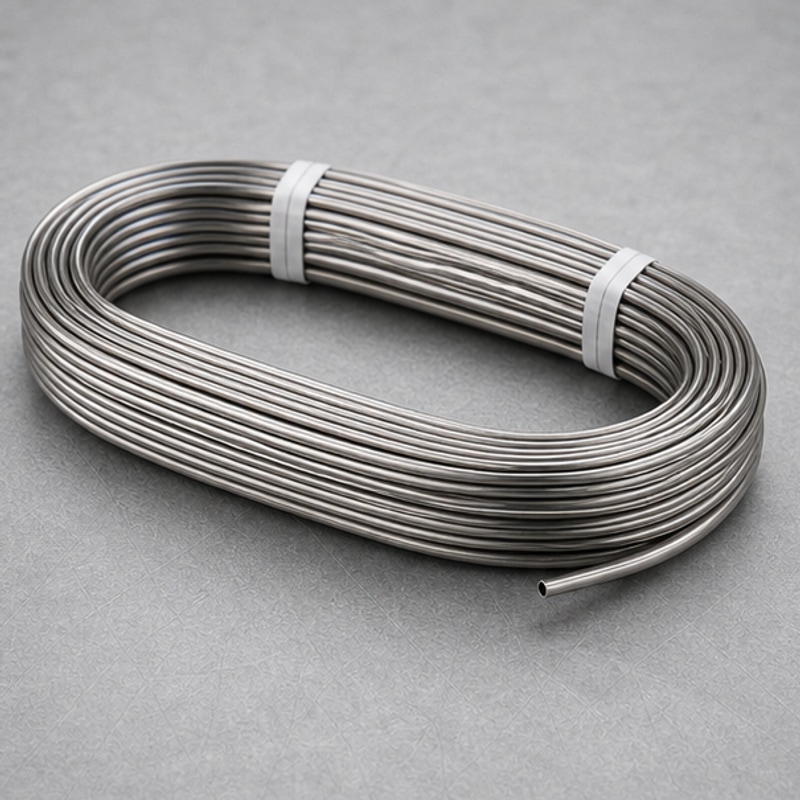
Length can be supplied as random lengths, fixed cut lengths, or coiled depending on OD and wall. Coiled supply is common for instrumentation lines; straight lengths are typical for heat exchanger and precision assembly work.
Tolerances for Capillary and Small Diameter Tubing
Typical commercial tolerances vary widely by size and by whether the tube is seamless or welded-and-drawn. The values below are representative ranges; the actual tolerance must be stated on the drawing and agreed between parties.
| OD tolerance | Typically ±0.05 mm to ±0.10 mm for small capillary sizes; wider for larger OD |
| Wall tolerance | Typically ±10% of nominal wall, sometimes tighter by agreement |
| ID tolerance | Derived from OD and wall; specify directly if the ID is functional |
| Straightness | Usually expressed as mm per meter; depends on temper and length |
| Concentricity | Wall eccentricity is a function of the drawing process; specify if critical |
For pressure-containing or flow-critical applications, specify OD, ID, and wall independently rather than relying on a single nominal size.
End Condition and Burr Control
Super duplex is tough and gummy relative to 316L, so burr formation at cut ends is a real concern. Common end conditions include:
- Clean cut, deburred, square to within a stated angle
- Chamfered for orbital welding or fitting insertion
- Prepared for compression or bite-type fittings
- Sealed or capped for shipment
If the tube will be welded, specify the end preparation and the maximum allowable burr height. If it will be inserted into a ferrule fitting, specify the OD finish and ovality at the end.
Surface Finish and Cleanliness
Surface finish requirements for super duplex small diameter tubing usually fall into one of three categories:
- As-drawn — acceptable for many hydraulic and structural uses
- Pickled and passivated — removes heat tint and restores the passive layer after annealing
- Bright annealed or electropolished — used when internal cleanliness or low particle shedding matters
Internal cleanliness specifications (for example, maximum particle size or residual contamination limits) should be stated explicitly if the tube is destined for analyzer, sampling, or high-purity service. Do not assume that a standard mill finish meets a cleanliness requirement that is not written on the drawing.
Inspection Documentation
For super duplex, documentation is often as important as the tube itself. Typical documents requested by medical device, oil and gas, and process industry buyers include:
- Material test certificate (EN 10204 3.1 or equivalent) with heat number and chemical composition
- Mechanical property results — tensile, yield, elongation, hardness
- Ferrite content verification, since the ferrite-austenite balance affects corrosion resistance and toughness
- Dimensional inspection report against the drawing
- Surface finish and cleanliness report where specified
- Hydrostatic or pneumatic pressure test record where applicable
Confirm in advance which documents are included as standard and which are chargeable extras.
Packaging Considerations
Super duplex tubing is susceptible to mechanical damage and to chloride contamination from packaging materials. Specify:
- Straight lengths in rigid tubes or wooden boxes with end protection
- Coils supported to prevent kinking and to maintain minimum bend radius
- Chloride-free packaging materials for corrosion-sensitive end uses
- End caps or plugs to keep internal surfaces clean
- Labeling with heat number, size, and specification for traceability
RFQ Information Checklist
To get an accurate quotation and a realistic feasibility assessment, include the following in your inquiry:
- Material grade and specification (for example, UNS S32750, ASTM A789)
- OD, ID, and wall thickness with tolerances
- Length — random, fixed, or coiled, with coil weight or length limits
- Temper or condition (annealed, cold worked, etc.)
- Surface finish and internal cleanliness requirements
- End condition and burr limits
- Pressure rating or test requirements
- Inspection documents required
- Quantity and delivery schedule
- Any special packaging or traceability requirements
To request a quotation for super duplex 2507 small diameter tubing, submit your drawings, material grade, quantity, tolerance, surface finish, and inspection requirements through the Healsmed website. The engineering team will review and respond with a technical evaluation.

Healsmed
Leading Stainless Steel Capillary Tube Factory. 1,400+ standard sizes IN STOCK & ready to ship worldwide! High precision, factory-direct price.