Inconel 825 Seamless Capillary Tube: Material Properties, Manufacturing Tolerances, and Application Guide
Engineers sourcing Inconel 825 seamless capillary tube are typically specifying a nickel-iron-chromium alloy tube for instrumentation, chemical processing, or high-temperature service where 316L would corrode too quickly. The challenge is not finding the alloy — it is finding a mill or distributor who can supply seamless capillary in the exact OD, ID, wall, and temper you need, with the dimensional and documentation package your quality system requires. This guide covers what to specify, what to verify, and how to structure an RFQ that gets an accurate response.
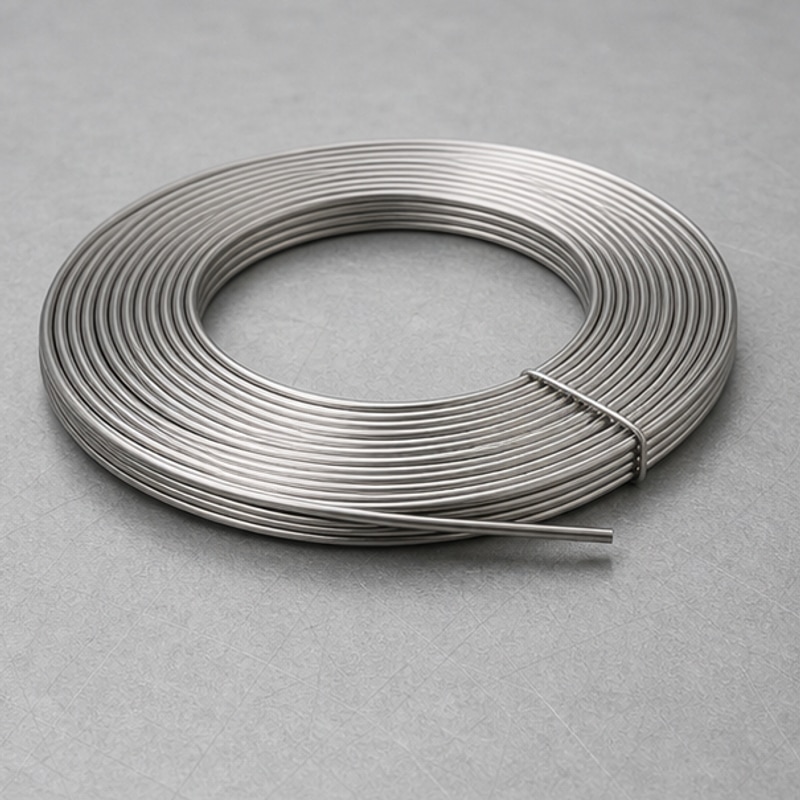
What Inconel 825 Is and Why It Is Specified
Inconel 825 (UNS N08825) is a nickel-iron-chromium alloy with additions of molybdenum, copper, and titanium. The chemistry is designed to resist both oxidizing and reducing acids, and to resist chloride-ion stress-corrosion cracking. It is not a stainless steel in the 300-series sense, although it is often grouped with corrosion-resistant alloys in procurement discussions.
Typical chemical composition ranges per ASTM B423 / ASME SB423 include:
- Nickel: 38.0–46.0%
- Chromium: 19.5–23.5%
- Iron: balance (minimum 22.0%)
- Molybdenum: 2.5–3.5%
- Copper: 1.5–3.0%
- Titanium: 0.6–1.2%
- Carbon: 0.05% max
- Manganese: 1.0% max
- Sulfur: 0.03% max
- Silicon: 0.5% max
- Aluminum: 0.2% max
These ranges are from the ASTM specification for seamless nickel-iron-chromium alloy pipe and tube. Always confirm the applicable revision and product form, because composition limits can differ between plate, bar, and tube specifications.
Applicable Scenarios and Industries
Inconel 825 seamless capillary tube is specified when the service environment combines chlorides, acids, and elevated temperature, and when the tube bore must remain clean and dimensionally stable. Common applications include:
- Chemical processing: sampling lines, injection quills, and instrument impulse lines handling sulfuric or phosphoric acid streams
- Oil and gas: downhole instrumentation and surface sampling in sour service where sulfide stress cracking is a concern
- Pollution control: flue-gas desulfurization spray and sampling lances
- Nuclear and power: heat-exchanger and instrumentation tubing where alloy 825 is already qualified in the plant specification
- Medical and analytical: only where the alloy is explicitly required by the end application; Inconel 825 is not a standard implant material and should not be assumed biocompatible without application-specific evaluation
If your application is primarily aqueous corrosion at ambient temperature and you do not need the nickel content, 316L or 904L may be more economical. Inconel 825 is a deliberate choice for aggressive chemistry, not a default upgrade.
Seamless vs. Welded Capillary
The keyword specifies seamless. Seamless tube is produced by piercing and cold-drawing a billet or tube shell, so there is no longitudinal weld. For capillary dimensions, seamless is often requested because:
- No weld bead or heat-affected zone inside the bore
- More uniform concentricity at small OD
- Preferred or required by many instrument and sampling specifications
Welded-and-drawn capillary can meet many of the same dimensional requirements at lower cost, but if the specification says seamless, the mill certificate must state seamless. Do not accept a welded tube with a drawn finish as a substitute without written approval from the end user.
OD, ID, Wall Thickness, and Length
Capillary tube is generally defined by outside diameter, inside diameter, and wall. For Inconel 825 seamless capillary, common supply ranges include:
| Parameter | Typical range | Notes |
|---|---|---|
| Outside diameter | 0.5 mm to 12.7 mm (0.020 in to 0.500 in) | Smaller and larger sizes depend on mill capability and drawing |
| Wall thickness | 0.05 mm to 1.5 mm | Wall-to-OD ratio affects drawability and concentricity |
| Inside diameter | Derived from OD minus 2× wall | ID is usually specified as a minimum or range, not a single value |
| Length | Straight lengths or coils | Coil weights and straight lengths depend on OD and wall |
These are general industry ranges, not a statement of Healsmed inventory. Exact availability depends on drawing, material condition, process route, and mutual agreement between parties.
Tolerances for Capillary Tube
Tolerance is where most RFQs fail. Capillary buyers often need tighter control than standard pipe or heat-exchanger tube tolerances. Typical capillary tolerances for cold-drawn seamless tube can include:
- OD: ±0.05 mm or tighter, depending on size and drawing
- Wall: ±10% of nominal wall, or tighter by agreement
- ID: controlled by mandrel or plug during drawing; specify as a range
- Concentricity: often expressed as a percentage of wall
- Straightness: specified as mm per meter or mm per foot
- Length: ±1 mm or better for cut-to-length straight pieces
Do not assume a tolerance from a previous stainless project applies to Inconel 825. The alloy work-hardens differently, and the draw schedule affects achievable concentricity and surface finish. State the functional requirement — for example, “must pass a 0.5 mm gauge ball” — rather than only a nominal ID.
End Condition and Burr Control
Capillary tube end condition matters for both assembly and cleanliness. Common end conditions include:
- Clean cut with deburred ID and OD
- Square cut to a specified angle tolerance
- Chamfered for fitting or welding
- Sealed or capped for shipment
Burr control is especially important in instrument lines and medical devices. Specify whether a burr is acceptable, and if so, the maximum height. If the tube will be swaged, welded, or inserted into a fitting, the end condition should be agreed before production.
Surface Finish and Cleanliness
Inconel 825 capillary can be supplied in as-drawn, bright annealed, or pickled condition. For high-purity or analytical service, additional cleaning may be specified. Relevant requirements may include:
- Surface roughness (Ra) target for ID and OD
- Freedom from scale, drawing lubricant, and embedded particles
- Passivation or citric acid cleaning if specified by the end user
- Bore cleanliness verified by wipe test or flow test
Surface finish and cleanliness requirements should be stated as measurable criteria. “Clean” is not a specification. If the tube is for a medical device, the device manufacturer is responsible for validating the cleaning and biocompatibility of the final product; the tube supplier provides the material and dimensional documentation.
Inspection Documentation
For Inconel 825 seamless capillary, a typical documentation package can include:
- Mill certificate or material test report (MTR) showing chemistry and mechanical properties
- Dimensional inspection report with OD, ID, wall, and length results
- Concentricity and straightness data if specified
- Surface finish and cleanliness records if specified
- Hydrostatic or pneumatic test report if required by the specification
- Eddy current or ultrasonic test report if specified
- Certificate of conformance (CoC) to the purchase order
Specify the standard and revision you want the material certified to, such as ASTM B423 or ASME SB423. If you need EN or ISO equivalents, state the exact designation. Do not assume a supplier’s standard package matches your quality system.
Packaging Considerations
Inconel 825 capillary is susceptible to mechanical damage and surface contamination during shipping. Packaging should protect:
- Tube ends from deformation and burrs
- Bore from dust, moisture, and oil
- Surface from scratches and handling marks
Common packaging methods include plastic end caps, heat-sealed bags, rigid tubes or wooden boxes for straight lengths, and coil wraps for coiled product. If cleanliness is critical, specify bagging and labeling requirements in the purchase order.
RFQ Information Checklist
To get an accurate quotation for Inconel 825 seamless capillary tube, include the following in your request:
- Material grade and UNS number: Inconel 825 / UNS N08825
- Product form: seamless capillary tube
- Dimensions: OD, ID or wall, and length
- Tolerances: OD, wall, ID, concentricity, straightness, and length
- Quantity: total length, number of pieces, or coil weight
- Condition: as-drawn, bright annealed, pickled, or other
- Surface finish and cleanliness requirements
- End condition: cut, deburred, chamfered, capped
- Inspection and documentation: MTR, dimensional report, test reports, CoC
- Applicable standard and revision: ASTM B423, ASME SB423, or other
- Packaging and labeling requirements
- Delivery destination and any shipping constraints
If a requirement is not yet fixed, state the functional need. A supplier who understands the application can propose a practical tolerance and process route.
To request a quotation for Inconel 825 seamless capillary tube, submit your drawings, material grade, quantity, tolerance, surface finish, and inspection requirements through the Healsmed website. The engineering team will review and respond with a technical evaluation.

Healsmed
Leading Stainless Steel Capillary Tube Factory. 1,400+ standard sizes IN STOCK & ready to ship worldwide! High precision, factory-direct price.