Inconel 625 Seamless Capillary Tube: Material Properties, Manufacturing Tolerances, and Application Guide
When an engineer searches for an Inconel 625 seamless capillary tube, the goal is usually specific: source a small-diameter, high-pressure or high-temperature line that resists chloride pitting and crevice corrosion where 316L would fail, while holding tight OD/ID tolerances and a clean, burr-controlled bore. Inconel 625 (UNS N06625) is a nickel-chromium-molybdenum-niobium alloy supplied under specifications such as ASTM B444 and ASTM B829, and it is commonly selected for instrumentation, sampling, and fluid-handling lines in aggressive service. This guide covers what to specify, how seamless capillary tubing is manufactured and inspected, and what to include in an RFQ.
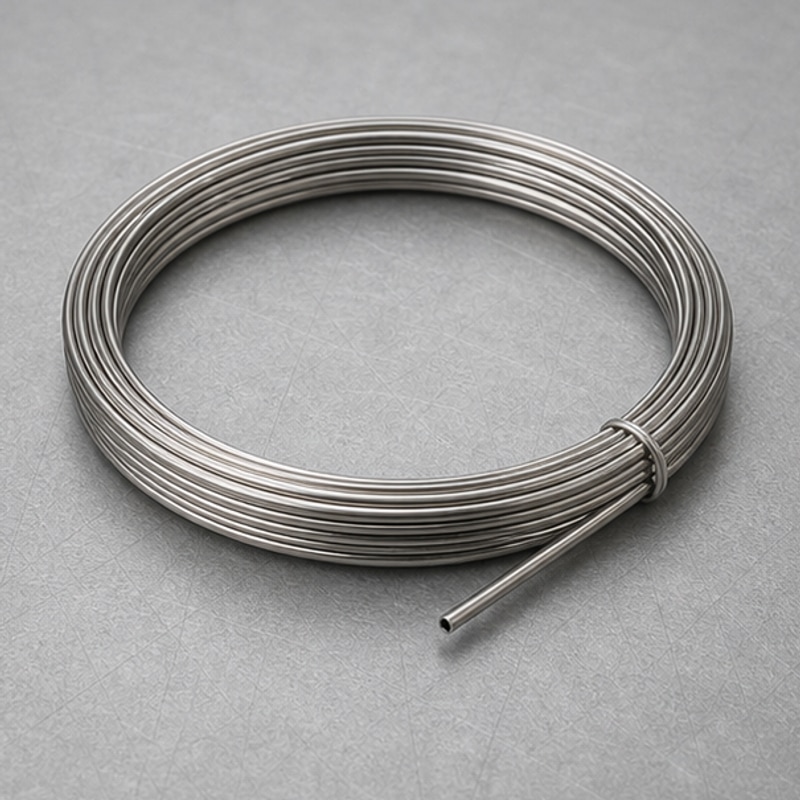
Why Inconel 625 for Seamless Capillary Tubing
Inconel 625 is a solid-solution-strengthened nickel alloy with molybdenum and niobium additions. Compared with austenitic stainless steels such as 304 or 316L, it offers substantially higher resistance to pitting, crevice corrosion, and stress-corrosion cracking in chloride-bearing environments, and it retains useful strength at elevated temperatures. For capillary-scale tubing, the practical benefits are:
- Corrosion resistance in seawater, brine, and chloride-containing process streams.
- High yield strength relative to 316L, supporting thinner walls at a given pressure rating.
- Good fatigue and thermal-fatigue behavior for cyclic service.
- Weldability and brazeability for fittings and sensor assemblies.
Seamless construction is normally specified where the bore must be free of a longitudinal weld, where pressure integrity is critical, or where the tube will be bent, coiled, or subjected to vibration. Welded-and-drawn tubing is available in the market, but it is a different product with different inspection implications; specify “seamless” explicitly if that is what the design requires.
Material Grades and Designations
For capillary tubing, the relevant designations are typically:
| Designation | Notes |
|---|---|
| UNS N06625 | Base alloy designation for Inconel 625. |
| ASTM B444 | Standard specification for nickel-chromium-molybdenum-columbium alloys (UNS N06625) pipe and tube. |
| ASTM B829 | General requirements for nickel and nickel alloy pipe and tube. |
| Grade 1 / Grade 2 | ASTM B444 distinguishes Grade 1 (annealed, lower carbon) and Grade 2 (solution-treated, higher carbon). Grade 2 is often specified where higher creep or elevated-temperature strength is needed. |
| DIN 17752 / 17753 | German wrought nickel alloy specifications, sometimes cited in European drawings. |
Confirm the grade and heat treatment condition on the drawing. Chemistry and mechanical properties must be reported against the applicable ASTM or customer specification; do not assume a supplier’s generic “Inconel 625” meets a specific grade without a certificate.
Applicable Scenarios and Industries
Inconel 625 seamless capillary tubing is commonly considered for:
- Oil and gas downhole instrumentation, chemical injection, and sampling lines.
- Chemical process and petrochemical pressure instrumentation, impulse lines, and analyzer tubing.
- Marine and offshore sensor and hydraulic lines exposed to seawater.
- Aerospace and defense fluid and pneumatic lines where high strength and corrosion resistance are required.
- Semiconductor and specialty gas systems where contamination control is critical.
- Medical device and analytical instrument fluid paths, subject to the device manufacturer’s own biocompatibility and cleaning validation requirements.
Note that “medical” or “implant” suitability is a function of the finished device, its cleaning and passivation, and the manufacturer’s regulatory submissions. A tube supplier’s material certificate does not by itself establish biocompatibility or regulatory clearance.
OD, ID, Wall Thickness, and Length
Capillary tubing is generally produced in the small-diameter range, but exact limits depend on the mill, the drawing route, and the ordered quantity. Typical parameters to define on a drawing include:
- Outside diameter (OD): specify nominal and tolerance band, e.g., 0.5 mm to several millimeters depending on application.
- Inside diameter (ID): critical for flow rate, pressure drop, and cleaning; specify nominal and tolerance.
- Wall thickness: derived from OD and ID; state minimum wall if pressure rating is the driver.
- Length: straight lengths, random lengths, or coiled lengths; state whether random or fixed.
- Straightness: important for automated feeding and bending; specify if required.
Because seamless capillary drawing is a multi-pass process, achievable OD/ID combinations and tolerances vary. Where a specific value cannot be guaranteed, the drawing should state the requirement and the acceptable range, and the supplier should confirm feasibility before quoting.
Tolerances for Capillary Tube
Tolerance capability depends on material, size, wall thickness, anneal condition, and process route. The table below shows typical categories to discuss with a supplier; actual values must be confirmed against the drawing and mutual agreement.
| Parameter | Typical specification approach |
|---|---|
| OD tolerance | Expressed as ± mm or as a percentage of OD; tighter bands may be achievable on smaller sizes depending on process route. |
| ID tolerance | Often specified as a minimum ID or a range; verify with the supplier because ID is harder to hold than OD after drawing and annealing. |
| Wall thickness | Specify nominal and minimum wall; eccentricity may be a separate requirement. |
| Concentricity / wall variation | State if flow symmetry or pressure integrity requires it. |
| Straightness | Specify per unit length if the tube will be fed automatically. |
| Length tolerance | State cut length and tolerance for fixed-length orders. |
Do not assume a tolerance from a catalog applies to Inconel 625 capillary; confirm with the supplier based on the actual size and condition.
End Condition and Burr Control
Capillary tubing is often used in precision assemblies where burrs, chips, or deformed ends can cause leaks, block flow, or damage seals. Specify the end condition clearly:
- Square cut, deburred ID and OD.
- Chamfered ends for fitting or welding prep.
- Ends capped or plugged for shipment.
- Maximum allowable burr height or a visual acceptance criterion.
Burr control is a process and inspection issue; the drawing should state the requirement and the inspection method (visual, dimensional, or both), and the supplier should confirm capability.
Surface Finish and Cleanliness
Surface condition affects corrosion resistance, cleanliness, and downstream joining. Common requirements include:
- Pickled and passivated condition, or bright annealed condition, depending on specification.
- Maximum surface roughness (Ra) if the application is contamination-sensitive.
- Freedom from scale, embedded iron, lubricant residue, and drawing marks.
- Cleaning and packaging in a controlled environment if required by the end user’s quality system.
Where cleanliness is critical, define the acceptance criteria and the verification method in the purchase order; do not rely on a generic “clean” statement.
Inspection Documentation
For Inconel 625 capillary tubing, typical documentation includes:
- Material test certificate (EN 10204 3.1 or equivalent) with chemistry and mechanical properties against the ordered specification.
- Dimensional inspection report for OD, ID, wall, and length.
- Visual and burr inspection record.
- Surface finish or cleanliness report if specified.
- Heat number traceability on the tube, bundle, or tag.
- Third-party inspection or witness testing if required by the customer.
The exact document package should be agreed before order placement. If a certificate is required, state the standard and the acceptance criteria on the RFQ.
Packaging Considerations
Capillary tubing can be damaged by handling, bending, or contamination in transit. Packaging requirements to consider:
- Straight lengths in rigid tubes or channels with end protection.
- Coils supported to prevent kinking and to maintain minimum bend radius.
- Individual or bundle wrapping to prevent abrasion.
- Cleanroom-compatible packaging if required.
- Labels with material grade, heat number, size, and quantity.
Specify the packaging method on the purchase order if it affects incoming inspection or production.
RFQ Information Checklist
To receive an accurate quotation and technical evaluation, include the following in your RFQ:
- Material grade and specification (e.g., UNS N06625, ASTM B444 Grade 1 or 2).
- Dimensions: OD, ID, wall thickness, length, and tolerances.
- Quantity: total length or number of pieces, and whether trial or production volume.
- Condition: annealed, solution-treated, pickled, bright annealed, etc.
- End condition: cut, deburred, chamfered, capped.
- Surface finish and cleanliness requirements.
- Inspection and documentation requirements.
- Packaging and labeling requirements.
- Any special requirements: straightness, concentricity, pressure testing, or third-party inspection.
To request a quotation for Inconel 625 seamless capillary tube, submit your drawings, material grade, quantity, tolerance, surface finish, and inspection requirements through the Healsmed website. The engineering team will review and respond with a technical evaluation.

Healsmed
Leading Stainless Steel Capillary Tube Factory. 1,400+ standard sizes IN STOCK & ready to ship worldwide! High precision, factory-direct price.