How to Specify Cut Length, End Condition, and Lot Length for Medical Micro Tubing
Introduction
Specifying tube length for medical micro tubing is not as simple as writing a number on a drawing. A single tube may be ordered by cut length, overall length, usable length, or coil length, and each interpretation affects price, inspection, and assembly yield. When the tube OD drops below 2 mm and wall thickness below 0.2 mm, length measurement itself becomes a significant source of uncertainty. This article explains how to specify length dimensions for stainless steel and nitinol capillary tubing so that buyer and supplier interpret them identically.
Types of Length Specifications
Cut Length
Cut length is the dimension of an individual tube after parting from the parent stock. This is the most common specification for medical components: biopsy needle cannulae, catheter shaft segments, trocar tubes, and guidewire delivery tubes. The buyer should specify cut length with tolerance, end condition (burr-free, chamfered, faced), and measurement method.
Typical cut-length tolerances for precision capillary tubing:
- OD 0.5–2.0 mm, cut length 10–150 mm: ±0.05 mm to ±0.10 mm achievable with CNC cutting and vision-based inspection.
- OD 2.0–6.0 mm, cut length 20–300 mm: ±0.10 mm to ±0.20 mm.
- For lengths below 10 mm, achievable tolerance depends heavily on the cutting method and end condition.
Overall Length (OAL)
Overall length applies to formed or processed tubes where the finished component is longer than the cut blank. The buyer must specify whether OAL is measured before or after forming and whether measurement is taken along the tube centerline (for bent components) or as a linear end-to-end dimension.
Lot Length or Coil Length
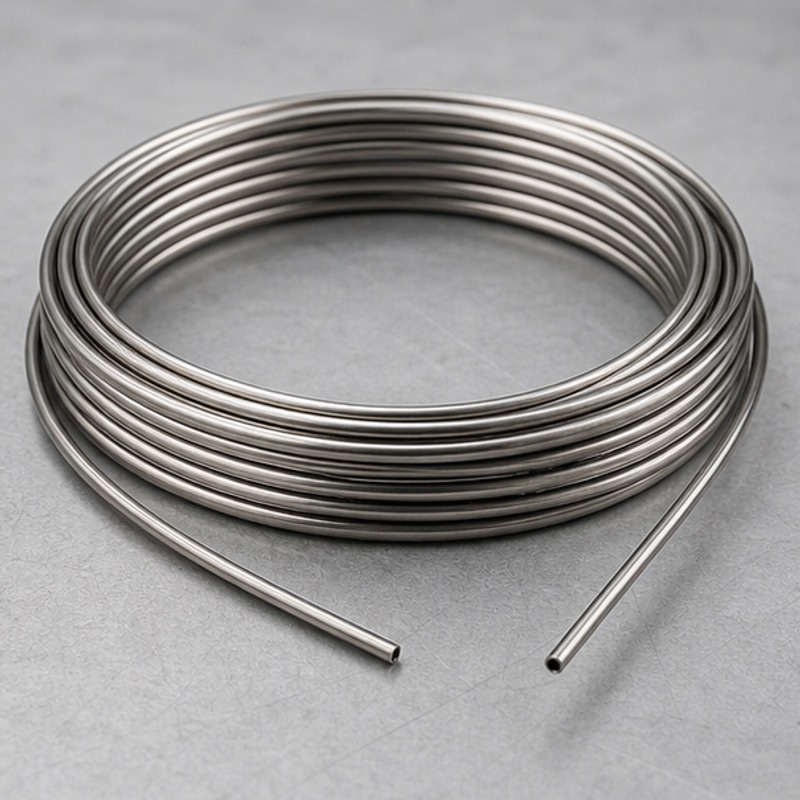
When tubing is supplied in coils rather than cut lengths, the buyer specifies total linear meters or feet per coil. Key considerations:
- Continuous length requirement: If the device requires tube segments each 300 mm long, buying in short random-cut coils creates scrap.
- Weld joints: Seam-welded tubing may have a weld seam every few meters. Specify whether weld-joint-free segments are required.
- Packaging constraints: Coils below a certain diameter may kink thin-wall tubing. Specify coil ID to prevent yield loss.
End Condition and Its Effect on Effective Length
The cut-end condition directly affects functional length. A tube cut to 50.00 mm with a 0.03 mm burr on each end has an effective clean length of approximately 49.94 mm. Buyers should specify end condition in measurable terms:
- Burr-free: Define maximum burr height (e.g. “max burr height 0.02 mm on OD and ID, verified under 20× magnification”).
- Squareness: For tubes that must seat against a flat surface (e.g. “end face square within 0.03 mm TIR”).
- Chamfer or radius: If the tube end must guide assembly, specify chamfer angle, depth, and tolerance.
Additional processing such as burr-free cutting may be needed to meet specified end conditions.
Measurement Methods for Small-Diameter Tube Length
Measurement method influences the reported length, especially on tubes below 2 mm OD:
- Vision system with telecentric lens: Non-contact. Measures length and end condition simultaneously. Uncertainty typically ±0.005–0.01 mm.
- Laser micrometer with length stage: Measures OD and length in a single pass. Suitable for higher throughput.
- Contact gauge with V-block: Simple but operator-dependent. May compress thin-wall tubes.
- Hand caliper: Not recommended for tubes below 3 mm OD due to jaw deformation.
When length tolerance is ±0.05 mm or tighter, buyer and supplier should agree on the measurement method and temperature conditions (typically 20°C ±2°C per ISO 1).
Common Specification Errors
- No cut-length tolerance. “Length 50 mm” without tolerance allows the supplier to use a general tolerance such as ±0.5 mm.
- Unspecified end condition. The supplier may assume “as-cut” is acceptable when burr-free ends are required.
- Mixing cut length and overall length. A drawing calling “50 mm” for a tube that will be flared to 52 mm creates ambiguity.
- Requesting coil supplies without specifying coil ID. Thin-wall tubing on too small a mandrel may kink.
- No lot-acceptance criteria. Tight length tolerance without a sampling plan leaves inspection undefined.
Supplier Verification Checklist for Tube Length
- Cutting method: Which machine and tooling is used for the target OD/wall/length combination?
- Length measurement: Is length verified by vision system, laser, or contact gauge? At what temperature?
- Process capability: Cpk data for cut-length capability on a similar OD/WT combination.
- End condition inspection: 100% or sampling? What is the acceptance standard?
- Batch traceability: Is each batch traceable to raw material heat number and cutting machine setup?
Length in RFQ Documentation
When requesting a quotation for cut-length medical tubing, include:
- Cut length with bilateral tolerance (e.g. 50.00 ±0.05 mm)
- End condition: burr max height, squareness, chamfer specification
- Measurement method for length verification
- Sampling plan: AQL level and sample size per inspection lot
- Packaging: trays, vials, or bulk — affects handling damage during transit
For a complete medical tubing RFQ checklist, see our RFQ preparation guide.
Summary
Precise length specification for medical micro tubing requires more than a dimension on a drawing. Define cut length with tolerance, end condition with measurable acceptance criteria, and an agreed measurement method. Verify supplier process capability with Cpk data. Include a sampling plan that reflects the application’s risk tolerance. Small oversights in length specification can cascade into assembly failures — investing effort at the RFQ stage reduces procurement risk.
Need cut-to-length medical tubing with documented end quality? Contact HealsMed with your length requirements, end condition, material grade, and target quantity.

Healsmed
Leading Stainless Steel Capillary Tube Factory. 1,400+ standard sizes IN STOCK & ready to ship worldwide! High precision, factory-direct price.