316Ti Small Diameter Tubing: Material Properties, Manufacturing Tolerances, and Application Guide
When medical device engineers and procurement teams search for 316Ti small diameter tubing, they are typically sourcing a material that offers improved resistance to intergranular corrosion at elevated service temperatures compared to standard 316L, while maintaining the formability and weldability required for precision instruments, sensors, and fluidic components. The challenge is balancing the enhanced creep strength and carbide stabilization of 316Ti with the tight dimensional tolerances and surface finishes demanded by capillary and small-bore applications.
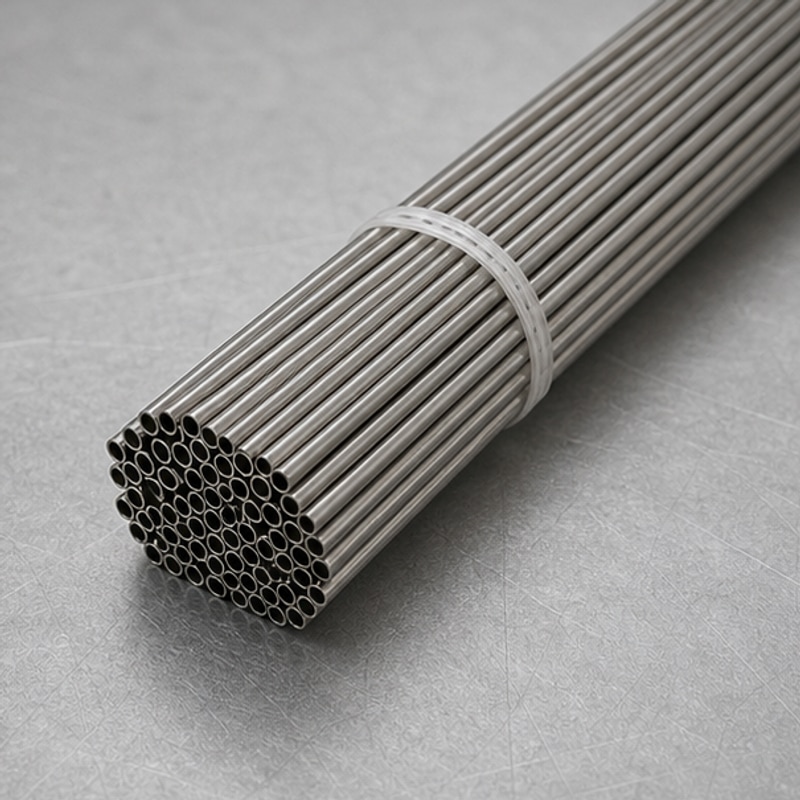
Applicable Scenarios and Industries
316Ti small diameter tubing is specified where parts experience sustained temperatures between 425°C and 815°C, or where welding is performed without post-weld heat treatment. Key applications include:
- Thermocouple sheaths and temperature sensor probes in industrial and laboratory equipment
- Hydraulic and pneumatic control lines in aerospace actuation systems
- Exhaust gas sampling tubes in emissions monitoring
- Chemical injection and catalyst delivery lines in process analyzers
- Medical device components that require autoclave sterilization cycles (note: material selection alone does not imply biocompatibility)
Industries commonly specifying 316Ti include aerospace, chemical processing, power generation, and analytical instrumentation.
Material Grades and Designations
316Ti is a titanium-stabilized austenitic stainless steel. Relevant specifications include:
- ASTM A269: Standard specification for seamless and welded austenitic stainless steel tubing for general service
- ASTM A213: Standard specification for seamless ferritic and austenitic alloy-steel boiler, superheater, and heat-exchanger tubes
- EN 10216-5: Seamless steel tubes for pressure purposes – stainless steels
- UNS S31635: Unified numbering system designation for 316Ti
Comparable grades include 316L (low carbon, UNS S31603) for lower-temperature corrosion resistance, and 321 (UNS S32100) which uses titanium stabilization with a slightly different base chemistry. 316Ti is preferred over 321 in some applications due to better creep strength at upper temperature ranges.
Chemical Composition (Typical, per ASTM A240)
| Element | 316Ti (UNS S31635) wt% |
|---|---|
| Carbon | ≤ 0.08 |
| Manganese | ≤ 2.00 |
| Phosphorus | ≤ 0.045 |
| Sulfur | ≤ 0.030 |
| Silicon | ≤ 0.75 |
| Chromium | 16.0 – 18.0 |
| Nickel | 10.0 – 14.0 |
| Molybdenum | 2.0 – 3.0 |
| Titanium | ≥ 5 × (C + N) min; typically 0.30 – 0.70 |
Note: Titanium content is dictated by the stabilization ratio, not a fixed range. Actual values depend on the mill certificate.
OD / ID / Wall Thickness / Length Considerations
316Ti small diameter tubing is typically produced in the following ranges (custom sizes depend on drawing, material condition, process route, and mutual agreement between parties):
- Outside diameter (OD): 0.5 mm to 6.35 mm (common capillary range)
- Wall thickness: 0.10 mm to 1.65 mm
- Inside diameter (ID): Calculated from OD minus 2× wall thickness; ID control is critical for fluid flow and sensor fit
- Length: Random mill lengths (typically 1–6 m) or cut-to-length as specified
Tolerances (Typical Ranges for Capillary Tube)
For small diameter tubing, tolerances are commonly specified per ASTM A269 or customer drawing. Typical values for capillary sizes (OD < 6.35 mm):
| Parameter | Typical Tolerance |
|---|---|
| OD | ± 0.05 mm to ± 0.10 mm (depends on OD and wall) |
| Wall thickness | ± 10% of nominal (or ± 0.05 mm, whichever is greater) |
| Length (cut-to-size) | ± 0.5 mm to ± 1.0 mm (longer lengths may have looser tolerance) |
| Straightness | 1 mm per meter max (can be tightened upon agreement) |
All values are representative; final tolerances depend on drawing, material condition, process route, and mutual agreement between parties.
End Condition and Burr Control
End finishing is critical for capillary tubing used in compression fittings, welding, or insertion into assemblies. Common options:
- Square cut (sheared): Acceptable for non-critical ends; burr may be present
- Deburred ends (ID and OD): Burr height ≤ 0.13 mm per end is typical
- Chamfered / bevelled ends: Specified when welding or fitting into tapered ports
- Cut-to-length with burr-free face: Achieved by precision sawing or abrasive cutting with secondary deburring
Burr control requirements should be stated on the drawing or in the RFQ.
Surface Finish and Cleanliness Requirements
Surface finish affects corrosion resistance, fluid flow, and fit in tight assemblies. Typical finishes for 316Ti small diameter tubing:
- Mill finish (annealed and pickled): Ra 0.8–1.6 μm (32–63 μin) – standard for general service
- Bright annealed (BA): Ra 0.4–0.8 μm (16–32 μin) – smoother, cleaner surface
- Electropolished (EP): Ra ≤ 0.25 μm (10 μin) – for high-purity or low-particulate applications
- Mechanical polish (MP): Custom OD finish as specified
Cleanliness may be specified as degreased, ultrasonically cleaned, or packaged in a cleanroom environment. Standard packaging does not guarantee medical-grade cleanliness unless explicitly agreed.
Inspection Documentation
Standard documentation for 316Ti small diameter tubing includes:
- Material test report (MTR) / EN 10204 3.1 certificate: Chemical composition, mechanical properties (tensile, yield, elongation), and heat number traceability
- Dimensional inspection report: OD, ID, wall thickness, length, straightness (sample or 100% as agreed)
- Surface finish measurement report: Ra values and method used
- Hydrostatic or eddy current test report: If required by specification (e.g., ASTM A269)
Additional certifications (e.g., NACE, PMI) are available upon request but must be specified at RFQ stage.
Packaging Considerations
Packaging protects surface finish and prevents contamination. Common methods:
- Bundled and banded: For standard mill lengths
- Individual tubes sleeved or wrapped: For cut-to-length parts
- Foam-lined or partitioned boxes: For delicate capillary sizes
- Vacuum-sealed or nitrogen-purged bags: For high-cleanliness or long-term storage
Packaging requirements (e.g., export crating, cleanroom bagging) should be stated in the RFQ.
RFQ Information Checklist
To obtain an accurate evaluation for 316Ti small diameter tubing, include the following in your inquiry:
- Material grade: 316Ti (UNS S31635) and applicable standard (e.g., ASTM A269)
- OD, wall thickness, and length (with tolerances)
- Quantity (pieces or total length)
- End condition (deburred, chamfered, square cut)
- Surface finish (mill, BA, EP, or Ra value)
- Cleanliness requirement
- Inspection documentation required
- Packaging specification
- Any special testing (PMI, hydrostatic, eddy current)
To request a quotation for 316Ti small diameter tubing, submit your drawings, material grade, quantity, tolerance, surface finish, and inspection requirements through the Healsmed website. The engineering team will review and respond with a technical evaluation.

Healsmed
Leading Stainless Steel Capillary Tube Factory. 1,400+ standard sizes IN STOCK & ready to ship worldwide! High precision, factory-direct price.