904L SS Capillary Tubing: Material Properties, Manufacturing Tolerances, and Application Guide
Engineers and procurement specialists frequently search for 904L stainless steel capillary tubing when their application demands a material that can withstand aggressive chloride environments, reducing acids, and elevated temperatures without compromising dimensional precision. The search is driven by the alloy’s unique metallurgical composition—high nickel (23–28%), chromium (19–23%), molybdenum (4–5%), and copper (1–2%)—which collectively provide a pitting resistance equivalent number (PREN) of approximately 34–36. This places 904L well above standard 316L (PREN ~24–26) and even 317L (PREN ~29–32), making it a preferred choice for chemical injection lines, offshore instrumentation, heat exchanger coils, and pharmaceutical process sampling systems where media corrosivity exceeds the capability of conventional austenitic grades. This article provides a technical reference for specifying, procuring, and validating 904L capillary tubing for B2B applications.
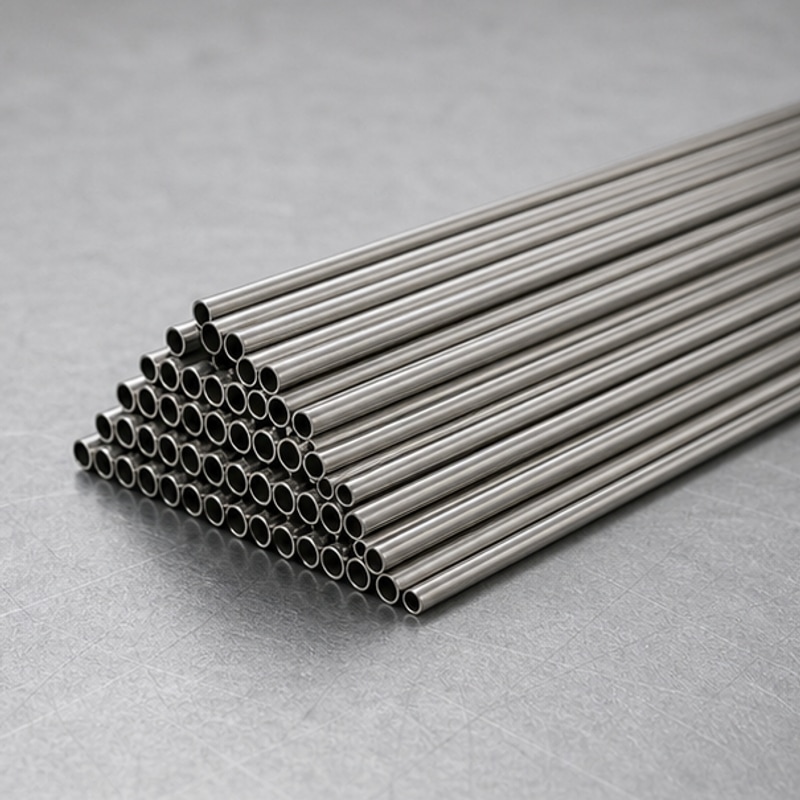
1. Material Composition and Applicable Standards
904L stainless steel is a fully austenitic, low-carbon grade with a nominal composition that distinguishes it from other high-alloy stainless steels. The key alloying elements and their typical weight percentages are listed below. Note that exact ranges follow ASTM A213 / A269 or EN 10216-5, and final certification should reference the specific standard agreed upon at order placement.
| Element | Typical Range (wt%) | Function |
|---|---|---|
| Nickel (Ni) | 23.0 – 28.0 | Stabilizes austenite, improves resistance to chloride stress corrosion cracking |
| Chromium (Cr) | 19.0 – 23.0 | Forms passive oxide layer, enhances pitting and general corrosion resistance |
| Molybdenum (Mo) | 4.0 – 5.0 | Increases resistance to localized corrosion (pitting and crevice) in chloride media |
| Copper (Cu) | 1.0 – 2.0 | Improves resistance to sulfuric and phosphoric acids |
| Carbon (C) | ≤ 0.020 | Low carbon prevents sensitization and intergranular corrosion after welding |
| Manganese (Mn) | ≤ 2.00 | Deoxidizer, minor effect on mechanical properties |
| Silicon (Si) | ≤ 1.00 | Deoxidizer, improves oxidation resistance |
| Phosphorus (P) | ≤ 0.045 | Impurity, controlled for weldability |
| Sulfur (S) | ≤ 0.030 | Impurity, controlled for machinability and corrosion |
| Iron (Fe) | Balance | Base element |
In international standards, 904L is designated as UNS N08904 and EN 1.4539 (X1NiCrMoCu25-20-5). For capillary tubing, the governing product standards are typically ASTM A269 (seamless and welded austenitic tubing for general service) or ASTM A213 (seamless ferritic and austenitic alloy-steel boiler, superheater, and heat-exchanger tubes). When the tubing is supplied in coiled form, ASTM A1016 may also be referenced for general requirements. It is critical to specify the standard and grade explicitly in your RFQ, as 904L is not interchangeable with 316L or 317L in fabrication or performance.
2. Corrosion Resistance Characteristics
The primary reason for selecting 904L capillary tubing is its exceptional resistance to localized corrosion. The alloy’s PREN is calculated as %Cr + 3.3 × %Mo + 16 × %N, and with nitrogen additions (typically 0.04–0.10%), the effective PREN reaches 34–36. This translates into superior performance in the following areas:
2.1 Pitting and Crevice Corrosion
In chloride-rich environments (seawater, brine, or chlorine-containing process streams), 904L exhibits a critical pitting temperature (CPT) that is significantly higher than 316L. For capillary tubing with small diameters, where wall thickness is limited, pitting resistance is critical because a single pit can lead to through-wall leakage. Laboratory data and field experience indicate that 904L can tolerate chloride concentrations up to several thousand ppm at ambient temperatures without pitting, whereas 316L would fail at much lower levels. However, exact CPT values depend on surface finish, temperature, and chloride concentration; always validate against your specific process conditions.
2.2 Stress Corrosion Cracking (SCC)
Due to its high nickel content (≥23%), 904L offers excellent resistance to chloride-induced stress corrosion cracking, a failure mode commonly observed in 304L and 316L under tensile stress and hot chloride solutions. This makes 904L capillary tubing suitable for instrument impulse lines in offshore platforms, chemical plants, and geothermal applications where both mechanical stress and chloride exposure coexist. The alloy also resists SCC in caustic environments, though not to the level of nickel-based alloys like Alloy 600 or 825.
2.3 Acid Resistance
The addition of copper provides notable resistance to sulfuric acid (H₂SO₄) and phosphoric acid (H₃PO₄) at moderate concentrations and temperatures. For example, 904L can handle 10–50% sulfuric acid at temperatures up to 40–60°C, depending on aeration and impurities. In dilute hydrochloric acid (HCl), performance is limited but still superior to 316L. For capillary tubing used in chemical dosing or sampling lines, this acid resistance is often the deciding factor.
3. Dimensional Considerations: OD, ID, Wall, and Length
Capillary tubing is defined by a small outside diameter (OD), typically from 0.5 mm to 6.35 mm (1/16 inch to 1/4 inch), with a correspondingly small inside diameter (ID). The wall thickness is chosen to balance pressure rating, flow rate, and mechanical strength. Common dimensions for 904L capillary tubing include:
- OD: 1.0 mm, 1.6 mm, 2.0 mm, 3.0 mm, 3.175 mm (1/8”), 6.35 mm (1/4”)
- Wall thickness: 0.15 mm to 1.0 mm, depending on pressure requirements
- ID: Calculated as OD minus 2 × wall thickness; typical IDs range from 0.3 mm to 5.0 mm
- Length: Straight lengths (1 m, 2 m, 3 m, or custom) or coils (up to 100 m or more, depending on OD and wall)
For capillary tubing, the ID is often more critical than the OD, as it determines flow rate and pressure drop. In applications such as gas chromatography, mass spectrometry, or chemical injection, a slight variation in ID can cause significant performance deviations. Therefore, it is essential to specify whether you require a nominal ID or a controlled ID with a tight tolerance. The table below summarizes typical dimensional tolerances for 904L capillary tubing, but note that these are indicative ranges—final tolerances depend on mutual agreement between parties.
4. Manufacturing Tolerances
The manufacturing process for 904L capillary tubing—whether seamless (pilgered or drawn) or welded and drawn—introduces inherent variations. For precision applications, tolerances are specified as follows:
| Parameter | Typical Tolerance (mm) | Remarks |
|---|---|---|
| Outside Diameter (OD) | ±0.05 to ±0.10 | For OD ≤ 3.0 mm; tighter tolerances (±0.02) possible with centerless grinding |
| Inside Diameter (ID) | ±0.05 to ±0.10 | Controlled by mandrel or plug drawing; verify with air gauge or pin gauge |
| Wall Thickness | ±10% of nominal | For thin walls (<0.3 mm), tolerance may be ±15% |
| Length (straight) | +10 mm / -0 mm | Standard commercial tolerance; custom lengths by agreement |
| Length (coil) | ±1% of total length | Coil ends must be clearly marked |
| Straightness | 1 mm per 1000 mm | For straight lengths; coiled tubing exempt |
| Ovality | ≤ 2% of nominal OD | Measured as (max OD – min OD) / nominal OD |
For applications requiring extremely tight ID control (e.g., for flow metering), specify the tolerance explicitly. In such cases, the manufacturer may need to perform a 100% dimensional inspection, which adds cost but ensures reliability. If you do not have a specific tolerance requirement, the manufacturer will typically apply standard ASTM A269 tolerances, which are broader. Always confirm the tolerance basis in your RFQ.
5. End Preparation and Burr Control
Capillary tubing ends are critical for leak-free connections, especially when using compression fittings, Swagelok-type connectors, or orbital welding. The following end preparation options are available:
- Square cut (as-cut): Standard for most applications; ends are cut with a saw or shear, leaving a burr that must be removed.
- Deburred (internal and external): Recommended for all capillary tubing; burrs are removed to prevent flow obstruction and to ensure proper seating in fittings. Internal deburring is essential for IDs below 1.0 mm.
- Chamfered ends: For welding applications, a 30–45° chamfer may be specified to facilitate full penetration welds.
- Cut to length with tolerance: For precise installation, specify length tolerance (e.g., ±0.5 mm) and ensure ends are clean and free of oil or grease.
Burr control is particularly important for 904L because the alloy work-hardens rapidly. A poorly deburred end can cause fitting damage or create a leak path. For critical applications, request a visual inspection report or a 10× magnification check for burr presence. The manufacturer should document the deburring process and, if required, provide a sample end for your evaluation.
6. Surface Finish and Cleanliness
The internal surface finish of capillary tubing directly affects flow characteristics, pressure drop, and the risk of particulate entrapment. For 904L tubing, the following surface finishes are commonly specified:
| Surface Finish (Ra) | Typical Application | Inspection Method |
|---|---|---|
| ≤ 0.8 µm (32 µin) | General industrial, chemical injection | Profilometer or visual comparison |
| ≤ 0.4 µm (16 µin) | Pharmaceutical, high-purity process | Profilometer, surface roughness tester |
| ≤ 0.2 µm (8 µin) | Analytical instrumentation, chromatography | Interferometry or stylus profilometer |
Cleanliness is equally important. Tubing should be supplied free of oils, greases, and particulate matter. For applications requiring ultra-clean surfaces (e.g., oxygen service or semiconductor gas lines), specify a cleaning procedure such as ultrasonic degreasing with a solvent, followed by nitrogen purge and capping of both ends. The cleanliness level should be agreed upon in writing; common standards include a visual inspection under UV light or a solvent rinse test with a residue limit (e.g., ≤ 5 mg/m²). For 904L, avoid pickling with hydrofluoric acid unless the process is controlled, as residual fluorides can initiate corrosion.
7. Inspection and Documentation
For B2B procurement, documentation is a key deliverable. The following documents are typically required for 904L capillary tubing orders:
- EN 10204 Type 3.1 Inspection Certificate: Confirms material grade, heat number, chemical composition, and mechanical properties. This is the minimum acceptable certification for most process industries.
- EN 10204 Type 3.2 Certificate: Issued by an independent third-party inspector (e.g., TÜV, Bureau Veritas) when specified by the purchaser or end-user.
- Dimensional Inspection Report: Provides measured OD, ID, wall thickness, and length for each bundle or coil. For critical tolerances, 100% inspection may be required.
- Hydrostatic or Pneumatic Test Report: If pressure testing is specified, the test pressure, duration, and results must be documented. Note that for capillary tubing with very small IDs, hydrostatic testing may be impractical; in such cases, a pneumatic test under water immersion or a helium leak test is used.
- Surface Finish Report: Ra values measured at both ends and at mid-length, if required.
- Positive Material Identification (PMI) Report: For 904L, PMI using X-ray fluorescence (XRF) is recommended to verify the high Ni, Cr, and Mo content, especially if the tubing is supplied in mixed batches.
All documents should be traceable to the specific heat number and bundle/coil number. If you require additional testing (e.g., ferrite content measurement, intergranular corrosion test per ASTM A262 Practice E), specify this in your RFQ. Note that the manufacturer may not perform these tests as standard—they are typically offered as optional extras at additional cost.
8. Packaging and Protection
Proper packaging prevents mechanical damage, corrosion, and contamination during transit and storage. For 904L capillary tubing, the following packaging practices are recommended:
- Straight lengths: Bundled in wooden or plastic crates, with each tube individually sleeved in plastic or paper to prevent surface abrasion. Ends should be capped with plastic plugs or taped to prevent ingress of dirt.
- Coils: Wound on a spool or in a coil form, with the inner and outer ends secured and sealed. The coil should be wrapped in a moisture-resistant barrier (e.g., VCI paper or polyethylene film).
- Desiccant: For long-term storage or humid climates, include desiccant bags inside the packaging. The use of volatile corrosion inhibitor (VCI) paper is also effective.
- Labeling: Each package must be labeled with the grade (UNS N08904 / EN 1.4539), heat number, OD × wall × length, quantity, and the order reference number. A copy of the inspection certificate should be enclosed or sent electronically.
Upon receipt, the purchaser should inspect the packaging for signs of damage or moisture ingress. If the tubing is to be stored for more than six months, consider re-inspecting the surface condition and re-applying protective measures as necessary.
9. RFQ Checklist for 904L Capillary Tubing
To ensure an accurate and competitive quotation, provide the following information in your request for quotation (RFQ):
- Material grade: UNS N08904 / EN 1.4539 (confirm if 904L is acceptable or if you need a specific dual-certified grade).
- Dimensions: OD, wall thickness, and ID (if critical). Specify whether ID is nominal or controlled.
- Length: Straight length (in meters) or coil length (in meters). State the maximum number of pieces per bundle or coil.
- Tolerances: State which tolerances are required (OD, ID, wall, straightness). If none specified, the manufacturer will apply standard tolerances.
- Surface finish: Internal and external Ra value required. State if a specific finish (e.g., bright annealed, pickled, or electropolished) is needed.
- End preparation: Square cut, deburred, chamfered, or special. Specify if ends must be capped or sealed.
- Cleanliness: Indicate if the tubing must be cleaned for oxygen service, pharmaceutical, or semiconductor use. Provide a residue limit if applicable.
- Inspection and certification: Required documents (3.1, 3.2, PMI, dimensional report, pressure test, surface finish report).
- Quantity: Total meters or pieces, and the number of bundles/coils.
- Delivery requirement: Required delivery date and shipping destination.
- Special requirements: Any additional testing (e.g., intergranular corrosion, ferrite content) or packaging requirements (e.g., export crating).
Providing complete information reduces the risk of misinterpretation and ensures that the supplier can offer a technically sound and commercially accurate quotation. If you are uncertain about any parameter, specify “depends on mutual agreement between parties” so that the supplier can propose a suitable option based on standard practice.
10. Conclusion and Quotation Request
904L stainless steel capillary tubing is a specialized product that demands careful specification of material, dimensions, tolerances, surface finish, and documentation. By understanding the alloy’s corrosion resistance, manufacturing constraints, and inspection requirements, you can ensure that the tubing meets your application’s performance and reliability expectations. Healsmed.com supplies 904L capillary tubing in a range of sizes and finishes, with full traceability and quality documentation. To receive a detailed quotation, please submit your drawings, material grade, quantity, tolerances, surface finish, and inspection requirements via our custom quote page. Our engineering team will review your specification and respond with a technical proposal within one business day.

Healsmed
Leading Stainless Steel Capillary Tube Factory. 1,400+ standard sizes IN STOCK & ready to ship worldwide! High precision, factory-direct price.