347 SS Capillary Tubing: Material Properties, Manufacturing Tolerances, and Application Guide
Engineers and procurement professionals sourcing capillary tubing for high-temperature or corrosive environments often encounter a specific requirement: a stainless steel grade that resists intergranular corrosion after welding or prolonged service in the 800–1500°F (427–816°C) range. This is the engineering problem 347 SS capillary tubing solves. Its columbium (niobium) stabilization prevents chromium carbide precipitation, making it a reliable choice for medical device components, chemical injection systems, and analytical instruments where dimensional precision and material integrity are critical.
Applicable Scenarios and Industries
347 SS capillary tubing is selected for applications that combine elevated operating temperatures with exposure to mildly corrosive media or repeated thermal cycling. Typical industries include:
- Medical device manufacturing: Heat exchangers, surgical tools, and fluid delivery systems requiring autoclave sterilization.
- Chemical processing: Sampling lines, thermowells, and catalyst transfer tubes in environments where intergranular attack is a risk.
- Oil and gas: Downhole instrumentation and control lines exposed to sour service conditions.
- Aerospace: Hydraulic and pneumatic sensing lines in engine nacelles or exhaust regions.
- Analytical instrumentation: Gas chromatography columns and HPLC flow paths requiring inertness and clean surfaces.
Material Grades and Designations
347 stainless steel is designated UNS S34700 under the Unified Numbering System and is covered by ASTM A269 (welded and drawn capillary tubing) and ASTM A213 (seamless tubing). The primary alloying difference from 304 or 316L is the addition of columbium (approximately 10× carbon content minimum) to stabilize the material against sensitization. For comparison:
| Grade | UNS | Stabilizer | Max Service Temp (Continuous) |
|---|---|---|---|
| 347 | S34700 | Cb (Nb) + Ta | 800°C (1472°F) |
| 321 | S32100 | Titanium | 800°C (1472°F) |
| 316L | S31603 | None (low carbon) | 450°C (842°F) |
Chemical composition (per ASTM A213): Carbon 0.08% max, Chromium 17.0–19.0%, Nickel 9.0–13.0%, Columbium/Tantalum 10× C min to 1.0% max. Mechanical properties in annealed condition: tensile strength 515 MPa min, yield strength 205 MPa min, elongation 35% min (values per ASTM A269 for welded and drawn tubing). These values are for reference and depend on material condition, process route, and mutual agreement between parties.
OD / ID / Wall Thickness / Length Considerations
Capillary tubing is generally defined by an outside diameter (OD) of 6.35 mm (1/4″) or smaller. For 347 SS capillary tubing, common dimensions include:
- OD range: 0.5 mm to 6.35 mm (0.020″ to 0.250″)
- Wall thickness: 0.10 mm to 1.65 mm (0.004″ to 0.065″)
- ID is calculated from OD minus 2× wall thickness; standard sizes often follow fractional or metric tubing gauge series.
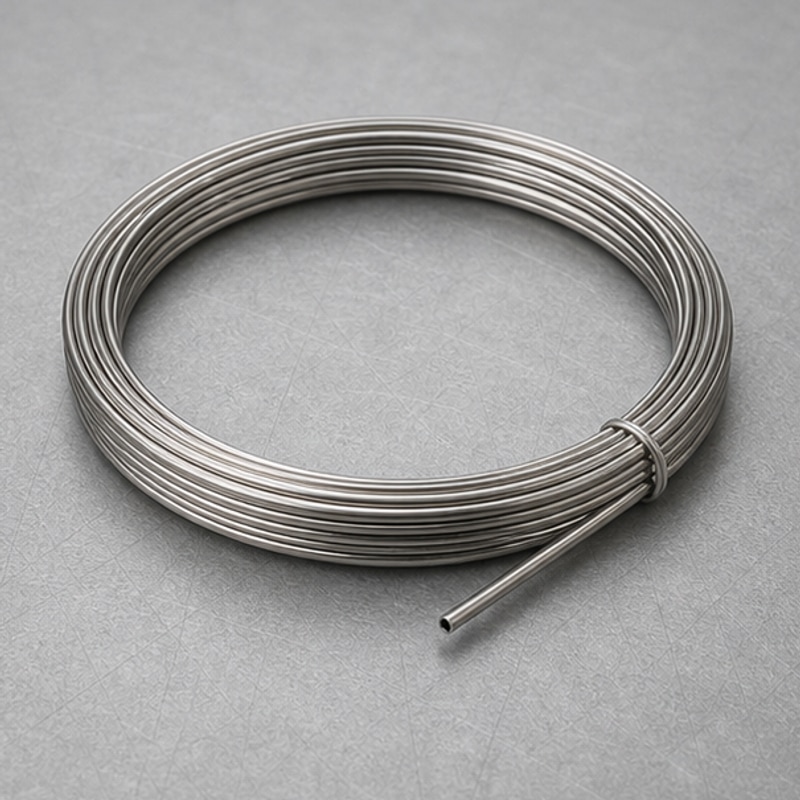
- Lengths: typically supplied in straight lengths up to 6 meters (20 feet) or coiled for longer continuous runs.
Selection depends on flow requirements, pressure rating, and space constraints. The ratio of OD to wall thickness should be evaluated against the end-use pressure and temperature per ASME B31.3 or similar codes.
Tolerances
Dimensional tolerances for 347 SS capillary tubing are not uniform and must be specified on the drawing. Typical industry ranges for precision applications are:
- OD tolerance: ±0.05 mm (±0.002″) for diameters under 6.35 mm; tighter (±0.025 mm) negotiable.
- ID tolerance: ±0.05 mm sometimes achievable but wall thickness control is more critical; ID is often a derived dimension.
- Wall thickness tolerance: ±10% of nominal.
- Length tolerance: ±1 mm per meter or as specified.
Note: Actual tolerances depend on drawing, material condition, process route, and mutual agreement between parties. Always confirm achievable ranges with the supplier for your specific quantity and process.
End Condition and Burr Control
Capillary tube ends must be square-cut (90° ±1°) and free of internal and external burrs to prevent flow disruption, particle generation, or seal damage. Common methods include:
- Precision cutoff (abrasive or saw) followed by deburring.
- Laser cutting for clean, minimal-burr edges.
- Electrochemical deburring for extremely hard-to-reach IDs.
Specify the maximum allowable burr height (e.g., <0.025 mm) and the inspection method (visual, profilometer, or go/no-go gauge).
Surface Finish and Cleanliness Requirements
For medical or high-purity applications, the internal and external surface finish must be controlled. Typical specifications:
- Inner surface roughness: Ra 0.4 μm (16 μin) maximum; Ra 0.2 μm achievable with electropolishing.
- Outer surface: Ra 0.8 μm (32 μin) or smoother depending on sealing requirements.
- Cleanliness: Free of oil, grease, and particulates per ASTM B912 or industrial standard; passivation per ASTM A967 may be required.
These values are common industry expectations; specific limits should be defined in the procurement specification.
Inspection Documentation
Standard documentation for 347 SS capillary tube orders includes:
- Material test certificate (EN 10204 3.1 or 3.2) showing heat analysis and mechanical test results.
- Dimensional inspection report documenting OD, ID, wall thickness, length, and ovality.
- Surface finish measurement report (when specified).
- Hydrostatic or pneumatic test certificate if required by application (typically for pressure-rated tubes).
- Certificate of conformance to ASTM A269 or A213.
Packaging Considerations
Capillary tubing is easily bent or scratched. Proper packaging must prevent damage during transit:
- Straight lengths: bundled and wrapped with foam or paper, placed in rigid cardboard tubes or wooden crates.
- Coiled tubing: placed on spools with flanges to maintain coil ID and avoid kinking.
- Cleanliness level: packaging materials must be compatible with the required cleanliness (e.g., acid-free paper, poly bags).
Specify whether the tubing requires protective end caps or heat-shrink wrapping for critical surfaces.
RFQ Information Checklist
To ensure accurate quotation and delivery, the following must be provided with your inquiry:
- Material grade: 347 SS (UNS S34700)
- OD / ID / wall thickness with tolerances
- Length per piece and total quantity
- End condition requirements (square cut, deburred, chamfered)
- Surface finish (Ra value, inner/outer)
- Cleanliness level and any passivation specification
- Inspection documentation requirements (3.1 cert, dimensional report, etc.)
- Packaging and delivery requirements
- Any specific test reports (hydrostatic, NDT)
To request a quotation for 347 SS capillary tubing, submit your drawings, material grade, quantity, tolerance, surface finish, and inspection requirements through the Healsmed website. The engineering team will review and respond with a technical evaluation.

Healsmed
Leading Stainless Steel Capillary Tube Factory. 1,400+ standard sizes IN STOCK & ready to ship worldwide! High precision, factory-direct price.