317L Thin Wall Capillary Tube: Material Properties, Manufacturing Tolerances, and Application Guide
When your medical device design or analytical instrument requires a capillary tube that must resist pitting and crevice corrosion in chloride-containing environments—while maintaining thin-wall precision for fluid flow or sensor delivery—you are specifying a 317L thin wall capillary tube. The engineering problem is balancing enhanced corrosion resistance (over 316L) with the tight dimensional control needed for small-bore tubing, without sacrificing wall uniformity or surface integrity.
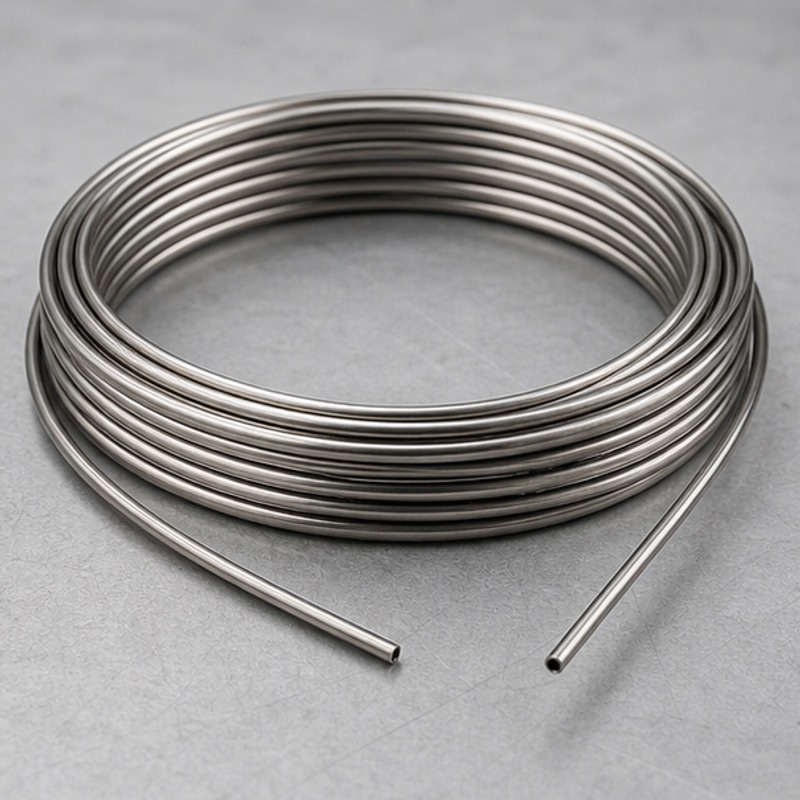
Applicable Scenarios and Industries
317L thin wall capillary tube is specified where the fluid or gas stream contains chlorides, reducing acids, or other corrosive species that would attack 304 or 316L. Typical applications include:
- Medical device fluid pathways (e.g., HPLC, blood gas analyzers, infusion pump manifolds) where chloride-containing reagents or saline are present
- Pharmaceutical process instrumentation (pressure sensing lines, sample loops)
- Chemical injection and sampling systems in bioprocessing
- Laboratory analytical columns and micro-bore heat exchangers
- Downhole sensing and control lines in oil & gas (limited sweet/sour service)
The material is not typically selected for implantable devices unless specific biocompatibility testing is performed by the device manufacturer—317L is not inherently “medical grade.”
Material Grade and Designations
317L is a molybdenum-bearing austenitic stainless steel with a low carbon content to minimize sensitization during welding. Key designations:
- UNS S31703
- ASTM A269 (general seamless & welded tubing)
- ASTM A632 (small-diameter stainless steel tubing for general service)
- EN 1.4438 (X2CrNiMo18-15-4)
It differs from 316L (UNS S31603) primarily by higher molybdenum (3.0–4.0% vs. 2.0–3.0%) and nickel content, providing improved resistance to pitting and crevice corrosion. Compared to 316Ti or 321, 317L does not contain titanium or niobium; stabilization is not required due to low carbon.
Chemical Composition (ASTM A269, typical weight %)
| Element | 317L (UNS S31703) | 316L (for reference) |
|---|---|---|
| Carbon | ≤ 0.030 | ≤ 0.030 |
| Manganese | ≤ 2.00 | ≤ 2.00 |
| Phosphorus | ≤ 0.045 | ≤ 0.045 |
| Sulfur | ≤ 0.030 | ≤ 0.030 |
| Silicon | ≤ 0.75 | ≤ 0.75 |
| Chromium | 18.0–20.0 | 16.0–18.0 |
| Nickel | 11.0–15.0 | 10.0–14.0 |
| Molybdenum | 3.0–4.0 | 2.0–3.0 |
OD / ID / Wall Thickness / Length Considerations
For capillary tube, “thin wall” typically means a wall thickness less than 10% of the outer diameter. Common size ranges for 317L capillary tube:
- OD: 0.5 mm to 6.35 mm (0.020″ to 0.250″)
- Wall thickness: 0.10 mm to 0.50 mm (0.004″ to 0.020″)
- ID: Determined by OD minus 2× wall; tight ID control is often critical for flow consistency
- Length: Custom cut lengths from 10 mm to 6,000 mm; longer lengths may require special handling to maintain straightness
Because 317L work-hardens more rapidly than 316L during cold drawing, achieving very thin walls (below 0.15 mm) may require multiple passes with intermediate annealing. This affects lead time and cost.
Tolerances (Typical Ranges for Capillary Tube)
Tolerances for 317L thin wall capillary tube depend on drawing condition (annealed or hard-drawn) and whether the tube is seam welded or seamless. Typical values per ASTM A269/A632:
| Parameter | Typical Tolerance | Notes |
|---|---|---|
| OD | ± 0.05 mm (for OD ≤ 3 mm) | Tighter on cold-drawn capillary |
| ID | ± 0.05 mm or ± 0.10 mm | Depends on wall ratio and process route |
| Wall thickness | ± 10% of nominal | For thin walls, absolute tolerance may be specified |
| Length | +2 / -0 mm (cut lengths) | Or as per drawing |
| Straightness | 1 mm per 1000 mm (typical) | Tighter possible with straightening |
For critical applications (e.g., chromatography columns), tolerances tighter than ASTM standard are achievable but depend on drawing, material condition, process route, and mutual agreement between parties.
End Condition and Burr Control
For capillary tube, end condition directly affects sealing and fluid flow. Common requirements:
- Square cut (90° ± 1°) with deburred ID and OD
- Burr height typically ≤ 0.05 mm (0.002″) unless otherwise specified
- No secondary burr inside the bore that could trap particulates
- Options: chamfered ends, polished ends, or custom profiles per drawing
For very small IDs (< 0.5 mm), burr removal becomes difficult and may require specialized micro-deburring processes. The supplier should confirm capability before quoting.
Surface Finish and Cleanliness Requirements
Surface finish for 317L thin wall capillary tube is typically specified as:
- OD: As-drawn or bright annealed (Ra 0.4–0.8 µm typical). For hygienic applications, Ra ≤ 0.4 µm may be required.
- ID: As-drawn (Ra 0.6–1.2 µm). Electropolishing is possible but may affect wall thickness.
- Cleanliness: Tubes must be free of oil, grease, and particulate. For medical or pharmaceutical use, clean-room packaging and hydrocarbon-free certification may be specified.
No surface finish should be claimed as “medical grade”—the appropriate finish depends on the device’s fluid contact and cleaning validation.
Inspection Documentation
Standard documentation for 317L thin wall capillary tube includes:
- Material Test Report (MTR) per EN 10204 Type 3.1 or 3.2, showing heat chemical analysis and mechanical properties
- Dimensional Inspection Report with OD, ID, wall, length, and straightness measurements
- Surface finish measurement report (if specified)
- Certificate of Conformance (CoC) to ASTM A269 or A632
- Optional: PMI (Positive Material Identification) report for alloy verification
All values on the MTR must be traceable to the original steel mill heat.
Packaging Considerations
Packaging must protect thin-wall tubes from bending, scratching, and contamination:
- Individual tubes sleeved or nested in foam-lined cartons
- Multiple tubes bundled with non-abrasive separators
- Clean-room double-bagging (required for medical/pharma)
- Desiccant and vacuum-sealing for moisture-sensitive applications
- Labeling with material grade, heat number, PO number, and quantity
RFQ Information Checklist
To obtain an accurate quotation for 317L thin wall capillary tube, provide the following:
- OD, ID, wall thickness (nominal and tolerance limits)
- Length and quantity (pieces or total meters)
- Material specification (e.g., ASTM A269 317L, UNS S31703)
- Condition: annealed (soft) or hard-drawn
- End condition: square cut, deburred, chamfered
- Surface finish requirements (OD and ID Ra values)
- Cleanliness level (degreased, medical clean, etc.)
- Inspection documentation required (MTR, dimensional report, etc.)
- Packaging specification (individual sleeving, clean-room, etc.)
- Any special straightness or ovality requirements
To request a quotation for 317L thin wall capillary tube, submit your drawings, material grade, quantity, tolerance, surface finish, and inspection requirements through the Healsmed website. The engineering team will review and respond with a technical evaluation.

Healsmed
Leading Stainless Steel Capillary Tube Factory. 1,400+ standard sizes IN STOCK & ready to ship worldwide! High precision, factory-direct price.