310S SS Capillary Tubing: Properties, Tolerances, and Sourcing Guide
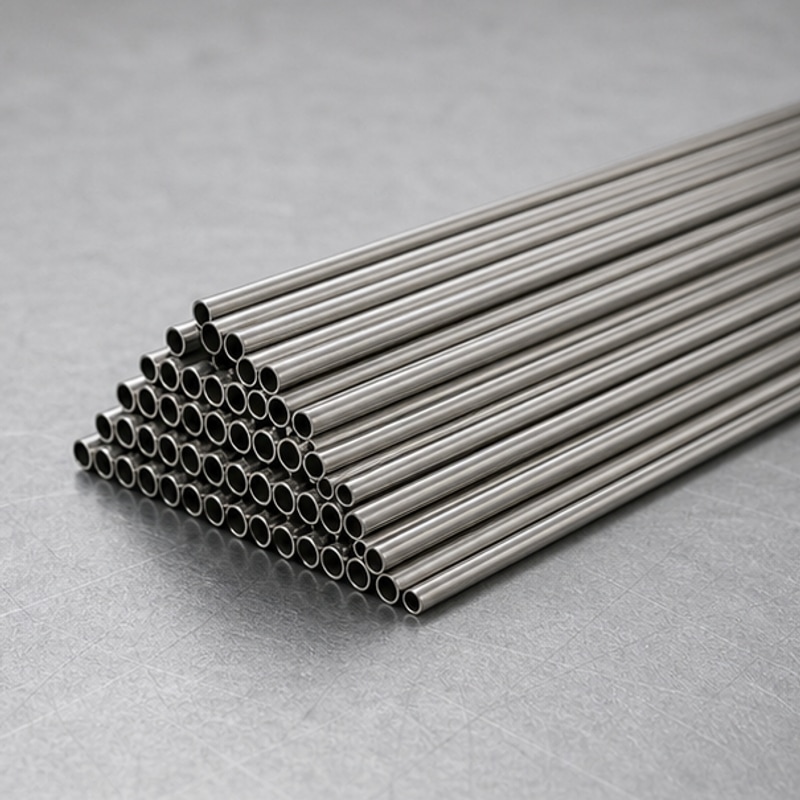
310S Capillary Tubing: An Overview for Industrial Buyers
310S stainless steel capillary tubing bridges the gap between standard stainless grades and exotic nickel alloys. Its 25Cr-20Ni austenitic structure delivers exceptional oxidation resistance without the cost premium of Inconel or Hastelloy grades. For engineers specifying tubing for high-temperature fluid or gas transport, 310S offers a practical balance of performance, availability, and cost.
Cold Drawing, Annealing, and Mechanical Properties
310S capillary tubing is typically produced through cold drawing with intermediate annealing. The solution annealing temperature for 310S is 1040-1120°C followed by rapid quenching to maintain a fully austenitic structure. This process achieves tensile strength between 515-690 MPa with elongation exceeding 35%. Hardness after annealing is typically 95 HRB maximum — the tube remains ductile and formable for secondary operations like bending or flaring.
Corrosion Behavior and Maximum Service Temperature
310S exhibits strong resistance to oxidation in air up to 1035°C continuously and 1100°C intermittently. It resists sulfidation in sulfur-bearing atmospheres better than 304/316 grades. However, 310S is not recommended for environments with high chloride content at elevated temperatures — stress corrosion cracking becomes a risk above 60°C in chloride-bearing water. For wet corrosion at ambient temperatures, 316L often performs better due to its molybdenum content.
Dimensional Tolerances for Precision Tubing
Capillary-grade 310S tubing typically conforms to ASTM A269 tolerances for OD and wall thickness. Common OD tolerances: ±0.05 mm for OD ≤ 1.6 mm, ±0.08 mm for OD 1.6-3.2 mm. Wall thickness tolerance is typically ±10% of nominal. For tighter requirements, precision drawing can achieve ±0.025 mm on OD and ±0.013 mm on wall — buyers must specify “precision drawn” explicitly as standard mill tolerances may not suffice.
Comparison with 310 (Non-Low Carbon) Grade
The key difference between 310 and 310S is carbon content: 310 allows up to 0.25% carbon, while 310S caps at 0.08%. This matters significantly for welded or brazed assemblies — 310S resists sensitization (chromium carbide precipitation at grain boundaries) during welding. For welded capillary assemblies operating above 425°C, 310S is strongly preferred over standard 310. The mechanical properties are essentially identical in the annealed condition.
Sourcing Considerations for Industrial Buyers
- Minimum order quantities: 310S capillary tubing often carries higher MOQs than 304/316 due to lower production volumes.
- Lead times: Expect 4-8 weeks for standard sizes; custom dimensions may require 10-14 weeks.
- Certification requirements: Request EN 10204 3.1 certificates with chemical and mechanical test data.
- Surface finish: Specify whether bright annealed, pickled, or mechanically polished finish is required.
Conclusion
310S capillary tubing fills a critical niche for high-temperature applications between standard stainless grades and nickel superalloys. The key selection criteria are continuous operating temperature, atmosphere composition (particularly sulfur content), and dimensional tolerance requirements. When specifying 310S tubing, always reference ASTM A213 or A269 standards and request full material certifications to verify the 25Cr-20Ni low-carbon chemistry.

Healsmed
Leading Stainless Steel Capillary Tube Factory. 1,400+ standard sizes IN STOCK & ready to ship worldwide! High precision, factory-direct price.