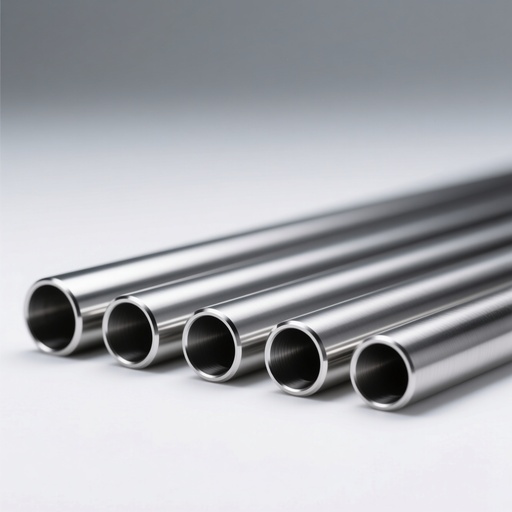
316L Stainless Steel Capillary Tubing for Medical and Laboratory Components
<p>316L stainless steel capillary tubing is the most commonly specified austenitic stainless steel for small-diameter fluid-handling components in medical devices and laboratory instruments. Its low-carbon formulation (max 0.03% C) provides as-welded corrosion resistance without post-weld annealing, making it the default choice when components require welding, exposure to saline or mildly acidic solutions, or a combination of small diameters and repeatable mechanical properties. This article covers what makes 316L suitable for medical and laboratory capillary applications, how it compares to other grades, what buyers should verify with suppliers, and the key items for an RFQ. It is written for OEM engineering, quality, and procurement professionals — not as a substitute for device-specific material validation, which remains the device manufacturer's responsibility.</p>
<h2>Why 316L, Not 304 or 316</h2>
<p>The key difference is carbon and molybdenum. 316L contains 2.0–3.0% molybdenum and max 0.03% carbon; 304 has no intentional molybdenum; 316 has molybdenum but a higher carbon ceiling (≤ 0.08%). In thin-wall capillary tubing — wall thickness can be 0.1 mm or less — even minimal carbide precipitation during welding creates corrosion risk that 304 or 316 cannot reliably eliminate without post-weld annealing. For components welded into manifolds, sensor housings, or fluidic assemblies, 316L avoids sensitization in the as-welded condition, which benefits production throughput.</p>
<p>If welding, brazing, or laser sealing is involved, specifying 316L from the start reduces re-validation. The tensile strength difference between 316 (~515 MPa) and 316L (~485 MPa per ASTM A269) is rarely limiting in fluid-handling applications where pressure ratings are governed by wall thickness and diameter. For a fuller comparison, see <a href="https://www.healsmed.com/304-vs-316l-stainless-steel-capillary-tubes-for-medical-applications/">304 vs 316L stainless steel capillary tubes for medical applications</a>.</p>
<h2>Typical Medical and Laboratory Applications</h2>
<ul>
<li><strong>Chromatography and analytical tubing:</strong> HPLC/UHPLC systems use 316L capillary with IDs from 0.05 mm to 1.0 mm at pressures exceeding 400 bar. The smooth internal surface of drawn seamless tubing reduces band broadening compared to polymer alternatives.</li>
<li><strong>Syringe needles and cannula stock:</strong> Produced to ISO 9626 or ASTM A908, with OD tolerances as tight as ±0.0125 mm for precise fit.</li>
<li><strong>Endoscopic and laparoscopic instrument shafts:</strong> 316L provides stiffness, corrosion resistance, and compatibility with repeated autoclave sterilization.</li>
<li><strong>Diagnostic instrument fluid transfer:</strong> Clinical chemistry analyzers route reagents and samples through 316L capillary lines where chemical compatibility matters.</li>
<li><strong>Gas chromatography transfer lines:</strong> 316L supports high-temperature GC applications at continuous service to approximately 870°C (oxidation significant above 800°C).</li>
</ul>
<h2>Standards and What They Mean for Buyers</h2>
<ul>
<li><strong>ASTM A269:</strong> Seamless and welded austenitic stainless tubing for corrosion-resisting service — the baseline for instrument-grade capillary.</li>
<li><strong>ASTM A632:</strong> Specifically for small-diameter tubing (OD ≤ 6.35 mm, wall ≤ 0.51 mm) — a better fit for true capillary dimensions.</li>
<li><strong>ASTM A908:</strong> Needle tubing for hypodermic applications.</li>
<li><strong>EN 10216-5 / EN 10305-1:</strong> European equivalents, often called out in EU-sourced components.</li>
</ul>
<p>Confirm the standard on the MTR and ensure the "L" grade suffix is documented if welding is involved. For material certificate guidance, see <a href="https://www.healsmed.com/medical-tubing-material-certificates-what-oem-buyers-should-ask-for/">medical tubing material certificates: what OEM buyers should ask for</a>.</p>
<h2>Dimensional Tolerances</h2>
<p>Common commercial tolerance bands for cold-drawn seamless 316L capillary:</p>
<ul>
<li><strong>OD:</strong> ±0.025 mm for OD ≤ 1.0 mm; ±0.05 mm for 1.0–3.0 mm; ±0.08 mm for 3.0–6.0 mm.</li>
<li><strong>ID:</strong> ±0.025 mm for ID ≤ 1.0 mm (varies with wall thickness).</li>
<li><strong>Wall:</strong> ±10% nominal typical; ±5% may require grinding or honing.</li>
<li><strong>Cut length:</strong> ±0.1 mm up to 100 mm; ±0.2 mm for longer pieces.</li>
</ul>
<p>These are illustrative ranges from published supplier data. Include tolerance requirements explicitly in your RFQ and confirm the supplier has capability data (Cpk) for the dimensions in question.</p>
<h2>Surface Finish and Cleanliness</h2>
<p>As-drawn seamless 316L capillary typically has an internal Ra of 0.4–1.0 µm. Electropolishing can reduce it to 0.25 µm or below — important for chromatography and protein-contact applications. Cleanliness is buyer-specified: options include ultrasonic cleaning, passivation per ASTM A967, oxygen-cleaning, and vacuum annealing for bright surfaces. Do not assume "clean" has a universal definition; define the cleaning protocol, packaging (individually sleeved, capped, nitrogen-purged), and cleanliness certification (particle count, NVR) in the purchase specification. See also <a href="https://www.healsmed.com/cleanliness-requirements-for-medical-tubing-what-buyers-should-confirm/">cleanliness requirements for medical tubing</a>.</p>
<h2>Supplier Verification Questions</h2>
<ol>
<li><strong>Full MTR with heat traceability?</strong> Must include chemistry, mechanical properties, and referenced standard.</li>
<li><strong>Actual tolerance capability for your diameter range?</strong> Ask for measured data, not catalog values.</li>
<li><strong>Eddy current or ultrasonic testing?</strong> ASTM A269/A632 call for NDT. 100% in-line or sample-based?</li>
<li><strong>Minimum order quantity for custom dimensions?</strong> Tooling setup costs affect MOQs.</li>
<li><strong>Samples with documented burr condition?</strong> Even small burrs obstruct flow — confirm deburring method.</li>
<li><strong>Lead time for your size and quantity?</strong> Standard stock vs. custom-drawn differ significantly.</li>
</ol>
<p>For broader evaluation criteria, see our <a href="https://www.healsmed.com/how-to-find-a-reliable-stainless-steel-capillary-tube-manufacturer-for-medical-parts/">guide on finding reliable capillary tube manufacturers</a>.</p>
<h2>RFQ Checklist</h2>
<ul>
<li><strong>Material:</strong> 316L (UNS S31603), applicable standard</li>
<li><strong>OD / ID / Wall thickness:</strong> Nominal dimensions with tolerances</li>
<li><strong>Length:</strong> Cut-to-length or random mill lengths with tolerance</li>
<li><strong>Quantity:</strong> Sample, prototype, and estimated annual volume</li>
<li><strong>Surface finish:</strong> Internal Ra target; electropolish if required</li>
<li><strong>Cleaning and passivation:</strong> Protocol and packaging condition</li>
<li><strong>Testing:</strong> MTR with heat traceability, NDT method and coverage</li>
<li><strong>Burr condition:</strong> Acceptable specification on cut ends</li>
<li><strong>Drawing:</strong> Attach dimensioned drawing</li>
</ul>
<h2>Common Risks and Management</h2>
<ul>
<li><strong>Material substitution:</strong> 304 mislabeled as 316L — verify molybdenum via handheld XRF. Insist on traceable MTR.</li>
<li><strong>Tolerance drift:</strong> Tool wear can shift dimensions across a run. Agree sampling plan and acceptance criteria before ordering.</li>
<li><strong>Internal contamination:</strong> Drawing lubricants and fines can remain in small IDs. Confirm cleaning validation for your ID range.</li>
<li><strong>Weld seam quality:</strong> If specifying welded 316L (ASTM A269 Class II), confirm weld zone meets base metal corrosion requirements. Seamless is preferred for smallest diameters.</li>
</ul>
<h2>316L vs. Other Stainless Grades</h2>
<ul>
<li><strong>316LVM (UNS S31673):</strong> Vacuum-melted, tighter inclusions. Used for high-fatigue or long-term patient-contact components. Adds cost; standard 316L typically suffices for fluid-handling.</li>
<li><strong>Nitronic 50 (UNS S20910):</strong> Higher strength and chloride resistance. For most medical fluidics, 316L is adequate unless chloride exposure exceeds typical saline levels.</li>
<li><strong>17-4 PH (UNS S17400):</strong> Higher strength after heat treatment, but lower chloride corrosion resistance than 316L. Heat treatment changes dimensions — unsuitable for precision capillary.</li>
</ul>
<p>Start with 316L unless the application has a documented requirement for higher strength or specific chloride resistance that 316L cannot meet. Over-specifying narrows procurement options without benefit.</p>
<p>The final material choice for any medical device component should be validated by the device manufacturer through appropriate material evaluation, sterilization compatibility testing, and functional verification under intended use conditions. This article identifies selection factors and verification questions — it does not constitute material approval for any specific device or application.</p>
<div class="cta-section">
<p><strong>Request a Quote for 316L Stainless Steel Capillary Tubing</strong></p>
<p>Submit your drawing or specification with OD, ID, wall thickness, tolerance, quantity, surface finish, cleaning, packaging, and inspection requirements to receive a quotation for your medical or laboratory tubing project.</p>
<a href="/custom-quote/" class="cta-button">Send Your Specifications</a>
</div>

Healsmed
Leading Stainless Steel Capillary Tube Factory. 1,400+ standard sizes IN STOCK & ready to ship worldwide! High precision, factory-direct price.