310S SS Capillary Tube: Material Properties, Manufacturing Tolerances, and Application Guide
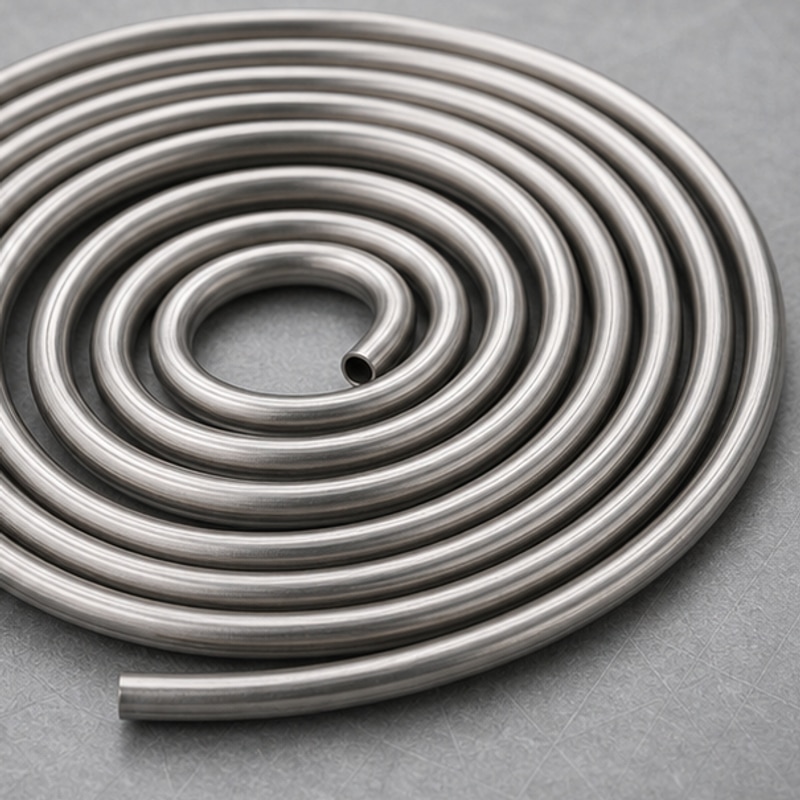
When an application demands sustained performance above 800°C, a standard 304 or 316L capillary tube will oxidize, creep, or scale. Engineers turn to 310S SS capillary tube for its superior high-temperature oxidation resistance and creep strength. This article examines the material properties, manufacturing tolerances, and practical application considerations for 310S stainless steel capillary tubing, providing procurement and design engineers with the technical data needed for informed material selection.
Chemical Composition and Mechanical Properties of 310S SS
310S is a low-carbon version of 310 stainless steel, formulated to minimize sensitization and carbide precipitation during welding or prolonged high-temperature exposure. The nominal chemical composition (weight %) per ASTM A213/A269 is:
| Element | 310S (min – max %) | 310 (typical %) |
|---|---|---|
| Carbon | 0.04 – 0.08 | 0.25 max |
| Chromium | 24.0 – 26.0 | 24.0 – 26.0 |
| Nickel | 19.0 – 22.0 | 19.0 – 22.0 |
| Manganese | 2.00 max | 2.00 max |
| Silicon | 1.50 max | 1.50 max |
| Phosphorus | 0.045 max | 0.045 max |
| Sulfur | 0.030 max | 0.030 max |
Typical mechanical properties for annealed 310S SS capillary tube (small diameters) are: tensile strength 515–620 MPa, yield strength (0.2% offset) 205–260 MPa, elongation in 50 mm 40–50%. The material maintains useful strength up to 1150°C, with maximum continuous service temperature around 1050°C in oxidizing atmospheres. Its scaling temperature is approximately 1100°C, significantly higher than 304 (900°C) or 316L (870°C).
310S vs 310: Why the Lower Carbon Matters for Capillary Tubing
Standard 310 stainless steel contains up to 0.25% carbon. At elevated temperatures (425–815°C), this carbon can combine with chromium to form chromium carbides at grain boundaries—a phenomenon called sensitization. In thin-wall capillary tubing, sensitization drastically reduces corrosion resistance and ductility. 310S limits carbon to 0.08% max, virtually eliminating sensitization during welding or service. For capillary applications involving intermittent high-temperature cycling or welded assemblies, 310S is the preferred grade. If the operating temperature is below 400°C and no welding is required, standard 310 may be acceptable, but most OEM specifications default to 310S for conservative design.
Dimensional Specifications and Tolerance Classes for 310S Capillary Tubing
Healsmed supplies 310S SS capillary tube in outer diameters from 0.5 mm to 12.7 mm, with wall thicknesses from 0.05 mm to 2.0 mm. Tolerances depend on the cold drawing pass schedule and final annealing. Typical commercial tolerances for drawn capillary tubing are:
| OD Range (mm) | OD Tolerance (± mm) | Wall Tolerance (± %) |
|---|---|---|
| 0.5 – 2.0 | 0.025 | 10 |
| 2.0 – 6.0 | 0.038 | 10 |
| 6.0 – 12.7 | 0.050 | 10 |
Tighter tolerances (e.g., ±0.013 mm on OD) are achievable with additional drawing passes and precision straightening, but these increase lead time and cost. Straightness is typically specified as 1 mm per 1000 mm length, with tighter requirements (0.5 mm/m) available for automatic assembly applications.
Manufacturing Process: Cold Drawing, Annealing, Straightening, and Cutting
310S SS capillary tube is produced primarily via cold drawing from annealed seamless or welded hollows. The process begins with a tube hollow (seamless extruded or welded from strip). The hollow is pointed, drawn through a die over a mandrel to reduce OD and wall, then annealed in a controlled atmosphere furnace at 1030–1100°C to restore austenitic structure and ductility. Multiple passes (typically 3–6) are required to reach final dimensions. After the final anneal, the tube is straightened using a two-plane rotary straightener. Cutting is performed by abrasive saw, CNC lathe, or laser, depending on end-face requirements. For capillary applications, internal cleanliness is critical; after cutting, tubes are degreased, and if specified, passivated or electropolished.
Seamless vs Welded 310S Capillary Tubing: Selection Criteria
Seamless 310S capillary tube is produced by piercing and extruding a solid billet. It offers uniform wall structure and no longitudinal weld seam, which is advantageous for high-pressure or cyclic thermal service where weld integrity could be a failure point. Welded 310S capillary tube is formed from strip and longitudinally welded (TIG or laser), then cold drawn and annealed. After drawing, the weld zone is often indistinguishable from the base metal in terms of grain structure. For most non-critical instrumentation and industrial capillary applications, welded-and-drawn 310S tube is cost-effective and meets performance requirements. Seamless is specified when the application involves internal pressures above 35 MPa, aggressive thermal cycling, or regulatory mandates (e.g., certain aerospace or nuclear codes).
Corrosion Resistance and High-Temperature Behavior
310S SS offers excellent resistance to oxidation, sulfidation, and carburization at elevated temperatures. The high chromium content (24–26%) forms a dense, adherent Cr₂O₃ scale that protects against further attack. In oxidizing environments, 310S can be used continuously at 1050°C and intermittently up to 1150°C. In reducing or sulfur-bearing atmospheres, maximum service temperature decreases; for example, in H₂S-containing environments, 310S may suffer sulfidation above 600°C. For aqueous corrosion, 310S has good resistance to nitric acid and many organic acids, but it is not recommended for chloride-rich environments (e.g., seawater) due to susceptibility to pitting and stress corrosion cracking. For chloride service, 316L or duplex grades are more appropriate.
Quality Control and Inspection Protocol
Standard inspection for 310S SS capillary tube includes dimensional verification (OD, ID, wall, ovality, straightness) using laser micrometers and pin gauges. Mechanical properties are confirmed via tensile testing per ASTM A370. Chemical composition is verified by optical emission spectrometry (OES) or combustion analysis. For critical applications, additional NDT methods are applied: eddy current testing (ECT) for surface and near-surface defects, hydrostatic or pneumatic pressure testing for leak integrity, and helium leak testing for ultra-high-vacuum service. Internal surface roughness (Ra) is measured using profilometry; typical as-drawn Ra is 0.4–0.8 µm, with electropolishing reducing Ra to 0.1–0.2 µm.
Industry-Specific Applications for 310S SS Capillary Tube
Key applications include: thermocouple sheaths in furnace and kiln environments, gas sampling probes in combustion analysis, catalyst bed temperature monitoring in petrochemical reformers, heat exchanger tubing for high-temperature process gases, and capillary lines for hydraulic or pneumatic control systems in industrial furnaces. In analytical instrumentation, 310S capillary is used for transfer lines in gas chromatography where sample temperatures exceed 400°C. Medical device applications are limited due to nickel content (allergen concerns), but 310S is occasionally specified for surgical instrument components requiring repeated autoclaving and high-temperature sterilization.
For more information about 310S SS capillary tube, contact Healsmed’s engineering team with your material grade, drawing, tolerance requirements, and quantity. Submit inquiries through the Healsmed website for prompt technical review and quotation.
Conclusion
310S SS capillary tube fills a specific niche in the stainless steel tubing family: applications where sustained high-temperature oxidation resistance and mechanical integrity are non-negotiable. Its low-carbon chemistry prevents sensitization during welding and thermal cycling, making it suitable for demanding process instrumentation and industrial heating applications. Dimensional tolerances, surface finish, and inspection protocols should be specified clearly at the procurement stage to ensure the tube meets the functional requirements of the assembly.
When selecting a supplier, verify that the material is sourced with traceable mill certifications and that the drawing and annealing processes are matched to your dimensional and mechanical targets. A well-specified 310S capillary tube will perform reliably for years in environments that would rapidly degrade standard austenitic grades.

Healsmed
Leading Stainless Steel Capillary Tube Factory. 1,400+ standard sizes IN STOCK & ready to ship worldwide! High precision, factory-direct price.