310S Seamless Capillary Tubing: Engineering Specifications and Buying Guide
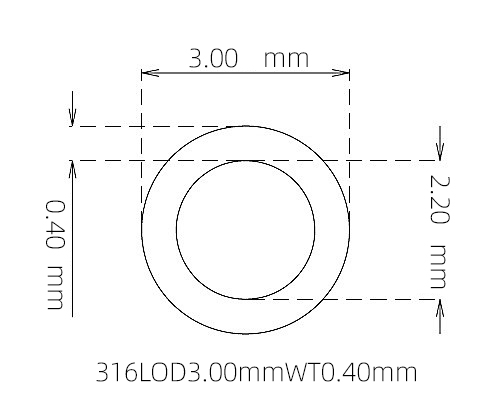
Engineering Specifications for 310S Seamless Capillary Tubing
310S seamless capillary tubing must conform to ASTM A213/A213M for seamless ferritic and austenitic alloy-steel boiler, superheater, and heat-exchanger tubes or ASTM A269 for seamless and welded austenitic stainless steel tubing for general service. The governing chemistry limits are: Cr 24.0-26.0%, Ni 19.0-22.0%, C max 0.08%, Mn max 2.00%, Si max 1.50%, P max 0.045%, S max 0.030%. Material certificates must verify each heat against these limits.
Dimensional Standards and Tolerance Tables
For capillary dimensions, OD tolerances follow ASTM A269: ±0.05 mm for OD up to 1.6 mm, ±0.08 mm for OD 1.6-3.2 mm, ±0.10 mm for OD 3.2-6.4 mm. Wall thickness tolerance is ±10% of nominal for standard production; ±5% is achievable with precision drawing at additional cost. Length tolerance for cut pieces is typically ±0.8 mm for lengths under 300 mm and ±1.6 mm for longer pieces. Straightness should not exceed 1 mm per 300 mm of length for capillary dimensions.
Mechanical Property Requirements and Testing
Tensile requirements per ASTM A213 TP310S in the solution-annealed condition: tensile strength 515 MPa minimum, yield strength (0.2% offset) 205 MPa minimum, elongation in 50 mm 35% minimum. Hardness: 95 HRB or 192 HBW maximum. For capillary tubing, tensile testing may use full-section specimens or longitudinal strip specimens depending on tube diameter. Flattening and flaring tests verify ductility and tube integrity — no cracks or flaws permitted after flattening to specified distance or flaring to specified diameter.
Burst Pressure and Working Pressure Calculations
Burst pressure for 310S seamless capillary tube can be estimated using Barlow’s formula: P = (2 × S × t) / D, where S is allowable stress (approximately 137.5 MPa for 310S at moderate temperature using ASME B31.3 allowable stress values), t is minimum wall thickness, and D is outside diameter. For a 3.0 mm OD × 0.5 mm wall tube, the calculated burst pressure is approximately 45.8 MPa. Working pressure with a safety factor of 4 yields approximately 11.5 MPa. Note that allowable stress decreases significantly above 540°C — consult ASME B31.3 Table A-1 for temperature-specific values.
Corrosion Resistance Data for Engineering Evaluation
310S seamless capillary tubing exhibits excellent oxidation resistance in air up to 1035°C due to the formation of a protective chromium oxide (Cr₂O₃) scale. In reducing sulfur-bearing atmospheres (H₂S, SO₂), 310S performs better than 304 and 316 grades but may still suffer attack above 650°C. The high nickel content provides resistance to carburizing atmospheres. For nitric acid service, 310S is suitable up to 65% concentration at ambient temperature and up to 20% concentration at boiling point. Chloride stress corrosion cracking remains a risk — avoid 310S in aqueous chloride environments above 60°C unless stress-relieved and operating at low stress levels.
Procurement and Inspection Checklist
- Confirm ASTM A213 TP310S grade designation on purchase order and certificates
- Verify chemical composition against heat analysis on material certificate
- Check mechanical test results: tensile, hardness, flattening, flaring
- Require hydrostatic or eddy current testing per ASTM E426 for each tube
- Specify surface condition: pickled, bright annealed, or polished
- Confirm grain size to ASTM E112 (recommend 6 or finer)
- Verify material is free from intergranular corrosion per ASTM A262 Practice E
- Review packaging for protection of capillary dimensions during shipping
Conclusion
310S seamless capillary tubing requires careful specification of grade, dimensions, mechanical properties, and testing requirements. Engineers should reference ASTM A213 for the base material and include supplementary requirements for surface finish, nondestructive testing, and certification level in purchase documents. The 25Cr-20Ni chemistry provides superior high-temperature performance compared to standard stainless grades; the seamless construction ensures uniform properties and eliminates weld-related failure modes in critical applications.

Healsmed
Leading Stainless Steel Capillary Tube Factory. 1,400+ standard sizes IN STOCK & ready to ship worldwide! High precision, factory-direct price.